


Introduction
Bringing a newborn home is exciting, emotional, and sometimes overwhelming. Newborn baby care involves much more than feeding and changing diapers; new parents also have to learn about safe sleep, bathing, hygiene, soothing, feeding cues, and the small signs that may need medical attention. During those first few days, it is completely normal to wonder whether you are doing everything correctly. This guide brings the essential parts of newborn baby care together in one place, so you can approach those early weeks with greater confidence and less guesswork.
Then comes the first night.
It may be 3 a.m. Your baby has just been fed, the diaper has been changed, the lights are low, and yet the baby is still awake. You start wondering: Is the baby hungry again? Is this normal? Am I doing this right?
For many new parents, newborn baby care is less about difficult tasks and more about learning dozens of unfamiliar little things at once.
The good news is that you do not need to know everything on the first day.
During the first few weeks, the most important priorities are quite simple: provide appropriate feeding, keep your baby warm and safe, maintain good hygiene, support safe sleep, care for the umbilical cord and skin, attend recommended health checkups, and learn which signs mean your baby needs medical attention.
This guide brings those everyday responsibilities together in one place. It also explains what you actually need at home, what you probably do not need to buy, how to make the first month a little easier, and when it is important to contact a healthcare professional.
Every baby is different. A healthy full-term newborn may have a very different pattern of feeding, sleeping and waking from another healthy baby. Your pediatrician, doctor or other qualified healthcare professional should always take priority when your baby’s individual medical needs are concerned.
Quick Takeaways
- Newborn care is mainly about feeding, warmth, hygiene, safe sleep, observation and timely medical care.
- Wash your hands before handling your baby, particularly before feeding or caring for the umbilical cord.
- Follow your healthcare professional’s feeding advice and learn to recognize your baby’s hunger and fullness cues.
- Place your baby on their back for sleep on a firm, flat sleep surface and keep loose bedding and soft objects out of the sleep area. (American Academy of Pediatrics)
- A newborn does not need a complicated daily timetable. A simple rhythm usually develops gradually.
- You do not need to buy every product marketed as a “newborn essential.”
- Never leave a baby unattended in or near water, even for a very short time. (NHS)
- Keep the umbilical cord clean and follow the care instructions given by your baby’s healthcare professional.
- Learn the warning signs that require prompt medical attention.
- Keep your baby’s health records and vaccination schedule organized according to your local recommendations.
Key Points
In this guide, we will cover:
- Newborn care after birth
- Newborn care at home
- Feeding and burping
- Newborn sleep and safe sleeping
- Diaper changing and hygiene
- Bathing your newborn
- Umbilical cord care
- Newborn skin care
- Newborn baby care during the first month
- Newborn baby care products
- Practical tips for new parents
- Visitor hygiene
- Common newborn-care mistakes
- Warning signs and when to seek medical help
- Frequently asked questions
Newborn Baby Care After Birth: What to Do First
The first hours and days after birth are an important transition for both the baby and the parents.
WHO identifies several essential newborn-care practices, including keeping the baby warm, skin-to-skin contact, early breastfeeding support, hygienic cord and skin care, assessment for health problems and appropriate preventive care. (WHO)
The First Hours With Your Baby
Immediately after birth, healthcare professionals assess the baby’s breathing, temperature, general condition and other important health indicators.
Parents should use this time to listen carefully to the medical team rather than trying to manage everything themselves.
If your baby is born prematurely, has a low birth weight, needs special care or develops a health problem, the routine for that baby may be very different from the routine described in a general newborn-care article.
Skin-to-Skin Contact
When medically appropriate, skin-to-skin contact between mother and baby is encouraged soon after birth.
It helps support warmth and can assist with early breastfeeding. WHO recommends immediate skin-to-skin contact for newborns without complications. (WHO)
Your healthcare team can guide you on the safest way to position your baby, particularly after a difficult delivery or if either mother or baby needs medical attention.
Starting Feeding
Feeding guidance depends on whether your baby is breastfed, formula-fed or receiving another feeding plan recommended by a healthcare professional.
WHO recommends supporting mothers to initiate breastfeeding as soon as possible after birth and encourages responsive feeding based on the baby’s cues. (WHO)
If breastfeeding is difficult, do not interpret difficulty as personal failure. Latching, positioning, milk transfer and other issues can take time to learn. A qualified lactation professional, midwife, nurse or doctor can provide individualized support.
Before Bringing Your Baby Home
Before discharge, make sure you know:
- When the baby’s next checkup is scheduled
- How feeding should be managed
- What medications or supplements, if any, have been prescribed
- How to care for the umbilical cord
- What vaccination or preventive-care steps are due
- Which warning signs require urgent medical attention
- Whom to contact if you have concerns
Do not leave the hospital with questions simply because you are worried about “bothering” the staff. Asking questions is part of newborn care.
Newborn Baby Care at Home: Building a Simple Daily Routine
Once you arrive home, the first temptation may be to create a strict timetable.
Newborns usually do not cooperate with one.
Rather than trying to make your baby fit a clock, think in terms of a repeating cycle:
Feed → Burp if needed → Diaper/change → Awake/comfort → Sleep → Repeat
The exact timing can vary considerably from one baby to another.
Morning Care
When your baby wakes:
- Check whether they appear hungry.
- Feed according to the recommended feeding plan.
- Change the diaper when needed.
- Check that the baby is comfortable and appropriately dressed.
- Spend a little quiet time talking or interacting with your baby when they are alert.
You do not need to create an elaborate morning routine.
During the Day
Keep the environment reasonably calm and comfortable.
You can talk, sing, cuddle and make eye contact with your newborn during awake periods. These ordinary interactions are part of nurturing care.
WHO and UNICEF emphasize nurturing care and a supportive environment during the newborn period. (WHO)
At Night
Night-time care should generally be quiet and boring.
Keep the lights low, minimize unnecessary stimulation and return your baby to their safe sleep space after feeding and changing.
NHS guidance similarly recommends keeping night-time interactions quiet and calm to help babies gradually learn the difference between day and night. (NHS)
Feeding and Burping Your Newborn
Feeding is one of the biggest parts of newborn baby care.
The correct feeding approach depends on your baby’s age, health, birth circumstances and your chosen or medically recommended feeding method.
Understanding Newborn Feeding Cues
Rather than waiting until your baby is extremely upset, learn to notice early hunger cues.
A baby may:
- Stir or become more alert
- Turn their head toward a touch
- Open their mouth
- Bring their hands toward their mouth
- Make sucking movements
Crying can be a later sign of hunger.
WHO recommends responsive feeding, which involves helping parents recognize and respond to infant feeding cues. (WHO)
Breastfeeding
If you are breastfeeding, positioning and attachment matter.
If feeding is painful, the baby repeatedly struggles to latch, feeds very poorly or you are worried about whether the baby is getting enough milk, seek professional breastfeeding support.
Do not rely solely on advice from social media when there is a feeding problem.
Formula Feeding
If your baby receives formula, prepare and store it exactly according to the manufacturer’s instructions and the guidance of your healthcare professional.
Do not dilute formula or concentrate it differently from the instructions.
Safe preparation and hygiene are particularly important for newborns.
Burping Your Newborn Baby
Some babies need to be burped during or after a feed, while others may not burp every time.
Hold your baby securely with their head and neck supported and use a gentle technique recommended by your healthcare professional.
You do not need to keep patting your baby’s back for a long time if they appear comfortable.
When Feeding Needs Professional Help
Contact your baby’s healthcare professional if you are concerned about:
- Persistent feeding difficulty
- Very poor feeding
- Repeated vomiting
- Unusual sleepiness during feeds
- Difficulty waking for feeds
- Signs of dehydration
- Poor weight gain
Feeding problems can sometimes be an early sign that a newborn needs medical assessment. WHO lists feeding problems among newborn danger signs requiring prompt medical attention. (WHO)
Newborn Baby Sleep and Safe Sleeping
Newborn sleep can be confusing for new parents.
A baby may sleep for short periods throughout the day and night rather than following the sleep schedule adults expect.
The goal is not to “train” a newborn into a perfect schedule. The immediate priority is safe sleep.
Back to Sleep
The American Academy of Pediatrics recommends placing infants on their backs for every sleep. (American Academy of Pediatrics)
Use a firm, flat, non-inclined sleep surface designed for infants.
Keep the Sleep Area Clear
The AAP recommends keeping soft objects, loose bedding, pillows, quilts and similar items out of the infant’s sleep area. (American Academy of Pediatrics)
Do not use products simply because they are marketed as helping a baby sleep if they conflict with established safe-sleep recommendations.
This is one area where a fashionable baby product is not necessarily a safer product.
Room-Sharing
NHS advises that babies sleep in the same room as their parents for at least the first six months, while using their own appropriate sleep space. (NHS)
Day and Night Confusion
Newborns are not born understanding that daytime is for activity and nighttime is for sleep.
During the day, natural light and normal household sounds can help establish day-night differences.
At night:
- Keep lights dim.
- Speak quietly.
- Avoid unnecessary play.
- Feed and change the baby as needed.
- Return the baby to their safe sleep space.
There is no need to force a newborn into a rigid sleep schedule.
Diaper Changing and Newborn Baby Hygiene
Diaper changes will quickly become one of the most familiar parts of newborn care.
Before Changing the Diaper
Keep everything you need within easy reach.
Never leave your baby unattended on a changing surface.
A simple changing area might contain:
- Clean diapers
- Cotton or appropriate wipes
- A changing mat
- Clean clothes
- A disposal bag or suitable waste system
Cleaning Your Newborn Baby
Clean gently rather than scrubbing.
Pay attention to skin folds and make sure the area is dried appropriately before putting on a fresh diaper.
Frequent diaper changes and appropriate skin care can help reduce prolonged exposure to urine and stool and may help prevent irritation.
Hand Hygiene
Wash your hands before and after diaper changes, particularly if there has been contact with urine, stool or any bodily fluid.
Hand hygiene is especially important when caring for a newborn.
WHO includes infection prevention and hygienic care among essential newborn-care practices. (WHO)
How to Bathe a Newborn Baby Safely
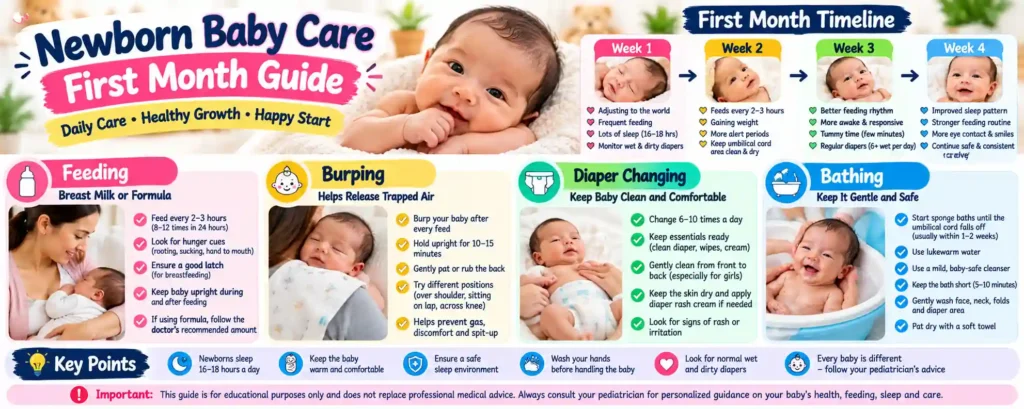
A newborn does not necessarily need a full bath every day.
NHS notes that parents can clean areas such as the face, neck, hands and bottom between baths, depending on the baby’s needs. (NHS)
Preparing for the Bath
Prepare everything before you put your baby in the water.
You may need:
- A suitable baby bath or safe bathing container
- Warm water
- A towel
- Clean clothes
- A clean diaper
- Appropriate washing supplies if recommended
The room should be comfortably warm.
During the Bath
Support your baby’s head and neck and keep your attention on the baby throughout the bath.
The most important rule is simple:
Never leave a baby alone in the bath, even for a moment.
NHS specifically warns that babies can drown very quickly and should always be supervised by an adult during bathing. (NHS)
After the Bath
Lift your baby out carefully, wrap them in a towel and gently dry the skin, paying attention to skin folds.
Have the clean diaper and clothes ready before you begin.
Bath-Time Essentials
A small number of practical products may make bathing easier:
- Baby towel
- Washcloth
- Suitable baby bath
- Basic bathing supplies
Affiliate Disclosure: Some product links in this section may be affiliate links. If you purchase through one of these links, Blooming Blogs may receive a small commission at no additional cost to you. Product recommendations are selected for usefulness and reader value, not simply because they offer a commission.
Publication note: Insert only a small number of genuinely useful product recommendations here.
Umbilical Cord Care
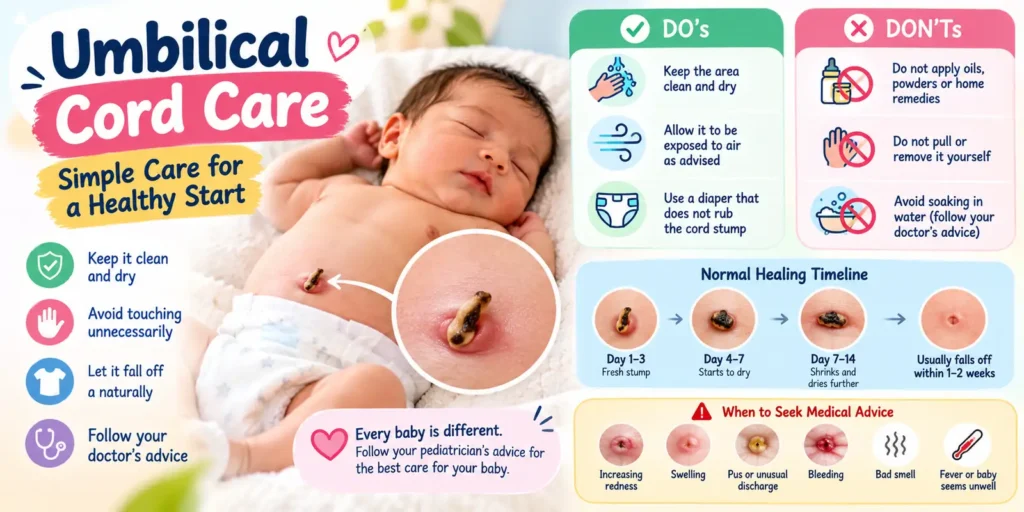
The umbilical stump normally needs time to dry and separate.
Your baby’s healthcare professional should tell you exactly how to care for it because local clinical practices and individual circumstances can differ.
WHO recommends hygienic cord care as part of essential newborn care. (WHO)
General Care Principles
- Keep the area clean.
- Keep it dry according to your healthcare professional’s instructions.
- Avoid repeatedly touching it unnecessarily.
- Follow the care instructions provided by your maternity or pediatric team.
Do not apply home remedies, oils, powders or other substances to the cord simply because someone recommends them.
When to Seek Medical Advice
Seek medical advice if you notice signs that concern you, such as:
- Increasing redness around the cord
- Swelling
- Pus or unusual discharge
- Significant bleeding
- Bad smell
- Fever
- A baby who seems unwell
A newborn with possible infection should be assessed promptly.
Newborn Baby Skin Care
Newborn skin can look different from what new parents expect.
Peeling, dryness, small rashes and changes in appearance can occur during the early days. Not every change requires treatment.
Keep Skin Care Simple
A newborn usually does not need a large collection of skincare products.
When choosing products:
- Look for products appropriate for newborns.
- Avoid unnecessary fragrances if your baby has sensitive skin.
- Do not introduce several new products at once.
- Stop using a product if it appears to cause irritation.
- Ask your healthcare professional about persistent or unusual skin changes.
Don’t Treat Every Rash Yourself
A photograph on the internet can never replace an examination when a newborn has a concerning rash or other skin problem.
Seek professional advice if the rash is accompanied by fever, poor feeding, unusual sleepiness, breathing problems, swelling, rapidly worsening symptoms or other signs that your baby is unwell.
Newborn Baby Care in the First Month
The first month can feel like one long learning curve.
Instead of expecting your baby to follow a precise developmental timetable, use each week as an opportunity to learn your baby’s individual patterns.
Week 1: Adjusting to Your Newborn Baby
The first week is mainly about recovery, feeding, sleeping, diaper changes and learning how your baby communicates.
You may spend much of your day asking:
“Is the baby hungry?”
“Does the baby need a diaper change?”
“Why is the baby crying?”
“Is this normal?”
That uncertainty is normal for new parents.
Focus on learning your baby’s feeding cues, sleep patterns and normal behaviour.
Follow your healthcare professional’s instructions for early follow-up and monitoring.
Week 2: Watching Patterns
By the second week, many parents begin to recognize some patterns.
You may become better at identifying:
- Hunger cues
- Tiredness
- Need for a diaper change
- Comfort-seeking
- Periods when the baby is more alert
Do not worry if your baby’s routine still changes from day to day.
Week 3: Becoming More Confident
By now, basic tasks such as diaper changing and settling your baby may feel easier.
This is a good time to review:
- Upcoming health appointments
- Vaccination schedule
- Feeding concerns
- Weight or growth monitoring
- Supplies at home
If something about your baby’s behaviour concerns you, discuss it with your healthcare professional rather than comparing your baby with another child.
Week 4: Establishing a Rhythm
At around the end of the first month, you may notice that certain patterns are becoming easier to recognize.
That does not mean your baby should have a strict routine.
Think of a newborn’s routine as a rhythm, not a timetable.
Newborn Baby Care Products: What Do You Really Need?
Walking into a baby store can make it appear as though newborns require hundreds of products.
They don’t.
A practical newborn setup can be surprisingly simple.
Diapering Essentials
Useful items can include:
- Newborn-size diapers
- Changing mat
- Cotton or suitable wipes
- Clean clothes
- Diaper-disposal supplies
Buy a reasonable quantity rather than stocking up excessively on one diaper size before you know which brand and fit work well for your baby.
Clothing Essentials
Choose comfortable, easy-to-wash clothing.
Useful basics may include:
- Cotton onesies
- Sleepsuits
- Comfortable daywear
- Socks where appropriate
- Weather-appropriate layers
Avoid buying huge quantities of newborn-size clothing. Babies grow quickly.
Bathing Essentials
A basic setup can include:
- Baby towel
- Washcloth
- Suitable baby bath
- Mild baby-care products if needed
Remember that a more expensive product is not automatically better.
Feeding Essentials
What you need depends heavily on how your baby is fed.
A breastfeeding family may need very different supplies from a family using formula.
Do not buy large quantities of bottles, teats or other feeding equipment before you know what your baby and healthcare professional actually require.
Basic Health and Care Items
One practical item worth having available is a suitable digital thermometer.
Ask your healthcare professional what other supplies should be kept at home.
A Simple Newborn Essentials Shopping List
Here is a practical starting point rather than a “buy everything” list.
| Category | What to Consider | Priority |
|---|---|---|
| Diapers | Appropriate newborn diapers | Essential |
| Changing | Changing mat and cleaning supplies | Essential |
| Clothing | Comfortable washable clothes | Essential |
| Towels | Soft baby towels | Useful |
| Burp cloths | Several washable cloths | Useful |
| Bathing | Safe bathing setup | Useful |
| Thermometer | Suitable digital thermometer | Useful |
| Feeding | Based on baby’s feeding method | Depends |
| Skincare | Keep products simple | Depends |
| Nursery accessories | Only if genuinely useful | Optional |
Blooming Blogs Newborn Essentials
Affiliate Disclosure: Some product links in this section may be affiliate links. If you purchase through one of these links, Blooming Blogs may earn a commission at no additional cost to you. We recommend products because they may be useful to readers, not simply because an affiliate relationship exists.
Publication note: Add only carefully reviewed products that genuinely meet the stated need. Avoid turning this section into a large product catalogue.
What Newborn Baby Products Do You Probably Not Need?
Parents are often told that they need every new gadget on the market.
Before buying, ask:
Does this product solve a real problem?
You may not need:
- Large collections of newborn clothing
- Multiple specialized baby containers
- Gadgets that make medical claims without good evidence
- Products that conflict with safe-sleep recommendations
- Dozens of skincare products
- Every nursery accessory advertised as an “essential”
The money saved can be much more useful for healthcare, good-quality basic supplies or other family needs.
Practical Tips for New Moms and Dads
Newborn baby care is easier when the parents’ environment is organized too.
Keep a Small Daily-Care Basket
Instead of walking around the house looking for supplies, keep commonly used items together.
For example:
Diapers + cleaning supplies + spare clothes + burp cloth + towel
Keep the basket in a location that is convenient but safely out of the baby’s reach as they grow.
Prepare Before Night-Time Feeding
Before going to bed, make sure essential supplies are available.
This can reduce unnecessary movement around the house during the night.
Accept Help
If someone offers to prepare food, wash dishes or handle household chores, let them help.
A new parent does not need to prove they can do everything alone.
Don’t Compare Your Baby Constantly
Another baby may sleep differently, feed differently or behave differently.
Comparison can create unnecessary anxiety.
Your baby’s healthcare professional is a far better source of guidance when you are concerned about health or development.
Parent’s Hack: Create a Simple Newborn Care Station
A dedicated care station can make everyday tasks much easier.
Keep the most frequently used items together:
Clean diaper → cleaning supplies → spare clothing → burp cloth → towel
The important point is not the furniture or storage basket.
It is organization.
And wherever you change your baby, keep one hand on your baby whenever necessary and never leave a baby unattended on a raised surface.
Rules for Newborn Visitors and Hygiene
Newborn visitors can be a wonderful part of family life, but parents are allowed to establish sensible boundaries.
Ask Visitors to Wash Their Hands
Anyone handling the baby should clean their hands first.
Keep Sick Visitors Away
People with fever, cough, vomiting, diarrhea or other contagious symptoms should postpone their visit.
Avoid Unnecessary Kissing
Parents can reasonably ask visitors not to kiss a newborn, particularly around the baby’s face and hands.
Keep Visits Calm
A newborn does not need a house full of people.
Short, peaceful visits may be easier for both the baby and the parents.
Follow Your Doctor’s Advice
If your baby was premature, has a medical condition or has another health concern, your healthcare team may recommend additional precautions.
Parent Recommendations: Things That Make Newborn Baby Care Easier
A few simple habits can make a surprising difference.
Keep emergency numbers accessible.
Save your pediatrician, maternity hospital and local emergency number in your phone.
Keep health records together.
Keep appointment notes, vaccination information and other important medical documents in one place.
Write down questions.
When you have a newborn, questions often appear at the least convenient time.
Keep a note on your phone and ask them during your next medical appointment.
Trust your instincts—but verify concerns.
Parents often notice when their baby’s behaviour is different from usual.
If something feels wrong, it is reasonable to seek professional advice.
When Professional Medical Advice Matters
Online newborn-care information is useful for education, but it cannot examine your baby.
A newborn who appears seriously unwell should be assessed by a healthcare professional rather than managed through internet advice.
WHO identifies danger signs including feeding problems, reduced activity, difficulty breathing, fever, seizures, and a baby who feels cold. It also highlights concerning jaundice patterns, such as jaundice appearing during the first 24 hours or yellow palms and soles. (WHO)
When Should I Call a Doctor for a Newborn?
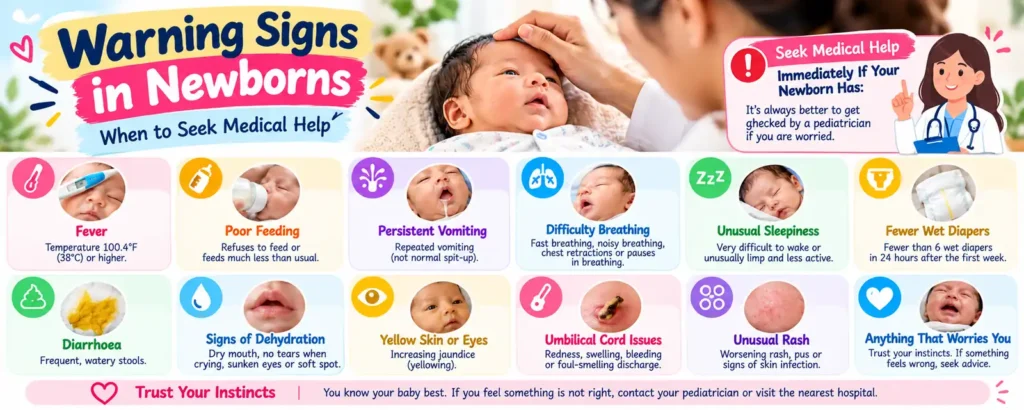
Contact your healthcare professional promptly if your newborn:
- Has difficulty breathing
- Is unusually difficult to wake
- Is feeding poorly or refusing feeds
- Has a fever or unusually low temperature
- Has seizures
- Appears significantly less active than usual
- Develops concerning jaundice
- Shows signs of serious infection
- Has another sudden or severe change that worries you
If your baby is seriously unwell or you believe there is an emergency, seek emergency medical care rather than waiting for an online response.
Common Newborn Baby Care Mistakes Parents Should Avoid
1. Trying to Create a Perfect Schedule
Newborns are not clocks.
Aim for a predictable environment rather than a rigid timetable.
2. Buying Too Many Products
More products do not automatically mean better care.
Start with the basics.
3. Following Every Piece of Online Advice
Internet advice ranges from excellent to dangerously wrong.
Look for information from recognized health organizations and qualified professionals.
4. Treating Every Symptom at Home
Newborns deserve a lower threshold for professional assessment when something appears wrong.
5. Ignoring Safe-Sleep Recommendations
Never replace evidence-based safe sleep with a product’s marketing promise.
6. Forgetting the Parents
A tired, overwhelmed parent also needs support.
Accept practical help where possible.
Gentle Reminders for Parents
You are not expected to know everything on the day your baby is born.
You will learn gradually.
In the beginning, even simple things can feel surprisingly difficult. A diaper change may not go according to plan, and clean clothes can somehow disappear just when you need them. Sometimes, ten minutes of trying to understand why your baby is crying ends with the simple discovery that the diaper needed changing.
That is normal.
Newborn care is not about being a perfect parent. It is about providing safe, responsive care and learning your baby a little better every day.
And when something genuinely concerns you, asking a healthcare professional is not overreacting.
It is good parenting.
Quick Summary: Your Newborn Care Checklist
Before moving on, remember the basics:
☐ Feed your baby according to the recommended feeding plan
☐ Learn your baby’s feeding cues
☐ Keep your baby warm and comfortable
☐ Follow safe-sleep practices
☐ Place your baby on their back for sleep
☐ Keep the sleep area free of loose bedding and soft objects
☐ Change diapers regularly
☐ Wash your hands before handling your baby
☐ Keep the umbilical cord clean and follow professional guidance
☐ Bathe your baby safely
☐ Never leave a baby unattended near water
☐ Keep health and vaccination records organized
☐ Know the newborn danger signs
☐ Ask for medical advice when something concerns you
External Authoritative References
For parents who want to explore the evidence behind the guidance in this article:
- World Health Organization (WHO) — essential newborn care, breastfeeding, postnatal care and newborn danger signs. (WHO)
- WHO & UNICEF — nurturing care for newborns during the first month. (WHO)
- NHS — practical newborn care, bathing and sleep guidance. (NHS)
- American Academy of Pediatrics — evidence-based safe infant sleep recommendations. (AAP)
Related Articles
As the Blooming Blogs Babycare section grows, this article should link naturally to related guides such as:
- [Pregnancy Due Date Calculator]
- [Baby Name Generator]
- [Vaccination Scheduler & Tracker]
- [Pregnancy and postpartum guides]
- [Breastfeeding guides]
- [Baby sleep guides]
- [Baby developmental milestone guides]
Publication note: Replace each bracketed item with the actual Blooming Blogs URL once the corresponding page exists. Do not create links to pages that do not yet exist.
Continue Exploring…
Useful Blooming Blogs Tools for New Parents
Pregnancy Due Date Calculator
Useful during pregnancy for estimating the expected delivery date.
Baby Name Generator
Explore baby names using different preferences and naming criteria.
Vaccination Scheduler & Tracker
Keep important vaccination information organized and easier to follow.
These tools provide general informational assistance and do not replace advice from a qualified healthcare professional.
Frequently Asked Questions
What is the best way to care for a newborn baby at home?
Focus on the basics: appropriate feeding, warmth, hygiene, safe sleep, diaper care, cord care, responsive interaction and timely medical care. You do not need a complicated routine or a large collection of products.
What does a newborn need in the first month?
A newborn mainly needs appropriate feeding, a safe sleeping environment, diapers, comfortable clothing, basic hygiene and bathing supplies, healthcare follow-up and plenty of responsive care from caregivers.
How often should a newborn feed?
There is no single feeding schedule that is appropriate for every baby. Feeding needs depend on the baby’s age, health and feeding method. Follow your healthcare professional’s advice and learn to recognize your baby’s feeding cues.
How much should a newborn sleep?
Newborn sleep varies considerably. Babies commonly sleep in multiple periods throughout the day and night. Rather than focusing only on a clock, concentrate on safe sleep practices and your baby’s individual needs.
How often should you bathe a newborn?
A newborn does not necessarily need a full bath every day. NHS guidance notes that parents can clean areas such as the face, neck, hands and bottom between baths. (NHS)
How do you care for a newborn’s umbilical cord?
Follow the instructions provided by your baby’s healthcare professional. In general, hygienic cord care and keeping the area clean and appropriately dry are important. WHO includes clean and hygienic cord care among essential newborn-care practices. (WHO)
What newborn baby products are actually necessary?
Start with basic supplies such as diapers, suitable clothing, a changing surface, towels, basic bathing supplies and products appropriate for your baby’s feeding method. Avoid assuming that every product marketed as a newborn essential is necessary.
What should newborn visitors do before holding a baby?
Visitors should wash their hands before handling the baby and should postpone visits if they are unwell. Parents can also establish additional precautions based on their baby’s health and their healthcare professional’s advice.
What are the warning signs of illness in a newborn?
Concerning signs can include difficulty breathing, poor feeding, reduced activity, fever, seizures, unusual temperature and certain patterns of jaundice. These signs require prompt medical assessment rather than relying on online advice. (WHO)
When should I call a doctor for a newborn fever?
A newborn with a fever needs prompt medical assessment. Because newborns are particularly vulnerable to serious infections, parents should contact a qualified healthcare professional promptly rather than attempting to manage a suspected fever using internet advice alone.
What should I do if my newborn is not feeding well?
Persistent poor feeding, difficulty waking for feeds or a baby who is unusually sleepy during feeding should be discussed promptly with a healthcare professional. Feeding problems can be an important warning sign in newborns. (WHO)
Should I follow a strict newborn routine?
Usually, a newborn’s routine is better viewed as a flexible rhythm rather than a strict timetable. Feeding, sleeping and waking patterns can change from day to day.
What should new parents do if they are unsure about something?
Ask your baby’s pediatrician, doctor, nurse, midwife or other qualified healthcare professional. There is no prize for trying to solve every newborn-health question alone.
Final Thoughts
The first month with a newborn can feel like a completely new language.
Over time, patterns begin to make more sense. One cry may seem to mean hunger, while another sounds like tiredness or discomfort. Then, just when you think you have figured it out, your baby may surprise you the next day.
Little by little, you learn how to hold your baby, change a diaper, settle them, feed them, and recognize the small signs that show they are comfortable—or not quite comfortable.
There is no need to master everything immediately. Newborn baby care is a learning process, and confidence usually grows through those ordinary, sometimes messy, everyday moments.
Start with the fundamentals: feed your baby appropriately, keep them safe and warm, maintain good hygiene, follow safe-sleep practices, attend recommended health checks and learn the warning signs that require medical attention.
Keep the shopping list simple. Be cautious about advice from social media. And when you are worried about your baby’s health, speak with a qualified healthcare professional.
Newborn care becomes easier not because parents suddenly learn everything, but because they gradually become familiar with their own baby.
🔑 Final Review
Before you finish this guide, remember:
☑ Feed your baby responsively and follow professional guidance.
☑ Put your baby on their back for sleep.
☑ Keep the sleep surface firm, flat and clear.
☑ Keep the umbilical cord clean and dry.
☑ Change diapers regularly.
☑ Wash your hands before handling your baby.
☑ Keep healthcare appointments.
☑ Know the warning signs.
☑ Ask for help when something does not feel right.
👀Newborn Baby Care — Essential Checklist
Feeding ✓
Safe sleep ✓
Diaper care ✓
Bathing ✓
Umbilical cord care ✓
Skin care ✓
Hygiene ✓
First-month guidance ✓
Newborn essentials ✓
Visitor hygiene ✓
Warning signs ✓
Professional medical support ✓
Blooming Blog Promise
At Blooming Blogs, our goal is simple:
knowledge that blooms.
We aim to turn complicated everyday questions into practical, understandable information that helps readers make more informed decisions.
For health-related topics, we encourage readers to use our articles as educational resources and to consult qualified healthcare professionals for personal medical advice.
📝 Editorial Notes
This article was prepared using guidance from recognized health authorities and reputable medical sources, including WHO, UNICEF and NHS.
Blooming Blogs aims to provide clear, practical and responsible information for parents. Medical guidance can change, so readers should consult a qualified healthcare professional for individual advice.
Last reviewed: October 2026
Editorial responsibility: Blooming Blogs Editorial Team
Disclaimer
This article provides general educational information about newborn baby care. It is not medical advice and does not replace examination, diagnosis or treatment from a qualified healthcare professional.
Every newborn is different. Babies who are premature, have a low birth weight, have a medical condition or have experienced complications may require individualized care.
If you are concerned about your baby’s health, feeding, breathing, temperature, behaviour or any other symptom, contact your pediatrician, doctor or appropriate healthcare service.
For more information, please read the full Blooming Blogs Disclaimer Policy.
Affiliate Disclosure
Some product links on Blooming Blogs may be affiliate links. If you purchase through an affiliate link, Blooming Blogs may receive a commission at no additional cost to you.
Our aim is to recommend products because they may be useful to readers—not simply because an affiliate commission is available.
Any Amazon Associates disclosure required by Amazon should also be displayed according to the current Amazon Associates Program requirements.
💬 Your Experience Matters
What surprised you most during your baby’s first month?
Was there something you bought that turned out to be incredibly useful—or something you bought that you never actually needed?
Share your experience in the comments below. Your practical experience may help another new parent.
Leave a Comment
Have a newborn-care question or a practical tip that helped your family?
Share it in the comments.
Please remember not to post private medical information about yourself or your child.




Great work on your blog post! The content was engaging and kept my attention throughout. I appreciated the actionable advice and the practical tips you shared. To delve deeper into this topic, click here.