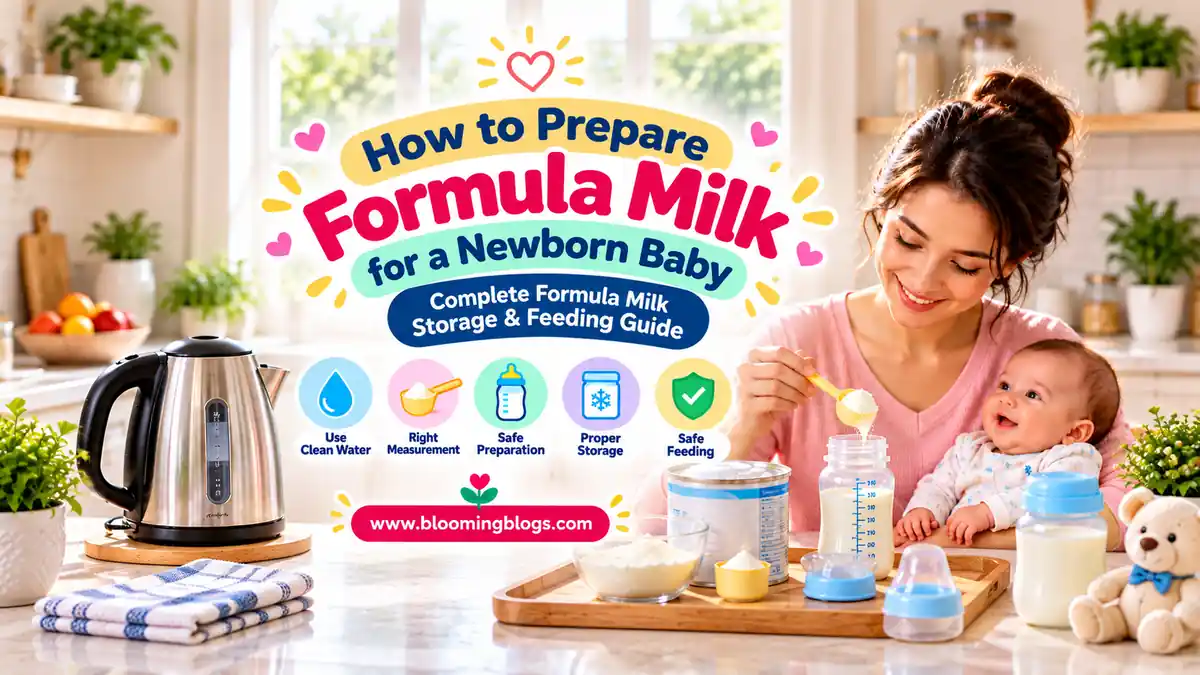

Complete Formula Preparation, Storage & Feeding Guide
Preparing formula milk for a newborn can feel surprisingly complicated, especially during those exhausting first weeks.
It may be 3:00 AM. Your baby is crying, you are tired, and there is a formula container, scoop and feeding bottle in front of you. Suddenly, simple questions can feel very important:
How much water should I use? Did I count the scoops correctly? Should the water be hot? Can I prepare the bottle in advance? How long can prepared formula stay outside? Can I refrigerate it? What should I do with leftover milk?
If you have asked any of these questions, you are not alone.
The good news is that safe formula feeding does not require you to remember dozens of complicated rules. It requires a simple, repeatable routine built around clean hands, clean feeding equipment, safe water, accurate measurements, appropriate storage and responsive feeding.
This complete guide explains how to prepare formula milk for a newborn baby, how to choose an appropriate formula, how to clean and sterilize bottles, how to measure water and powder, how to store prepared formula, how to feed your baby safely, what to do during travel or emergencies, and when to ask a paediatrician for help.
Important: This article provides general educational information. Formula preparation and storage recommendations can vary by country, product and individual circumstances. Always read and follow the instructions printed on your specific formula container and the instructions for your feeding equipment. If your baby was born prematurely, has a medical condition, has feeding difficulties or has other health concerns, ask your healthcare professional for individual advice.
👉 Quick Takeaway: The Most Important Formula Safety Rules
If you remember only a few things from this guide, remember these:
- Wash your hands before preparing a feed.
- Clean the preparation surface.
- Use properly cleaned and sterilized feeding equipment.
- Use a safe water source.
- Follow the formula manufacturer’s exact preparation instructions.
- Measure the water first and add formula powder second.
- Use only the scoop supplied with the relevant formula.
- Never guess the powder-to-water ratio.
- Never deliberately add extra powder to make a feed “stronger.”
- Never deliberately add extra water to make a feed “weaker.”
- Powdered infant formula is not sterile.
- Prepare feeds as close to feeding time as practical.
- Follow the storage times applicable to your product and local health guidance.
- Prepared formula that has not been used should be handled according to the applicable storage guidance.
- Once your baby has started drinking from a bottle, leftover formula should generally be discarded rather than saved.
- Check the temperature before feeding.
- Hold your baby during the feed.
- Never prop up a bottle and leave your baby alone.
- Watch hunger and fullness cues rather than forcing your baby to finish.
- If you are unsure whether a bottle is safe, discard it and prepare a fresh one.
The source material consistently emphasizes that formula safety depends on several connected steps rather than mixing powder and water alone.
What Does Formula Feeding Mean?
Infant formula is a manufactured food designed to provide nutrition to babies when formula feeding is being used.
Some babies receive formula as their main milk feed. Others receive both breast milk and formula.
Breast milk is recommended when breastfeeding is possible and appropriate, but infant formula is a regulated nutritional alternative for babies who are not breastfed or who need additional formula.
Formula feeding provides infants with a complete, nutritionally balanced alternative or supplement to breast milk. Infant formula is specifically formulated using processed cow’s milk, goat’s milk, or specialized soy/hydrolyzed proteins modified to meet a baby’s precise metabolic needs.
When formula feeding a newborn, precise preparation, accurate measurement, and proper formula milk storage are non-negotiable. Newborns have immature immune systems, making them highly vulnerable to foodborne pathogens like Cronobacter sakazakii and Salmonella enterica. Mastering how to prepare formula milk and understanding formula milk storage time creates a safe foundation for your baby’s growth.
For families using formula, preparation and hygiene are particularly important because powdered infant formula is not sterile. Even though it comes in a sealed container and looks clean, powdered formula can occasionally contain harmful microorganisms.
That is why safe formula preparation is not about being unnecessarily anxious. It is about creating habits that reduce avoidable contamination.
The basic sequence is simple:
👉 Clean → Check → Measure → Mix → Cool → Test → Feed → Store or Discard
💡 Did You Know?
Powdered infant formula is not sterile. Unlike liquid ready-to-feed formula, which undergoes high-temperature sterilization, powdered formula can naturally contain low levels of heat-resistant bacteria like Cronobacter sakazakii. That is why WHO and NHS guidelines advise mixing powder with water no cooler than 70°C (158°F) to sterlize the powder.

Basic Types of Newborn Baby Formula Milk
- Powdered Formula
- Ready to Feed Formula
👉 Powdered Formula vs Ready-to-Feed Formula
Infant formula commonly comes in two main broad forms.
| Type | What it means | Main consideration |
|---|---|---|
| Powdered formula | Dry powder mixed with water before feeding | Requires careful preparation and safe water |
| Ready-to-feed formula | Prepared liquid formula that does not require adding water | Convenient when safe preparation is difficult |
Ready-to-feed liquid formula is commercially sterile until opened, whereas powdered formula is not sterile.
This distinction can become particularly important for very young or medically vulnerable babies and during travel or emergencies.
👉 Types of Powdered Newborn Baby Formula Milk –
- First Infant Formula (Stage 1): Based on whey protein, suitable from birth up to 12 months.
- Follow-on Formula (Stage 2): Higher in iron, designed for infants aged 6 to 12 months alongside complementary weaning foods.
- Specialized Formulas: Includes hypoallergenic (extensively hydrolyzed), anti-reflux, or lactose-free formulas used under pediatric guidance.
| INFANT FORMULA TYPES MATRIX | PROTEIN TYPE | BEST FOR |
|---|---|---|
| Formula Type | Primary Protein Source | Best Suited For |
| Standard Whey-Based | Cow’s Milk (Whey Dominant) | Healthy Newborns (0-12m) |
| Goat’s Milk Formula | Goat’s Milk Protein | Mild Digestibility Needs |
| Extensively Hydrolyzed | Broken-Down Whey/Casein | Cow’s Milk Allergy (CMPA |
| Soy-Based Formula | Soy Protein Isolate | Galactosemia / Vegan |
Choosing the Right Infant Formula
Before learning how to prepare formula milk, it helps to understand How Many types of formula are There?
Selecting the right formula milk involves understanding your baby’s dietary needs, age, and potential sensitivities.
Parents may encounter products described as:
- Standard infant formula
- First infant formula
- Goat-milk infant formula
- Comfort formula
- Anti-reflux formula
- Lactose-free formula
- Hypoallergenic formula
- Extensively hydrolysed formula
- Soy-based formula
- Follow-on formula
- Toddler or growing-up milk
These products are not interchangeable.
Standard Infant Formula
For a healthy baby who needs formula, a standard infant formula specifically made for infants and appropriately fortified with iron is generally the usual starting choice.
There is no universal “best brand.” The important considerations are whether the product is appropriately regulated, suitable for the baby’s age and nutritional needs, and prepared exactly according to its instructions.
A more expensive formula is not automatically a better formula. Marketing terms such as “premium,” “gold,” “advanced,” “gentle” or “sensitive” should not replace consideration of your baby’s actual nutritional and medical needs.
Goat-Milk Infant Formula
Goat-milk infant formula is specially formulated for babies.
It should not be confused with ordinary goat milk. Regular goat milk is not an appropriate main milk drink for babies under 12 months.
Goat-milk infant formula is also not automatically easier to digest or safer for babies with cow’s-milk protein allergy. Because the proteins are similar, some babies with cow’s-milk protein allergy may also react to goat-milk proteins.
If you are considering goat-milk formula because of digestive problems or suspected allergy, speak with your baby’s healthcare professional before changing formula.
Comfort Formula
Comfort formulas are marketed for babies with digestive discomfort and may contain partially hydrolysed proteins.
They are sometimes marketed for concerns such as:
- Gas
- Colic
- Fussiness
- Constipation
- Digestive discomfort
However, marketing claims should not automatically be treated as medical evidence.
Comfort formula is also not appropriate treatment for a diagnosed cow’s-milk protein allergy.
If your baby has persistent vomiting, blood in the stool, significant diarrhoea, poor weight gain or other concerning symptoms, speak with a healthcare professional rather than repeatedly changing formula.
Anti-Reflux Formula
Anti-reflux formulas are specially thickened products intended for babies with significant reflux.
A baby who occasionally spits up does not automatically need anti-reflux formula.
Because some anti-reflux formulas have different preparation requirements, they should generally be used with appropriate professional advice.
Lactose-Free Formula
Lactose-free formula is designed for babies who genuinely require a lactose-free feed.
True lactose intolerance is uncommon in young babies, and symptoms such as diarrhoea, wind, bloating or abdominal discomfort can have many causes.
Do not assume that these symptoms automatically mean lactose intolerance.
Ask your healthcare professional before switching to lactose-free formula.
Hypoallergenic Formula
Some babies have problems with proteins found in standard milk-based formula.
A healthcare professional may recommend a specialised hypoallergenic formula, sometimes containing extensively hydrolysed proteins.
It is important to understand that comfort formula and hypoallergenic formula are not the same thing.
Do not diagnose a cow’s-milk protein allergy yourself simply by changing formula brands. A paediatrician can assess your baby’s symptoms and determine whether specialised formula is appropriate.
Soy-Based Formula
Soy-based infant formula uses soy protein instead of cow’s-milk protein.
It may be appropriate in selected situations, but it should not automatically be used whenever a baby is fussy or has gas.
Some babies with cow’s-milk protein allergy may also react to soy.
Discuss soy formula with your healthcare professional before making the switch for a young infant.
Follow-On Formula
Follow-on formula is marketed for older babies in some countries.
However, switching to follow-on formula at six months is not universally necessary. For example, NHS guidance allows first infant formula to remain the baby’s main milk drink throughout the first year.
Always follow the age range printed on your particular product and the guidance applicable in your country.
Toddler or Growing-Up Milk
Toddler formulas are marketed for children over 12 months.
For most healthy children, these products are not essential. Once children reach 12 months, nutritional needs increasingly come from a varied diet.
What Should Babies Under 12 Months Drink?
Regular milk and plant-based drinks are not interchangeable with infant formula.
They should not replace breast milk or infant formula as the main milk drink for a baby under 12 months.
👉 Babies under 12 months should not be given –
- Regular cow’s milk
- Regular goat milk
- Regular sheep milk
- Condensed milk
- Evaporated milk
- Almond drinks
- Oat drinks
- Rice drinks
- Regular soy drinks
- Other plant-based beverages
👉 Never use homemade infant formula.
Homemade recipes may not provide the correct balance of nutrients and can create serious health risks.
What Do You Need for Safe Bottle Feeding?
You do not need a complicated collection of equipment.
Most families need:
- Suitable feeding bottles
- Appropriate teats
- Bottle caps
- Retaining rings or collars
- A bottle-cleaning brush
- Appropriate sterilising equipment
- A clean preparation area
The best bottle is not necessarily the most expensive or most complicated.
👉 A bottle that is easy to clean, inspect and sterilize properly can be a practical choice.
Always make sure feeding equipment is intended for infant use and follow the manufacturer’s instructions.
Why Bottle & Nipple Hygiene Matters
Young babies are more vulnerable to infections.
Milk residue can remain inside bottles, teats, rings and other feeding components. If these parts are not cleaned properly, microorganisms can multiply.
Cleaning removes milk residue.
Sterilization provides an additional level of protection against microorganisms.
👉 All feeding equipment—including bottles, teats, rings, and caps—must be sterilized before every feed for babies under 12 months old.
The two processes are therefore not identical.
A simple principle is:
👉Clean first. Sterilize second.
How to Clean Baby Bottles Before Sterilizing
Clean feeding equipment as soon as reasonably possible after feeding rather than allowing milk residue to dry.
Step 1: Take the Bottle Apart
Separate:
- Bottle
- Teat
- Retaining ring
- Collar
- Cap
- Any other removable components
Step 2: Wash Thoroughly
Wash all parts in hot, soapy water.
Use a clean bottle brush dedicated to baby feeding equipment.
A small teat brush can help clean inside the teat.
Step 3: Rinse Thoroughly
Rinse the components with clean water before sterilizing.
👉 Important: Never Use Salt to Clean Baby Teats.
Salt can be harmful if residue remains on the teat.
Keep your bottle brush separate from brushes used for general household cleaning.
Can Baby Bottles Go in the Dishwasher?
Many feeding items can be cleaned in a dishwasher if the manufacturer says they are dishwasher-safe.
However, dishwasher cleaning does not automatically mean that a separate sterilization step is unnecessary.
Follow the equipment manufacturer’s instructions.
After washing, sterilize the equipment when sterilization is still required.
Three Common Ways to Sterilize Baby Bottles
Common sterilization methods include:
- Cold-water sterilizing solution
- Steam sterilisation
- Boiling
The appropriate method depends on your equipment, your baby’s circumstances and the manufacturer’s instructions.
1. Cold-Water Sterilizing Solution
If using a cold-water sterilizing solution:
- Read the product instructions carefully.
- Completely submerge bottles, teats and other components.
- Make sure air bubbles are not trapped inside bottles or teats.
- Use the supplied cover or device to keep equipment submerged.
- Follow the manufacturer’s required soaking time.
- Prepare fresh solution according to the product instructions.
👉 Cold Water Chemical Sterilization: Use specialized sterilizing tablets/solution in clean water, keeping items submerged for a minimum of 30 minutes. Do not guess the concentration of sterilizing solution.
2. Steam Sterilization
Steam sterilizers use high-temperature steam.
They may be:
- Electric steam sterilizers
- Microwave steam sterilizers designed specifically for that purpose
👉 Electric steam units or microwave sterilizers eliminate 99.9% of bacteria within 5–10 minutes.
Always check whether your bottles and teats are suitable.
Never use a microwave sterilizer unless it was specifically designed for microwave use.
Follow the sterilizer manufacturer’s instructions for water quantity, positioning and cycle time.
3. Boiling Sterilization
Boiling can be used for feeding equipment that is specifically suitable for boiling.
A general sequence is:
- Thoroughly clean the equipment.
- Place it in a clean pan.
- Completely cover the equipment with water.
- Bring the water to a boil.
- Follow the manufacturer’s recommended boiling time.
- Allow the equipment to cool safely.
👉 Submerge equipment completely in boiling water for at least 10 minutes. Ensure no air bubbles are trapped inside bottles.
The source material describes at least 10 minutes for suitable equipment, while also warning that repeated boiling can cause teats to deteriorate faster. Always check the instructions for your particular equipment.
What to Do After Sterilizing
Sterilization does not protect equipment indefinitely if it is subsequently contaminated.
After sterilizing:
- Wash your hands before handling the equipment.
- Avoid touching the inside of the bottle.
- Avoid touching the inside of the teat.
- Use clean or sterile tongs where appropriate.
- Assemble the bottle promptly.
- Keep sterilized parts protected from dirty surfaces.
Ideally, leave sterilized equipment inside the sterilizer or covered container until needed.
How Long Should Baby Bottles Be Sterilized?
Sterilization recommendations can vary according to the baby’s age, local health guidance and equipment.
The source material notes that NHS guidance recommends sterilizing feeding equipment until a baby is at least 12 months old.
Always check current local guidance and your equipment manufacturer’s instructions.
Babies born prematurely or babies with medical conditions may require individual advice from a healthcare professional.
Inspect Bottles and Teats Regularly
Sterilization cannot repair damaged equipment.
Replace bottles or teats that have:
- Cracks
- Splits
- Tears
- Distortion
- Severe scratches
- Damaged sealing areas
- Other damage that makes cleaning difficult
A damaged teat can also break during feeding.
Inspect equipment regularly, especially when it is frequently boiled or washed in a dishwasher.

Step-by-Step Guide: How to Prepare Formula Milk for a Newborn
👉 Following a sterile protocol ensures maximum safety during formula feeding preparation.
STEP 1: Wash hands thoroughly with soap and water for 20 seconds. Clean work surface.
↓
STEP 2: Sterilize bottles, nipples, caps, and tongs in an electric steam sterilizer or boiling water.
↓
STEP 3: Boil 1 liter of fresh tap water. Allow to cool for 20-30 minutes (must stay ≥70°C).
↓
STEP 4: Pour the exact volume of water needed into the sterilized bottle first.
↓
STEP 5: Add exact level scoops of formula powder according to package guidelines.
↓
STEP 6: Attach nipple and cap securely. Shake or swirl vigorously until all powder dissolves.
↓
STEP 7: Cool bottle rapidly under cold running water or in a jug of ice water.
↓
STEP 8: Test temperature on inner wrist. Feed baby immediately once warm or cool.
How to Prepare Formula Milk for a Newborn Baby
Now we can bring the preparation process together.
The most important principle is:
👉 Always follow the exact preparation instructions printed on your formula container.
Different formulas can have different scoop sizes, preparation instructions and requirements.
There is no universal scoop-to-water ratio that is safe to guess.
Maintaining the exact formula to water ratio is critical. Adding too much or too little water disrupts nutrient concentration and causes severe health issues.
But in general, for educational information, we can read this –
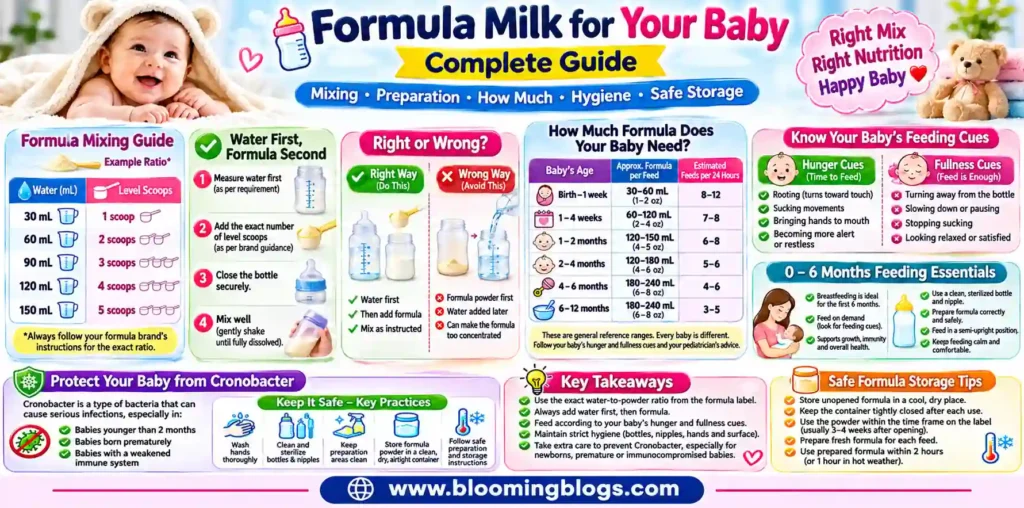
| STANDARD MIXING RATIO GUIDE | SCOOPS | VOLUME (ml) |
|---|---|---|
| Water Volume | Formula Powder Scoops | Final Yield Volume |
| 30 ml (approx. 1 fl oz) | 1 Level Scoop | ~33 ml |
| 60 ml (approx. 2 fl oz) | 2 Level Scoops | ~67 ml |
| 90 ml (approx. 3 fl oz) | 3 Level Scoops | ~100 ml |
| 120 ml (approx. 4 fl oz) | 4 Level Scoops | ~133 ml |
| 180 ml (approx. 6 fl oz) | 6 Level Scoops | ~200 ml |
👉 Always follow the exact preparation instructions printed on your formula container
Why Correct Formula Measurement Matters
The amount of water and powder must be accurate.
👉 Too Much Powder
Adding too much powder makes the feed more concentrated than intended.
This can contribute to dehydration and constipation and may be harmful.
👉 Too Much Water
Adding too much water makes the formula too diluted.
Your baby may receive insufficient nutrition from the feed.
👉 The Safe Rule
Never alter the manufacturer’s water-to-powder ratio.
The source material repeatedly emphasizes that the formula container’s instructions should take priority over guessed measurements.
Can You Use a Formula Preparation Machine?
Some families use automatic formula preparation machines.
If you use one:
- Follow the machine manufacturer’s instructions.
- Follow the formula manufacturer’s preparation instructions.
- Make sure the machine is operating correctly.
- Check any required water temperature specifications.
- Stop using the machine if you suspect it is not preparing feeds correctly.
Do not assume that an automated machine makes formula preparation automatically safe.
The same basic principles still apply:
👉 Correct water + correct powder + correct preparation + correct storage.
Step-by-Step Formula Milk Preparation in detail
Step 1: Wash Your Hands
Wash your hands thoroughly with soap and water before handling:
- The bottle
- Teat
- Formula powder
- Scoop
- Feeding equipment
Dry your hands with a clean towel.
Step 2: Clean the Preparation Surface
Clean and disinfect the surface where you will prepare the bottle.
Keep the area free from objects that could contaminate the bottle, teat, scoop or formula.
Step 3: Check the Formula
Before using the formula, check:
- The use-by or expiry date
- Package condition
- Whether the container is properly sealed
- Whether the formula has been stored correctly
Do not use formula beyond the manufacturer’s stated use-by date.
If a container is badly damaged, leaking, swollen, compromised or has a broken seal, do not use it.
Step 4: Prepare a Clean, Sterilized Bottle
Use the bottle, teat, retaining ring and cap according to the cleaning and sterilization instructions applicable to your equipment.
Make sure all components are correctly assembled when required.
Step 5: Use Safe Water
Using safe, clean water is essential when learning how to make formula milk. Tap water or bottled water must meet specific criteria to protect newborn kidney function.
👉 Safe Water Conditions
Not all water is safe for formula preparation. High levels of sodium or sulfate can strain a newborn’s kidneys or cause digestive distress.
Sodium Level: Must be less than 200 mg/L
Sulfate Level: Must be less than 250 mg/L.
Fluoride: Low fluoride is preferred to prevent dental fluorosis in developing teeth.
Water is one of the most important parts of formula preparation.
Use water from a safe drinking-water source and follow your formula manufacturer’s instructions and local public-health guidance.
Do not assume bottled water is automatically sterile or automatically better than safe tap water.
Some bottled waters can contain different mineral levels, including sodium and sulphate.
For families in India and elsewhere, local water quality can vary considerably. Therefore, follow the guidance applicable to your location rather than applying a universal bottled-water rule.
Should Formula Water Be Boiled?
👉 Yes…. Tap water and bottled water are not sterile. Boiling water kills potential waterborne pathogens. Furthermore, adding hot boiled water to powdered formula sterilizes the powder itself.
There is no single worldwide procedure that applies identically to every baby, formula and country.
This is one area where parents should be particularly careful about combining advice from different sources.
For example, the source material describes differences between CDC and NHS approaches for certain babies and circumstances.
Some higher-risk infants may require additional precautions.
The safest general rule for a parent is:
👉 Follow your formula manufacturer’s preparation instructions together with the current guidance from your local health authority and your baby’s healthcare professional.
Do not combine different protocols yourself simply because they appear similar.
Water Temperature and Formula Preparation
The temperature of water used to prepare powdered formula and the temperature at which the baby drinks the finished feed are two different things.
Some preparation guidance recommends sufficiently hot water when mixing powdered formula because powdered formula is not sterile.
However, the finished feed should never be given while it is too hot.
The source material specifically notes that CDC and NHS recommendations can differ according to the baby’s circumstances and country.
Therefore:
Preparation temperature = safety consideration
Feeding temperature = baby’s comfort and burn prevention
Never confuse the two.
👉 Water Temperature Guidelines
The ideal water temperature for mixing formula powder is at least 70°C (158°F).
To achieve this, boil fresh tap water and let it sit for no longer than 30 minutes. Water cooler than 70°C will not effectively destroy bacteria inside the formula powder, while water that is too hot (boiling point at 100°C) can destroy vitamins and heat-sensitive nutrients.
Step 6: Measure the Water First
This is one of the most important practical rules.
Water first → formula powder second.
Measure the exact amount of water specified by the formula manufacturer and pour it into the bottle before adding powder.
Do not put powder into the bottle first and then estimate the amount of water.
Please Don’t guess.
Do not use a generic internet scoop-to-water ratio.
Different formulas may use different scoop sizes and preparation instructions.
👉 Very Important – Water first → formula powder second.
👉How to Measure Water Correctly
- Place the clean feeding bottle on a flat, level surface.
- Pour the exact amount of cooled, boiled water into the bottle first.
- Read the liquid level at eye level to ensure accuracy.
Step 7: Measure the Formula Powder
Use the scoop supplied with the specific formula container.
Different formulas can have different scoop sizes.
Follow the manufacturer’s instructions for filling and levelling the scoop.
Avoid:
- Guessing
- Using a scoop from another formula
- Adding extra powder
- Deliberately packing powder tightly
- Using heaped scoops unless the manufacturer specifically instructs you to
Accurate measurement matters because changing the concentration can affect the nutritional content of the feed.
👉 How to Measure Formula Powder
- Use only the scoop provided inside your specific formula tub.
- Fill the scoop loosely until heaped.
- Level off the powder using the built-in scraper on the tub or the flat back of a clean, dry knife.
- Never press or pack down the powder, as this creates an overly concentrated feed.
Never Make Formula “Stronger”
A common mistake is thinking:
“My baby seems hungry, so I will add another scoop.”
Do not do this.
Adding extra powder makes the feed more concentrated than intended.
It can contribute to problems such as dehydration and constipation.
If you are worried that your baby is not getting enough milk, speak with your pediatrician rather than changing the concentration yourself.
Never Make Formula “Thinner”
The opposite mistake is adding extra water.
Do not dilute formula simply because you think the feed is too strong, your baby is uncomfortable or you want to make the bottle last longer.
Too much water reduces the nutritional concentration of the feed.
👉 If a bottle has been prepared incorrectly, do not try to repair it by adding more powder or water.
Discard it and prepare a fresh bottle.
Step 8: Assemble the Bottle
Attach the teat securely to the retaining ring or collar.
Attach the ring firmly to the bottle.
Make sure the cap is fitted correctly.
Before feeding, check that everything is securely assembled.
Step 9: Mix the Formula
Close the bottle securely and mix according to the manufacturer’s instructions.
Make sure the powder has dissolved adequately.
Do not leave large amounts of unmixed powder at the bottom.
If you discover that the wrong amount of water or powder was used, do not attempt to correct the mixture.
Prepare a new feed.
👉 Correct Mixing Technique to Prevent Lumps
To prevent clumping without generating excess air bubbles:
- Ensure water temperature is at least 70°C when powder is added.
- Secure the cap and roll the bottle horizontally between your palms for 5 seconds to initiate mixing.
- Shake vertically for 10–15 seconds until all powder granules are fully dissolved.
Step 10: Cool the Feed Safely
Freshly prepared formula may be too hot for your baby.
Keep the bottle closed while cooling.
If using running water to cool it, prevent the water from entering the bottle or touching the teat.
The goal is to cool the finished feed safely without contaminating the bottle.
Step 11: Check the Temperature
Place a few drops of formula on the inside of your wrist.
It should feel:
- Comfortable
- Warm or lukewarm
- Not hot
Formula does not necessarily need to be warm if your baby is happy to drink it at a cooler temperature.
Never feed a bottle that feels too hot.
👉 Formula Temperature Before Feeding
Serving formula milk at the right temperature prevents scalding your baby’s mouth and throat.
👉 How to Test Bottle Temperature
- Shake the bottle gently to distribute heat evenly.
- Invert the bottle and drop a few drops of formula onto the sensitive skin of your inner wrist.
- Target Feeling: It should feel lukewarm or neutral (around body temperature, 37°C/98.6°F). If it feels hot, continue cooling the bottle under running tap water.
Step 12: Feed Your Baby Promptly
Once the bottle has been prepared, follow the appropriate storage and feeding guidance.
Whenever practical, freshly prepared feeds can simplify safe formula handling.
If your baby has started drinking from the bottle, leftover formula should not be saved for another feeding.
The Simple Formula Preparation Routine
A useful routine to remember is:
CLEAN → CHECK → MEASURE → MIX → COOL → TEST → FEED → DISCARD/STORE
Or even more simply:
Clean → Water → Powder → Mix → Cool → Test → Feed
Repeating the same sequence every time can be particularly helpful during night feeds when you are tired.
Common Mistakes
- ❌ Mistake 1: Scooping formula powder and packing it tightly against the wall of the container.
Correction: Lightly dip the scoop into the powder and level it smoothly with a flat edge. - ❌ Mistake 2: Leaving leftover formula in the fridge to reuse later.
Correction: Always discard milk left over after a feed within 1 hour. - ❌ Mistake 3: Boiling water and letting it cool completely to room temperature before mixing.
Correction: Mix when water temperature is at least 70°C to sanitize the powder.
Newborn Feeding Patterns and Cues
Knowing how often newborns feed and recognizing their behavioral signals reduces feeding stress for both parent and child.
Hunger Cues vs. Fullness Cues
| NEWBORN HUNGER CUES REFERENCE | NEWBORN FULLNESS CUES REFERENCE |
|---|---|
| Hunger Cues (Time to Feed) | Fullness Cues (Time to Stop) |
| Lip smacking and sucking motions | Turning head away from nipple |
| Rooting (turning head side to side) | Closing mouth tightly / pushing bottle away |
| Bringing hands or fists to mouth | Relaxing hands and opening fingers wide |
| Whimpering or rapid eye movements | Falling asleep / slow or stopped sucking |
How Much Formula a Newborn Needs & Feeding Frequency
Newborn stomachs are small at birth and expand gradually over the first month.
- Days 1–3: 10–30 ml per feed every 2 to 3 hours.
- Week 1: 30–60 ml per feed every 2 to 3 hours.
- Weeks 2–4: 60–90 ml per feed, 6 to 8 times per 24 hours.
- Months 1–2: 90–120 ml per feed, 5 to 6 times per 24 hours.
Safe Bottle-Feeding Position
- Hold your baby in a semi-upright position with their head supported in the crook of your arm.
- Keep the bottle tilted horizontally (paced feeding) so formula fills the teat completely, preventing air intake.
- Never prop a bottle with a pillow or blanket, as this poses a serious choking hazard and increases the risk of ear infections.
Burping
Burp your baby halfway through a feeding session and again at the end. Hold your baby upright against your shoulder or sit them on your lap while gently patting or rubbing their back.
Formula Milk Storage: How Long Does Prepared Formula Last?
Storage is one of the most important parts of formula safety.
Prepared formula and unopened formula powder have completely different storage rules.
The source material based on CDC guidance gives these general limits for appropriately prepared formula:
| Situation | General guidance |
|---|---|
| Prepared formula at room temperature | Use within 2 hours |
| Once feeding begins | Use within 1 hour from the start of feeding |
| Prepared formula refrigerated promptly before feeding | Use within 24 hours |
| Leftover formula after feeding | Discard |
These limits should be considered alongside the instructions on your particular formula product and applicable local health guidance.
👉 Mastering formula milk storage protects your infant from bacterial growth. Powdered formula is not sterile, and mixed formula milk provides an ideal medium for bacteria to multiply if left at room temperature.
Formula Milk Storage: Rules, Limits & Safety
👉 FORMULA MILK STORAGE TIME CHART
| Storage Condition | Maximum Safe Time Limit |
|---|---|
| Freshly Prepared (Room Temp, 15-25°C) | 2 Hours Maximum |
| Refrigerated (4°C / 40°F or lower) | 24 Hours Maximum |
| Formula Left After Feeding Starts | 1 Hour Maximum (Then Discard) |
| Opened Formula Powder Tub | 1 Month / 30 Days |
| Unopened Powder Can | Check Manufacturer Expiry Date |
How Long Can Formula Stay at Room Temperature?
According to the CDC-based guidance included in the source material, prepared formula that has not been used should generally be used within 2 hours of preparation.
If the applicable safe period has passed, discard it.
Do not rely on appearance or smell to decide whether the bottle is safe.
If you cannot confidently determine how long it has been sitting out, the safer choice is to throw it away.
👉 Once mixed, untouched formula can sit at room temperature for up to 2 hours. After 2 hours, bacterial growth increases dramatically, and the feed must be thrown away.
How Long Can Prepared Formula Stay in the Refrigerator?
When prepared formula is refrigerated promptly and appropriately, CDC guidance in the supplied material gives a maximum of 24 hours.
The important point is that refrigeration should happen promptly.
👉 Do not leave a freshly prepared bottle sitting on the kitchen counter for a long period and then assume refrigeration makes it safe again.
Always follow the storage instructions for your particular formula.
👉 Can prepared formula be refrigerated?
Yes. If you prepare formula ahead of time, place it immediately in the coldest part of the refrigerator (usually the back of the shelf, never in the door). How long can formula milk be kept in the fridge? A maximum of 24 hours.
What Happens Once Your Baby Starts Drinking?
This is a separate situation.
When your baby’s mouth contacts the teat, saliva can enter the bottle.
That introduces microorganisms into the milk.
👉 Therefore, do not put a half-drunk bottle back in the refrigerator for another feeding.
The supplied CDC-based guidance uses a one-hour limit from the start of feeding.
After that period, discard the remaining formula.
Can You Refrigerate Leftover Formula?
No.
Refrigeration does not turn a half-drunk bottle into a fresh bottle.
Once feeding has begun, the bottle has been exposed to your baby’s mouth and saliva.
If formula remains after the applicable feeding period, discard it.
👉 This can feel wasteful, especially when your baby has taken only a few sips, but safety is more important than saving a small amount of milk.
👉 Formula Left After Feeding:
Once your baby’s mouth touches the teat, bacteria from their saliva enter the bottle. Formula left after feeding must be used within 1 hour or discarded. Never store leftover formula in the fridge for a later feed.
Can Prepared Formula Be Reheated?
👉 Refrigerated formula can be warmed by placing the bottle in a bowl of warm water or a bottle warmer for 15 minutes.
Never use a microwave, as it creates dangerous hot spots that can burn your baby’s mouth. Warm formula must be used immediately and cannot be returned to the fridge.
Can You Freeze Prepared Formula?
The supplied materials do not support using the freezer as a routine storage method for prepared formula.
For routine home feeding, follow the manufacturer’s instructions rather than treating freezing as a standard formula-storage solution.
Prepared formula should be handled according to the applicable product and health-authority guidance.
👉 Can Formula Be Frozen?
No, never freeze prepared formula milk. Freezing causes the fat emulsions to separate and destroys the protein structure, altering both texture and nutritional content.
Can We Store & Reuse Formula Milk?
👉 CAN I STORE & REUSE FORMULA MILK?
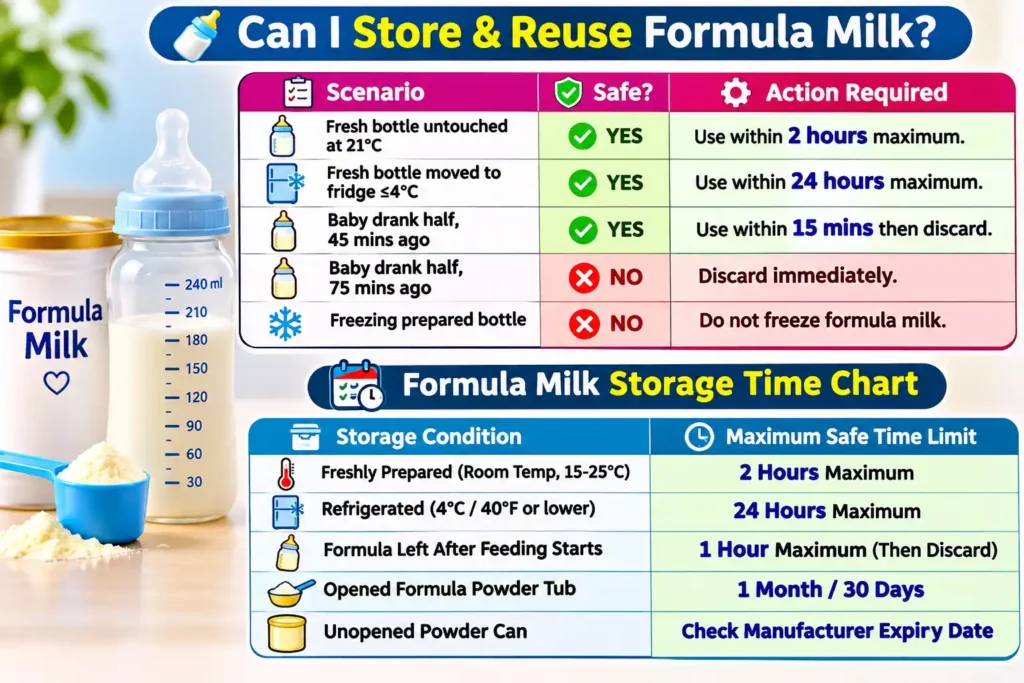
| SCENARIO | SAFE? | ACTION REQUIRED |
|---|---|---|
| Fresh bottle untouched at 21°C | YES | Use within 2 hours maximum |
| Fresh bottle moved to fridge ≤4°C | YES | Use within 24 hours maximum |
| Baby drank half, 45 mins ago | YES | Use within 15 mins then discard |
| Baby drank half, 75 mins ago | NO ❌ | Discard immediately |
| Freezing prepared bottle | NO ❌ | Do not freeze formula milk |
What About Opened Formula Powder?
Opened powdered formula should generally be:
- Kept in its original container unless the manufacturer says otherwise
- Tightly closed
- Stored in a cool, dry place
- Protected from excessive heat and moisture
- Used within the time specified by the manufacturer
👉 The supplied CDC-based material notes that many formulas are recommended for use within about one month after opening, but parents should check the specific product label rather than assuming one month applies to every formula.
Do not automatically store powdered formula in the refrigerator unless the manufacturer instructs you to do so.
When Should Formula Be Discarded?
👉 Discard formula if:
- The use-by date has passed.
- The storage time has expired.
- It has remained at room temperature too long.
- It is left over from a feeding.
- You cannot determine how long it has been sitting out.
- It was mixed with the wrong amount of water or powder.
- The packaging has been compromised.
- You are uncertain about its safety.
When in doubt:
Throw it out.
A wasted bottle is frustrating.
An unsafe bottle is not worth the risk.
How to Bottle Feed a Newborn Safely
Preparing the bottle is only half of safe formula feeding.
The way you hold and feed your baby matters too.
Bottle feeding can also be an opportunity for closeness and bonding.
Hold your baby securely, stay attentive and allow your baby to participate actively in the feeding process.
Keep Your Baby Semi-Upright
👉 Hold your baby in a semi-upright position.
Support your baby’s head and neck.
Avoid feeding your baby while they are lying completely flat.
Bring the teat gently toward your baby’s lips and allow your baby to take the teat rather than forcing it into their mouth.
Keep the Bottle Slightly Horizontal
👉 Hold the bottle mostly horizontal with a slight tilt.
This can help control the flow of milk rather than allowing it to pour too quickly.
It may also help reduce the amount of air swallowed.
If the teat becomes flattened, gently release the suction before continuing.
If the teat appears blocked, replace it with a clean, sterile teat rather than forcing milk through it.
Never Prop a Bottle
One of the most important bottle-feeding safety rules is:
👉 Never prop up a bottle and leave your baby to feed alone.
Do not place a bottle in your baby’s mouth and leave them unattended.
Do not use pillows, blankets or other objects to hold the bottle.
Stay with your baby throughout the feed.
Bottle propping can increase safety risks and prevents you from responding promptly to your baby’s feeding cues.
Let Your Baby Set the Pace
Babies do not all drink the same amount or follow the same schedule.
Some take smaller feeds more frequently.
Others take more at a time.
Responsive feeding means watching your baby’s behavior rather than concentrating only on the amount in the bottle.
How Do You Know When Your Baby Is Hungry?
👉 Early hunger cues can include:
- Becoming restless
- Becoming more alert
- Moving the head from side to side
- Opening the mouth
- Turning toward the bottle
- Sucking fingers or hands
- Making sucking movements
- Smacking or licking the lips
Crying is often a later sign of hunger.
Learning to recognize earlier cues can make feeding calmer.
However, no single behavior proves that a baby is hungry. Look at several cues together.
How Do You Know When Your Baby Has Had Enough?
👉 Your baby may:
- Slow down sucking
- Stop sucking
- Turn the head away
- Close the mouth
- Relax the hands
- Relax the body
- Push the bottle away
- Become calm or sleepy
- Leave milk in the bottle
👉 Do not force your baby to finish the bottle.
A baby does not need to empty every bottle simply because you prepared a particular amount.
Responsive feeding means respecting your baby’s fullness cues.
How Much Formula Does a Newborn Need?
There is no single bottle size that is correct for every newborn.
👉 Feeding needs can vary according to:
- Age
- Birth size
- Growth
- Appetite
- Whether breast milk is also being provided
- Medical circumstances
- Individual feeding pattern
The supplied materials intentionally emphasize watching the baby’s feeding cues, growth and wellbeing rather than relying on a rigid universal feeding schedule.
If you are concerned about how much your newborn is drinking, ask your pediatrician.
Do not respond to perceived hunger by adding extra formula powder.
How Can You Tell If Your Baby Is Getting Enough Formula?
The amount left in the bottle is only one piece of information.
👉 Healthcare professionals may consider:
- Weight gain
- Growth
- Wet nappies
- Alertness
- Feeding behavior
- Bowel movements
- Signs of dehydration
- General wellbeing
Once feeding is established, around six wet nappies a day is commonly used as a general guide, although individual babies vary.
Weight gain is particularly useful when assessing whether feeding is going well.
If your baby has very few wet nappies, poor weight gain, unusual sleepiness or difficulty feeding, contact your healthcare professional.
Does Your Baby Need to Burp?
👉 Some babies swallow air while feeding and may benefit from a short break.
You can hold your baby upright and gently rub or pat their back.
However, not every baby burps after every feed.
If your baby is comfortable, there is no need to keep trying for a long time.
Why Is My Baby Unsettled After a Bottle?
👉 A baby can remain unsettled for many reasons.
Possible causes include:
- Swallowed air
- Tiredness
- Discomfort
- Hunger
- Being too warm
- Wanting comfort
Do not automatically assume that crying means your baby needs more milk.
If your baby is regularly distressed during or after feeds, discuss it with your paediatrician.
Why Does My Baby Spit Up After Feeding?
Small amounts of milk coming back up during or after feeding are common in young babies and may be described as:
- Spitting up
- Posseting
- Regurgitation
- Reflux
Helpful habits can include:
- Keeping your baby comfortably upright after feeding
- Avoiding forcing the bottle
- Using an appropriate teat
- Allowing pauses
- Avoiding immediately laying the baby flat after a feed
Occasional spit-up is not necessarily a reason for alarm.
However, seek medical advice if vomiting is frequent, forceful or projectile, if your baby appears to be in significant pain, is not feeding properly, is not gaining weight as expected or you are concerned.
Can Formula Cause Constipation?
Formula-fed babies can have bowel patterns that differ from breastfed babies.
One of the most important things you can do is prepare formula exactly as instructed.
Never add extra formula powder.
Making formula more concentrated than instructed can contribute to constipation and dehydration.
Adding extra water to dilute formula can also be dangerous because it reduces nutritional concentration.
If your young baby has not passed stool for several days and is uncomfortable, feeding poorly or showing other symptoms, contact your healthcare professional.
What If You Suspect a Formula Allergy?
Do not diagnose an allergy simply by changing formula brands.
Possible symptoms of a food allergy can include digestive or skin symptoms, but many common infant symptoms have other causes.
If you suspect cow’s-milk protein allergy or another reaction to formula, speak with a pediatrician or doctor.
A healthcare professional can determine whether a specialized formula is appropriate.
Bottle Feeding Is Also About Bonding
Formula feeding is not simply about getting milk into your baby’s stomach.
It is also a chance to:
- Hold your baby close
- Make comfortable eye contact
- Talk softly
- Smile
- Respond to pauses
- Follow your baby’s pace
- Provide warmth and reassurance
Your baby needs comfort and connection as well as nutrition.
A calm bottle feed can become a special part of your daily routine.
What Should You Do with Leftover Milk?
This rule is simple:
Once your baby has started drinking from the bottle, do not save the remaining formula for another feeding.
Your baby’s mouth has contacted the teat, and bacteria can enter the milk.
Discard the leftover formula according to the applicable feeding-time guidance.
To reduce unnecessary waste, prepare an amount appropriate for your baby’s usual pattern while still following the formula manufacturer’s preparation instructions.
Formula Feeding Away from Home
Travelling with formula requires additional planning.
👉 Before leaving home, consider whether you have:
- Enough formula
- Clean or sterilized feeding equipment
- Safe water
- A clean preparation area
- A safe way to prepare the feed
- A safe way to cool it
- Appropriate storage if the feed must be carried
- A plan for discarding leftovers
The source material suggests that carrying powder separately and preparing a fresh feed when needed can be a practical approach when safe preparation conditions are available.
Ready-to-Feed Formula When Traveling
Sometimes it is simply not practical to prepare powdered formula safely.
You may not have:
- Safe water
- A clean preparation surface
- Sterilized feeding equipment
- Appropriate water temperature
- Refrigeration or safe cooling
In these circumstances, ready-to-feed liquid infant formula can be a convenient alternative because it does not require adding water.
Always follow the product’s storage and use instructions.
Carrying Prepared Formula
If you need to carry prepared formula, storage conditions matter.
The supplied NHS-based material gives these examples:
| Situation | Example NHS guidance |
|---|---|
| Refrigerated | Within 24 hours |
| Cool bag with ice pack | Within 4 hours |
| Room temperature | Within 2 hours |
These figures should not automatically be applied to every product or country.
Always check the formula label and applicable local health guidance.
👉 How to Transport Prepared Formula:
When traveling, transport formula safely to maintain the cold chain:
- Place cold bottles prepared within the last 24 hours into an insulated cool bag packed with frozen ice packs.
- Ensure the temperature remains below 4°C throughout transport.
- Use within 4 hours of bag transport, or transfer to a refrigerator upon arrival.
👉 Alternative Travel Method: Carry a vacuum flask filled with freshly boiled water and separate pre-measured powder portions in clean dispensers. Mix each bottle fresh right before feeding.
Night-Time Formula Preparation
Night feeds are often when mistakes happen.
You may be:
- Very tired
- Working in dim light
- Distracted by a crying baby
- Trying to work quickly
The answer is not to skip safety steps.
Instead, make the safe process easier.
👉 Before bedtime:
- Make sure feeding equipment is clean and ready.
- Keep the formula container in its normal storage location.
- Keep the correct scoop with the container.
- Know where your safe water is.
- Keep your preparation area organized.
- Keep a simple checklist nearby if helpful.
Avoid pre-mixing several bottles simply because you want to make the night easier unless you can maintain safe preparation, refrigeration and storage requirements.
For many families, preparing one feed at a time is the simplest approach.
👉 Night-Time Formula Preparation
To streamline night feeds safely:
- Fill vacuum flask with freshly boiled water before going to bed.
- Pre-measure formula powder into single-serve dispenser compartments.
- When baby wakes, pour hot water into bottle, add powder, mix, and cool rapidly under cold running water.
Formula Preparation During Emergencies
Emergencies can change normal feeding conditions.
Examples include:
- Flooding
- Water contamination
- Power failures
- Loss of safe drinking water
- Loss of refrigeration
If authorities have declared your tap water unsafe, do not assume that ordinary boiling or filtering will necessarily make it suitable for formula preparation.
Follow instructions from the local water or public-health authority.
When available, ready-to-feed liquid formula can be particularly useful because it does not require adding water.
If powdered formula is the only option, use water made safe according to official emergency guidance.
Formula Feeding for Higher-Risk Babies
Additional care may be needed for babies who are:
- Younger than two months
- Born prematurely
- Immunocompromised
- Living with certain medical conditions
Because powdered formula is not sterile, your healthcare professional may recommend additional preparation precautions.
Do not assume that general online instructions are sufficient for a medically vulnerable infant.
Ask your pediatrician about the safest preparation method for your baby.
👉 Common Formula Preparation Mistakes
Mistake 1: Guessing the Powder-to-Water Ratio
Never guess. Read the formula container every time you need to confirm the preparation instructions.
Mistake 2: Adding Powder Before Measuring Water
Measure the required water first, then add powder. Adding powder first skews liquid volume measurement, leading to an overly concentrated mixture that stresses newborn kidneys.
Mistake 3: Adding Extra Powder
More powder does not mean more nutrition.
Mistake 4: Adding Extra Water
Extra water changes the intended nutritional concentration.
Mistake 5: Using the Wrong Scoop
Use the scoop supplied with the relevant formula.
Mistake 6: Saving Half-Used Bottles
Once feeding begins, do not save the remaining milk for later. Saliva introduces bacteria into the bottle, causing rapid microbial proliferation.
Mistake 7: Microwaving the Bottle
Microwaves can create uneven heating and dangerous hot spots.
Mistake 8: Ignoring Storage Times
Do not assume a bottle is safe simply because it looks or smells normal.
Mistake 9: Ignoring the Formula Label
Your formula container is one of the most important sources of product-specific preparation information.
Mistake 10: Using Too Much or Too Little Powder
Diluting formula causes malnutrition and electrolyte imbalance; over-concentrating formula causes dehydration and constipation.
Mistake 11: Storing Formula in Refrigerator Door
Door shelves experience fluctuating temperatures; store bottles in the main back section instead.
Why You Should Never Microwave Infant Formula
Microwaves can heat liquids unevenly.
The outside of the bottle may feel comfortable while the inside contains hot areas capable of burning your baby’s mouth.
If formula needs warming, use a method recommended by your healthcare authority or formula manufacturer.
Always check the temperature before feeding.
🍼What If You Prepare a Bottle Incorrectly?
Do not try to repair an incorrectly prepared feed by adding more water or more powder.
For example:
Too much powder?
Do not estimate how much water to add.
Too much water?
Do not add extra powder.
Wrong scoop?
Do not guess how to compensate.
Unsure about the amount?
Prepare a fresh bottle according to the label.
The safest response to an uncertain or incorrectly prepared bottle is generally to discard it and start again.
A Practical Formula Safety Station
A simple preparation area can make formula feeding easier.
You can keep together:
- Formula container
- Manufacturer’s scoop
- Clean bottles
- Sterilised feeding equipment
- Bottle brush
- Approved sterilisation equipment
- Clean preparation materials
Keep powdered formula away from areas where water can splash into the container.
The goal is not to create a complicated baby-feeding station.
The goal is to make the safe routine easier to repeat.
👪Parent’s Tips
- Color-Code Powder Dispensers: Use multi-compartment formula dispensers with distinct colors for daytime vs. night-time feeds to prevent measuring errors while sleepy.
- Set a 1-Hour Feeding Timer: As soon as your baby begins drinking, set a timer on your smartphone for 60 minutes. Once the alarm rings, throw out any remaining liquid immediately.
- Keep a Water Temperature Gauge: Use a fast-reading digital kitchen thermometer to verify that boiled water has cooled to 70°C before adding powder.
Parent’s Hack
| THE 2-STEP WATER COOLING HACK |
|---|
| Need to prepare a feed quickly? Keep a sealed bottle of cold, previously boiled and sterilized water in the fridge. When preparing a feed: |
| 1. Fill 60% of the required bottle volume with hot boiled water (≥70°C) to dissolve the formula powder safely. |
| 2. Top up the remaining 40% with cold sterilized water from the fridge. |
| This immediately cools the bottle to safe drinking temperature while ensuring total bacterial destruction! |
👩🔬Expert Recommendations
“Precision in infant formula preparation is directly linked to neonatal health. Over-concentrating formula can lead to hypernatremia dehydration and necrotizing enterocolitis in vulnerable infants, while over-diluting formula compromises calorie intake and neurological growth. Always follow exact scoop-to-water ratios provided by manufacturers.”
— Pediatric Nutrition Advisory Council
🎗️ Gentle Reminders for Parents
- Be Patient with Yourself: Learning how to prepare formula milk and establishing a night-time routine takes time.
- Every Baby is Unique: Intake guides are general estimates. Watch your baby’s hunger and fullness cues rather than forcing them to finish every bottle.
- Never Hesitate to Consult: Reach out to your pediatrician if your baby experiences frequent vomiting, rash, severe diarrhea, or slow weight gain.
Quick Summary
Master Formula Feeding Cheat Sheet
| Key Step | Core Action |
| Water Prep | Boil fresh water, cool to ≥70°C (approx. 20-30 mins). |
| Order of Mixing | Water FIRST in bottle, powder scoops SECOND. |
| Scooping Technique | Loose, level scoops; never packed down. |
| Room Temp Limit | Discard untouched formula after 2 hours. |
| Refrigerator Limit | Store untouched formula at ≤4°C for max 24 hours. |
| In-Use Bottle Limit | Discard within 1 hour of baby starting to drink. |
| Heating Method | Warm in hot water bowl/warmer; NEVER use a microwave. |
📝The 60-Second Formula Safety Checklist
Before Mixing
☐ Hands washed thoroughly
☐ Preparation surface cleaned
☐ Bottle and teat properly cleaned and sterilised
☐ Formula container checked
☐ Use-by date checked
☐ Container properly closed and stored
During Mixing
☐ Exact water amount measured first
☐ Correct scoop used
☐ Powder measured according to label
☐ Powder not deliberately packed down
☐ Exact water-to-powder ratio followed
☐ No extra water added
☐ No extra powder added
Before Feeding
☐ Bottle securely assembled
☐ Formula mixed correctly
☐ Feed cooled appropriately
☐ Temperature checked
☐ Feed is not hot
During Feeding
☐ Baby held securely
☐ Baby semi-upright
☐ Bottle held rather than propped
☐ Baby allowed to pause
☐ Hunger and fullness cues observed
After Feeding
☐ Leftover formula discarded appropriately
☐ Bottle taken apart
☐ Feeding equipment cleaned promptly
🔄A Simple Daily Formula-Feeding Routine
If you want a routine that is easy to remember, use this:
Before the Feed
Clean → Check → Prepare
During Preparation
Water → Powder → Mix
Before Feeding
Cool → Test
During Feeding
Hold → Watch → Respond
After Feeding
Discard → Clean → Sterilise
This predictable sequence can be especially helpful when another family member is preparing a bottle.
Everyone involved in feeding should know the same basic safety routine.
💊When Should You Contact a Pediatrician?
You do not have to wait until a problem becomes severe before asking for help.
Contact your baby’s healthcare professional if you are concerned about:
- Poor weight gain
- Very few wet nappies
- Signs of dehydration
- Persistent vomiting
- Forceful or projectile vomiting
- Difficulty feeding
- Poor feeding
- Extreme sleepiness or unusual lethargy
- Blood in the stool
- Persistent diarrhea
- Ongoing constipation
- Possible food or formula allergy
- Repeated distress during or after feeds
- Consistent refusal of feeds
- Any symptom that concerns you
The supplied source material specifically recommends professional assessment when feeding, growth, hydration or illness is concerning.
Formula Feeding: The Most Important Things to Remember
You do not need every bottle to look identical.
Your baby may:
- Drink different amounts at different feeds
- Feed more frequently on some days
- Take longer to finish a bottle
- Leave milk in the bottle
- Change their feeding pattern as they grow
Instead of focusing only on millilitres or ounces, look at the whole picture:
Hunger cues + fullness cues + wet nappies + bowel movements + growth + alertness + overall wellbeing
If you are concerned about your baby’s intake, do not simply increase the amount of powder or force larger feeds.
Ask your healthcare professional.
Safe preparation, responsive feeding and attention to your baby’s growth are more important than making every feed identical.
❓Frequently Asked Questions About Formula Milk
1. How do I prepare formula milk for a newborn baby?
Wash your hands, use clean equipment, measure the exact amount of water specified by the formula manufacturer first, add the correct amount of powder, mix according to the instructions, cool if necessary and check the temperature before feeding.
2. How much water should I use?
Use exactly the amount printed on your formula container.
3. Should water go into the bottle before powder?
Yes. The supplied guidance emphasizes measuring water first and adding powder second.
4. Can I use a scoop from another formula?
No. Use the scoop supplied with the formula you are preparing unless the manufacturer specifically instructs otherwise.
5. Can I add an extra scoop if my baby seems hungry?
No. Do not increase formula concentration without appropriate professional advice.
6. Can I add more water if the formula looks too strong?
No. If the feed was incorrectly prepared, discard it and prepare a fresh bottle.
7. Does infant formula need to be warm?
Not necessarily. Some babies are happy to drink formula without warming.
8. Can I microwave formula?
No. Microwaving can create dangerous hot spots.
9. How do I check formula temperature?
Place a few drops on the inside of your wrist. It should feel comfortable and not hot.
10. Is powdered infant formula sterile?
No. Powdered infant formula is not sterile.
11. Why is formula hygiene important?
Because both powdered formula and feeding equipment can potentially become contaminated with microorganisms.
12. Should baby bottles be sterilised?
Follow appropriate health guidance and the instructions for your baby’s feeding equipment. Safe cleaning and sterilisation are important parts of infant feeding hygiene.
13. How long can prepared formula stay at room temperature?
The CDC-based guidance in the supplied material says prepared formula should generally be used within two hours of preparation.
14. How long can formula last once feeding starts?
The supplied CDC-based guidance says use it within one hour after feeding begins.
15. Can prepared formula be refrigerated?
Yes, when prepared and refrigerated appropriately. CDC guidance in the supplied material allows promptly refrigerated prepared formula to be used within 24 hours.
16. Can I refrigerate leftover formula from a feeding?
No. Once your baby has started drinking, discard the remaining formula rather than refrigerating it for later.
17. Can I prepare formula in advance?
It may be possible when safe preparation, immediate refrigeration and storage requirements can be maintained. Follow your formula label and local health guidance.
18. Is preparing every bottle fresh better?
Fresh preparation can simplify safe handling and reduce storage-related concerns. Follow the guidance applicable to your product.
19. Can I freeze prepared formula?
Do not assume prepared formula is suitable for freezing. Follow the manufacturer’s instructions instead.
20. How should opened formula powder be stored?
Keep it tightly closed in a cool, dry place and follow the product label.
21. How long does opened formula powder last?
The exact period varies by product. Many products specify approximately one month after opening, but check your container.
22. Can I use formula after its expiry date?
No. Never use infant formula after its manufacturer’s Use By or expiry date.
23. What if the formula container is damaged?
Do not use a compromised container. Contact the manufacturer if necessary.
24. Can I use bottled water?
Water recommendations vary according to country and circumstances. Bottled water is not automatically sterile or automatically safer than safe tap water. Follow local guidance and the formula manufacturer’s instructions.
25. Should bottled water be boiled?
Do not assume all bottled water is sterile. Follow the applicable preparation guidance for your baby and product.
26. What if my tap water is unsafe?
Do not use unsafe water to prepare formula. Follow the instructions from your local public-health or water authority.
27. Can I add cereal to formula?
Do not add cereal unless specifically instructed by your baby’s healthcare professional.
28. Can I add sugar to formula?
No. Do not add sugar unless specifically medically directed.
29. What if I accidentally add too much powder?
Do not attempt to correct the concentration by guessing. Discard the feed and prepare a fresh bottle.
30. What if I accidentally add too much water?
Discard the incorrectly prepared bottle and make a new one according to the label.
31. Why does my baby turn away from the bottle?
Turning away can be a fullness cue.
32. Should I make my baby finish the bottle?
No. Watch your baby’s fullness cues.
33. What are early hunger signs?
Your baby may bring their hands to their mouth, turn toward the bottle, open their mouth, lick or smack their lips, or become restless.
34. Is crying the first sign of hunger?
Crying can be a later hunger cue. Earlier signs may appear before crying.
35. Does every baby need to burp?
No. Some babies burp easily while others may not burp after every feed.
36. Can I prop my baby’s bottle?
No. Hold your baby and the bottle during feeding.
37. Can I put my baby to bed with a bottle?
No. Never leave your baby alone with a bottle or put them to sleep while feeding from a bottle.
38. Why does my baby spit up?
Small amounts of spit-up are common in young babies. Frequent, forceful or projectile vomiting should be assessed by a healthcare professional.
39. Can formula cause constipation?
Incorrectly concentrated formula can contribute to problems such as constipation and dehydration. Follow the manufacturer’s preparation instructions exactly.
40. What if my baby seems uncomfortable after feeds?
There can be many reasons, including swallowed air, tiredness, discomfort or hunger. If distress is persistent, consult your healthcare professional.
41. Should I change formula if my baby has gas?
Do not automatically change formula. Discuss persistent symptoms with your baby’s healthcare professional.
42. Is goat formula better than cow’s-milk formula?
Not necessarily. Goat-milk infant formula is not automatically better and is not an appropriate treatment for cow’s-milk protein allergy.
43. Is comfort formula suitable for milk allergy?
No. Comfort formula and hypoallergenic formula are not the same.
44. What formula is used for cow’s-milk protein allergy?
A healthcare professional may recommend an appropriate specialised formula, often based on extensively hydrolysed proteins.
45. Is expensive formula better?
No. Price and marketing do not automatically determine nutritional suitability.
46. Does my baby need follow-on formula at six months?
Not necessarily. Guidance differs by country, and some guidance allows first infant formula to continue throughout the first year.
47. Can I give regular cow’s milk before one year?
Regular cow’s milk should not replace breast milk or infant formula as the main milk drink before 12 months.
48. Can I make homemade infant formula?
No. Homemade infant formula can create serious nutritional and safety risks.
49. What is the safest formula option during difficult travel conditions?
Ready-to-feed liquid formula can be convenient when safe water, clean preparation facilities or appropriate storage are unavailable.
50. Can I carry prepared formula while travelling?
Yes, if it can be prepared, cooled and transported according to applicable storage guidance.
51. What should I do for night feeds?
Keep the preparation area organised and use the same safe sequence every time. Avoid shortcuts because you are tired.
52. Can I prepare multiple bottles in advance?
Only when safe preparation, immediate refrigeration and storage requirements can be maintained. Preparing one bottle at a time may be simpler.
53. Why shouldn’t I keep half-used formula?
Your baby’s saliva can enter the bottle and allow bacteria to multiply.
54. What if I don’t know when the bottle was prepared?
If you cannot confidently establish that it is still within the safe storage period, discard it.
55. What if my baby drinks only half the bottle?
Follow the applicable feeding-time limit and discard the remaining formula rather than saving it for later.
56. What if my baby consistently refuses feeds?
Contact your baby’s healthcare professional, especially if refusal is persistent or accompanied by other symptoms.
57. What if my baby has very few wet nappies?
Contact your healthcare professional, particularly if your baby also appears unusually sleepy or unwell.
58. What if my baby is not gaining weight?
Discuss it with your paediatrician. Weight gain is an important indicator of whether feeding is going well.
59. What if I am unsure whether a bottle is safe?
When you cannot confidently establish that formula was prepared or stored safely, discard it and make a fresh feed.
60. What is the most important formula-feeding rule?
Follow the manufacturer’s instructions, use safe water, maintain good hygiene, measure accurately, respect storage limits, feed responsively and discard questionable or leftover formula.
When in doubt, throw it out.
📖The Complete Formula Feeding Cheat Sheet
FORMULA CHOICE
Choose formula appropriate for your baby’s age and circumstances.
HYGIENE
Wash hands and use properly cleaned and sterilised equipment.
WATER
Use a safe water source and follow your formula’s instructions and local guidance.
MEASUREMENT
Water first. Powder second.
SCOOP
Use the scoop supplied with the relevant formula.
MIXING
Follow the manufacturer’s instructions exactly.
TEMPERATURE
The preparation temperature and feeding temperature are not the same thing.
FEEDING
Hold your baby securely and allow them to control the pace.
STORAGE
Follow applicable room-temperature and refrigeration limits.
LEFTOVERS
Discard formula left after feeding.
TRAVEL
Plan for safe water, clean equipment and appropriate storage.
EMERGENCIES
Follow official local public-health instructions.
MEDICAL CONCERNS
Ask your paediatrician when feeding, growth, hydration or symptoms are concerning.
🤔Final Thoughts: You Do Not Have to Get Everything Perfect
Newborn feeding can feel like a relentless cycle of washing bottles, checking temperatures, measuring powder, watching the clock and wondering whether you are doing everything correctly.
You may make mistakes while learning.
That does not make you a bad parent.
The safest response to an incorrectly prepared or questionable bottle is usually simple: discard it and prepare a fresh one.
You do not have to become a formula-feeding expert overnight.
Focus on the fundamentals:
Clean hands.
Clean equipment.
Safe water.
Accurate measurement.
Correct preparation.
Safe storage.
Responsive feeding.
Your baby may drink different amounts at different feeds. Some days may be easier than others. Feeding patterns change as babies grow.
Instead of trying to make every bottle identical, pay attention to your baby’s hunger and fullness cues, wet nappies, growth, behaviour and overall wellbeing.
And when something does not seem right, ask for help.
A paediatrician or qualified healthcare professional can assess your baby’s individual situation in a way that an online article cannot.
Take it one feed at a time.
📜Final Review
This guide brings together the key principles of safe infant formula feeding: choosing an appropriate formula, maintaining hygiene, using safe water, measuring accurately, preparing feeds correctly, cooling and checking temperature safely, respecting storage limits, responding to your baby’s hunger and fullness cues, and knowing when professional medical advice is needed.
The most important message is simple: follow the instructions for your specific formula and feeding equipment, avoid guessing, and when you are uncertain about the safety of a prepared feed, discard it and prepare a fresh one.
For newborns and medically vulnerable babies, individual advice from a paediatrician or qualified healthcare professional should take priority over general online guidance.
🩺Medical Disclaimer
This guide is provided for educational and informational purposes only and does not replace personalized medical advice, diagnosis, or treatment. Always consult your pediatrician or healthcare provider regarding specific feeding recommendations or medical concerns for your infant.
Infant-feeding recommendations can vary according to a baby’s age, growth, medical history, prematurity, allergies, feeding difficulties, country, water supply and the specific formula product being used.
Always read and follow the preparation, storage and feeding instructions supplied with your particular infant formula and feeding equipment.
If your baby was born prematurely, is younger and medically vulnerable, has a weakened immune system, is not gaining weight appropriately, has difficulty feeding, shows signs of dehydration, has persistent vomiting or diarrhea, has blood in the stool, develops concerning symptoms or you are otherwise worried, seek appropriate medical advice promptly.
📚 External Authoritative References
- Centers for Disease Control and Prevention (CDC) —
CDC, CDC — Infant Formula Preparation and Storage, CDC — Choosing an Infant Formula, CDC — Prepare and Store Powdered Infant Formula in an Emergency, CDC — Preventing Cronobacter in Infants - National Health Service (NHS) —
nhs.uk, NHS — How to Make Up Baby Formula, NHS — Types of Formula Milk, NHS — How to Use Formula - World Health Organization (WHO) —
World Health Organization, WHO — Safe Preparation, Storage and Handling of Powdered Infant Formula - American Academy of Pediatrics / HealthyChildren.org —
HealthyChildren.org, HealthyChildren.org — Choosing a Baby Formula, HealthyChildren.org — How to Safely Prepare Baby Formula With Water
These sources support the article’s core guidance that standard iron-fortified infant formula is generally appropriate for healthy infants who need formula, that no single brand is universally best, and that specialized formulas require more careful consideration.
🔗 Related Articles
If you are preparing for a newborn, these helpful Blooming Blogs guides can help you plan, prepare, and care for your baby with greater confidence:
- Newborn Baby Essentials Checklist for Soon-to-Be Parents — A practical checklist of important newborn essentials to prepare before your baby arrives.
- Best Infant Formula Milk for Newborn — Learn the basic steps for preparing formula milk safely and hygienically for a newborn.
- Newborn Baby Care: Complete Guide for New Parents — A comprehensive guide covering essential newborn care and everyday needs for new parents.
🌱 Continue Exploring…
Whether you’re nurturing a newborn, curating a sanctuary for your home and garden, or simply looking to level up your day-to-day life, there’s always a new perspective waiting to be discovered. From practical everyday parenting guidance, women’s wellness information, ideas to make your home more beautiful, tips for caring for pets and plants, or inspiration for your spiritual journey, Blooming Blogs brings useful knowledge together in one place.
Blooming Blogs — knowledge that blooms.
🌸 Blooming Blogs Promise
We’re here to bring you thoughtful, reliable, and helpful insights you can truly count on. Every article on Blooming Blogs is thoroughly researched, crafted with care, and written with genuine empathy to support you in your everyday journey. Your trust means everything to us, and we are dedicated to sharing content that informs, inspires, and makes your life a little easier.
📝 Editorial Notes
Our team strives for clarity, accuracy, and depth in every piece we publish. Content is periodically updated to ensure facts, recommendations, and guides stay relevant over time. While we consult trusted sources and expert research, our goal is always to present complex topics in a simple, practical, and conversational way that works for real life.
⚠️ Disclaimer
The content provided on Blooming Blogs is for informational and educational purposes only and should not be considered professional medical, legal, or financial advice. Always consult with a qualified expert or licensed professional before making decisions related to your health, family, or personal finances. Blooming Blogs is not liable for any actions taken based on the information provided on this website. (For full details, please visit our Disclaimer Policy Page).
💬 Share Your Experience — Leave a Comment
We’d love to hear from you! Did this article help you, or do you have a personal tip or story to share with our community? Drop your thoughts, questions, or feedback in the comment section below. Every voice enriches our community, and we read every single comment!
💌Leave a Comment
Join the conversation! Leave your questions, feedback, or personal advice in the comment box below.