
✨ Introduction
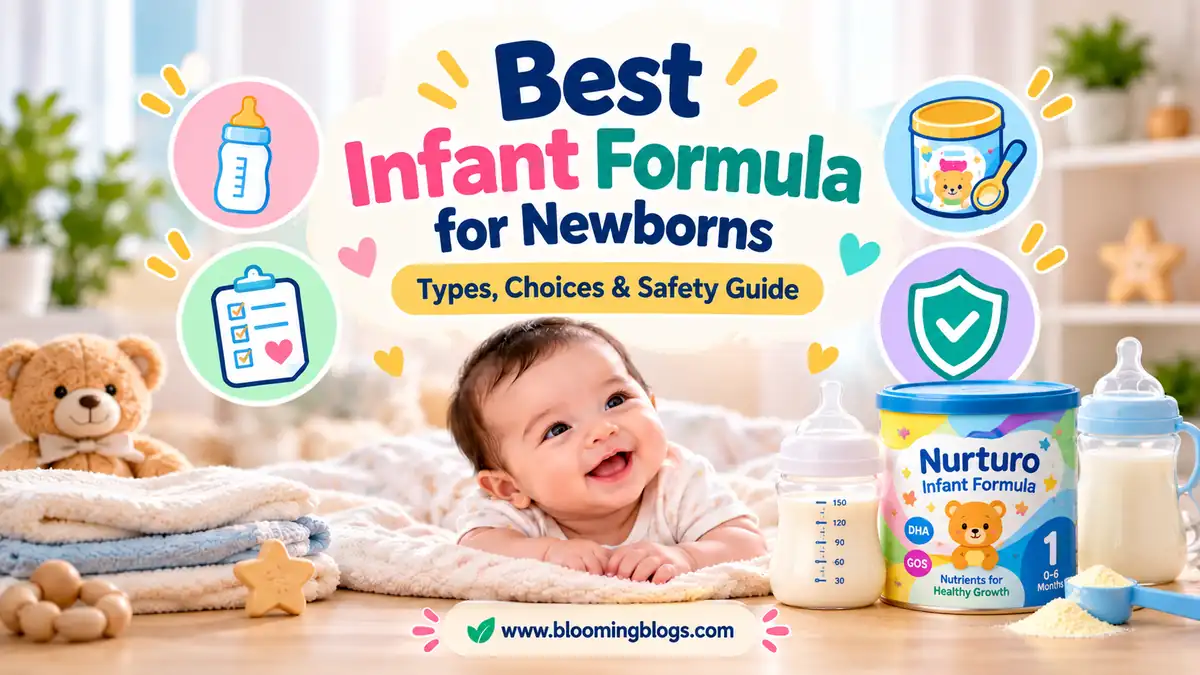
Choosing the best infant formula for newborns can feel confusing when you see so many different products on pharmacy and supermarket shelves. Labels such as first infant formula, comfort formula, anti-reflux, lactose-free, hypoallergenic, goat milk and soy formula can make it difficult for parents to know which product their baby actually needs.
If you are searching for which formula milk is best for newborns, which infant formula to choose, or which is the best formula milk for your baby, the answer usually starts with your baby’s individual needs rather than the most expensive package or the most heavily advertised brand.
The good news is that most healthy babies who need formula do not require a specialised product.
For a healthy infant who needs formula, a standard infant formula that is specifically made for babies and contains iron is generally the appropriate starting point. The brand itself is usually less important than choosing a properly regulated infant formula and preparing it exactly according to the instructions. Current CDC guidance also recommends choosing an infant formula made especially for infants and containing iron, and states that no particular brand is best.
Specialised formulas are designed for particular medical or feeding situations. Therefore, parents should generally select them with advice from a paediatrician or another qualified healthcare professional.
This guide explains the types of baby formula, how infant formula milk differs from ordinary milk, what parents should know about formula milk for baby 0-6 months, and how to choose the right formula without becoming overwhelmed by marketing claims.
✨ What Parents Should Know About the Best Infant Formula for Newborns
There is no single formula brand that is universally the best formula for infants.
For most healthy newborns who need formula, the practical starting point is a commercial infant formula that is specifically designed for infants and contains iron. The CDC states that no particular brand of infant formula is best. It recommends choosing a formula made especially for infants and including iron.
However, choosing formula becomes more complicated when a baby has symptoms or a diagnosed medical condition.
For example, a baby with a confirmed cow’s-milk protein allergy may need a specialised hypoallergenic formula. A baby with significant reflux may need medical assessment before using an anti-reflux formula. A baby with a genuine need for lactose-free feeding may require lactose-free formula under professional guidance.
Therefore, the question is not simply:
“Which is the best baby formula?”
A better question is:
“Which infant formula is appropriate for my baby’s age, nutritional needs, health and feeding situation?”
That difference can prevent parents from spending more money on unnecessary products or repeatedly changing formulas because of marketing claims.
⚡ Quick Takeaways
- There is no universal best infant formula for newborns or best formula brand for every baby.
- For most healthy babies who need formula, a standard iron-fortified infant formula is usually the appropriate starting point.
- First infant formula is generally the standard starting formula for newborns.
- Goat-milk formula is not automatically easier to digest and is not suitable for babies with cow’s-milk protein allergy.
- Comfort formula and hypoallergenic formula are not the same.
- Anti-reflux formula should generally be used with professional guidance.
- True lactose intolerance is uncommon in young babies.
- Toddler or growing-up milk is generally unnecessary for healthy children.
- A suspected milk allergy should be assessed by a healthcare professional.
- Lactose-free formula should not be chosen simply because a baby is gassy or unsettled.
- Follow-on formula is not automatically necessary at 6 months.
- Regular cow’s milk, goat’s milk, plant-based drinks and homemade formula should not replace infant formula as the main milk drink for babies under 12 months.
- Price does not automatically determine nutritional quality.
- Formula should always be prepared according to the manufacturer’s instructions.
- Never dilute infant formula by adding extra water.
- Never make homemade infant formula.
- If your baby has persistent vomiting, blood in the stool, poor weight gain, significant diarrhoea, suspected allergy or feeding difficulty, seek professional advice.
- Always check the age range, packaging, expiry date, ingredients, nutritional information and preparation instructions.
- Formula choice should depend on your baby’s age, health, nutritional needs and tolerance, not simply on price or advertising.
🧭 Key Points
When parents ask which infant formula is best, they often expect a particular brand name, but the answer depends on the baby’s individual situation.
However, choosing formula is not usually about finding one universally superior product.
Instead, ask these questions:
- Is the product specifically made as infant formula?
- Is it suitable for the baby’s age?
- Does it contain iron?
- Does the packaging remain sealed and undamaged?
- Does the baby have a diagnosed medical condition requiring specialized formula?
- Can the family prepare and store it safely?
- Does the baby’s healthcare professional recommend a particular type?
Is standard formula the best choice for a healthy baby?
For a healthy newborn without a diagnosed feeding or medical problem, these questions generally lead back to standard first infant formula. or in other words
“For a healthy baby who needs formula, a standard iron-fortified infant formula specifically made for infants is generally the appropriate starting choice.”
The CDC states that no particular brand of infant formula is best. The organization recommends infant formula specifically made for babies and fortified with iron.
A simple way to think about the decision is:
Baby’s situation | Formula usually considered |
|---|---|
Healthy baby needing formula | Standard iron-fortified infant formula |
Suspected cow’s-milk protein allergy | Healthcare assessment and appropriate hypoallergenic formula |
Significant reflux | Medical assessment before anti-reflux formula |
Diagnosed lactose intolerance | Lactose-free formula if recommended |
Specific medical or nutritional condition | Specialised formula recommended by a healthcare professional |
Parents considering goat formula | Goat-milk infant formula may be an option, but it is not automatically better |
Baby appears hungry between feeds | Assess feeding pattern before changing formula |
Ordinary fussiness or gas | Do not automatically switch formula |
Baby under 6 months | Never use follow-on formula before its stated minimum age |
Healthy child over 12 months | Toddler formula is generally unnecessary |
The exact products and recommendations can differ between countries. Always read the product label and follow the guidance applicable to where you live.
What Is Infant Formula?
Infant formula is a specially manufactured food designed to provide babies with nutrients needed for growth and development when breast milk is unavailable, insufficient, or not being used.
Many standard formulas are based on modified cow’s milk. Manufacturers process the milk and adjust its nutritional composition so the final product meets infant nutritional requirements. Other formulas may use goat milk, soy protein or specially processed proteins.
Therefore, infant milk, baby milk formula, and ordinary milk should not be treated as interchangeable terms.
Infant formula is generally available in two main forms:
Powdered infant formula
Powdered formula is mixed with water before feeding.
Its advantages include:
- Convenient storage
- Usually lower cost than ready-to-feed formula
- Easy availability
- Useful for regular home feeding
However, powdered infant formula is not sterile. Safe preparation, clean equipment and appropriate water are therefore important.
Ready-to-feed infant formula
Ready-to-feed formula is a liquid that does not require water to be added before feeding.
It can be convenient when parents are travelling, when safe preparation is difficult, or when a baby needs a feeding option where reducing preparation steps is helpful.
Ready-to-feed liquid formula is commercially sterile until opened, while powdered formula is not sterile.
Form | What it is | Main advantage | Important consideration |
|---|---|---|---|
Powdered formula | Dry powder mixed with water before feeding | Usually convenient and economical | Must be prepared carefully with safe water |
Ready-to-feed formula | Liquid formula that does not require adding water | Convenient and useful when safe preparation is difficult | Usually costs more and must be used according to its storage instructions |
Ready-to-feed liquid formula is commercially sterile until opened, whereas powdered formula is not sterile. This distinction is particularly important for very young or medically vulnerable infants. CDC guidance recommends extra precautions for babies younger than two months, babies born prematurely and babies with weakened immune systems.
Types of Baby Formula: Which Formula Is Best for Your Baby?
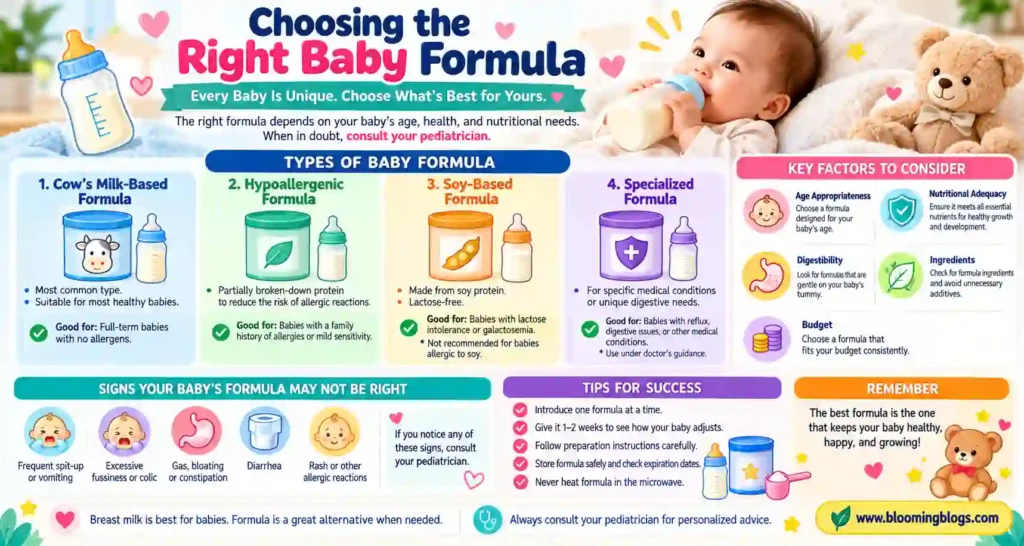
Parents searching for types of baby formula will find several products with different names and purposes.
Here is a quick comparison before we look at each type in more detail.
Formula type | Usually used for | Suitable from | Is it the usual first choice? | Medical advice? |
|---|---|---|---|---|
Standard cow’s-milk-based formula | Most healthy formula-fed babies | Birth, if labelled for infants | Yes | Usually not required, but follow local guidance |
Goat-milk formula | Babies whose parents choose a goat-milk-based infant formula | Depends on product | Not necessarily better than cow’s-milk formula | Seek advice if allergy is suspected |
Comfort formula | Certain digestive concerns | Depends on product | No | Ask a healthcare professional |
Anti-reflux formula | Babies with troublesome reflux | Depends on product | No | Yes |
Lactose-free formula | Diagnosed lactose intolerance or specific situations | Depends on product | No | Yes |
Hypoallergenic / extensively hydrolysed formula | Certain cow’s-milk protein allergies | Depends on product | No | Yes |
Soy-based formula | Selected medical or dietary situations | Depends on product/country | No | Yes |
Follow-on formula | Older infants in countries where it is marketed | Usually 6+ months | Not necessary in many guidelines | Check local guidance |
Toddler/growing-up milk | Older children | Usually 12+ months | Not needed for most children | Usually unnecessary |
The NHS similarly distinguishes first infant formula, goat-milk formula, hungry-baby formula, anti-reflux formula, comfort formula, lactose-free formula, hypoallergenic formula, follow-on formula, soy formula and growing-up milk. The exact age range and availability can vary between countries and individual products. Therefore, always read the label and follow local medical guidance.
1. Standard Infant Formula: The Usual Starting Choice
Standard infant formula is usually the starting point for a healthy baby who needs formula.
It is commonly made using modified cow’s-milk proteins and is nutritionally formulated for infants. Many commercial formulas contain added iron and other important nutrients.
The American Academy of Pediatrics recommends iron-fortified formula for infants who are not breastfed or who are only partially breastfed.
Is Standard Formula the Best Formula for Infants?
For a healthy baby without a diagnosed medical or feeding problem, usually yes, as a starting point.
If you are wondering about the best formula for babies, remember that the most expensive product is not automatically the most appropriate one.
Parents do not normally need to choose a specialized formula simply because a package says:
- Premium
- Advanced
- Gentle
- Gold
- Sensitive
- Comfort
- Organic
- Brain development
- Probiotic
Marketing terminology does not automatically mean that a formula is nutritionally superior.
The CDC specifically states that no particular brand of infant formula is considered best. Instead, parents should choose a formula made especially for infants and follow the preparation instructions correctly.
NHS guidance similarly identifies first infant formula as the standard formula to start with and states that babies can continue with it as their main milk drink throughout their first year
2. First Infant Formula for Newborns
First infant formula is one of the most important terms parents should understand when researching newborn formula.
In the UK, NHS guidance describes first infant formula as suitable from birth and the standard formula to start with.
For parents searching for best formula milk for baby 0-3 months, the first question should not be “Which brand has the most impressive label?”
Instead, ask whether the product:
- Is specifically intended for infants.
- Is suitable from birth.
- Contains iron.
- Comes from a properly regulated source.
- Has an intact package.
- Is within its expiry or use-by date.
- Can be prepared according to the manufacturer’s instructions.
In other words, first infant formula generally represents the standard starting category for a healthy newborn who needs formula.
First Infant Formula (First Milk)
If you choose to formula-feed your baby, first infant formula is usually the right formula to start with. It is suitable for babies from birth and can provide the nutrition they need during their early months.
First infant formula contains cow’s-milk proteins, mainly whey and casein. This type of formula has a higher proportion of whey protein, which many babies can digest more easily than formulas with a higher casein content.
For most healthy babies, first infant formula is all they need during the first year, unless a midwife, health visitor, doctor, or other healthcare professional recommends a different type of formula.
Therefore, when considering the best formula milk for baby 0-6 months, parents should first look for an infant formula intended for that age rather than automatically choosing the most expensive product.
3. Goat-Milk Infant Formula
Goat-milk infant formula is made using goat milk that has been specially formulated to meet infant nutritional requirements.
It is important not to confuse goat-milk infant formula with ordinary goat milk.
Ordinary goat milk is not an appropriate main drink for babies under 12 months.
Goat-milk formula is also not automatically easier to digest or less likely to cause allergies. Babies with cow’s-milk protein allergy may also react to goat-milk proteins because the proteins are similar. NHS guidance specifically states that goat-milk formula is not suitable for infants with cow’s-milk allergy.
Who should use goat-milk formula?
If you are considering goat-milk formula because your baby has digestive problems or a suspected milk allergy, speak with your baby’s doctor before changing formula.
For parents asking which baby formula is the best for newborns, goat-milk formula should not automatically rank above standard infant formula simply because the source is different.
4. Comfort Formula
Comfort formulas contain partially broken-down milk proteins and are marketed for babies who may have digestive discomfort.
They are sometimes promoted for concerns such as:
- Colic
- Gas
- Fussiness
- Constipation
- Digestive discomfort
However, marketing claims should not be confused with proven medical benefits.
NHS guidance notes that there is not good evidence that partially hydrolysed “comfort” formulas prevent colic or constipation.
Important
Comfort formula is not suitable for babies with a diagnosed cow’s-milk protein allergy.
If your baby has persistent vomiting, blood in the stool, poor weight gain, significant diarrhoea or other concerning symptoms, speak with a healthcare professional rather than changing formulas repeatedly.
5. Anti-Reflux Formula
Anti-reflux formulas are specially thickened formulas intended for babies who have significant reflux or frequently bring milk back up.
These products differ from standard formula because the consistency may be altered to help reduce regurgitation.
However, frequent spit-up does not automatically mean that a baby needs anti-reflux formula.
Should you use anti-reflux formula?
Not without appropriate medical advice.
Some anti-reflux formulas have preparation instructions that differ from standard formula. Therefore, follow the manufacturer’s instructions carefully.
NHS guidance recommends anti-reflux formula only under medical supervision and warns that preparation instructions may differ between products.
If your baby has persistent vomiting, appears to be in pain, is not gaining weight properly, or you are concerned about reflux, consult a paediatrician or other qualified healthcare professional.
6. Lactose-Free Formula
Lactose-free formula contains little or no lactose and is designed for babies who genuinely need a lactose-free feed.
True lactose intolerance is uncommon in young babies. Temporary lactose intolerance can sometimes occur after certain illnesses affecting the intestine.
Possible symptoms can include:
- Diarrhoea
- Excessive wind
- Bloating
- Abdominal discomfort
However, these symptoms can have many different causes. Therefore, parents should not automatically interpret them as lactose intolerance.
If you suspect your baby cannot tolerate lactose, speak with a healthcare professional before switching formula. NHS guidance recommends medical supervision for lactose-free formula.
7. Hypoallergenic Formula
Hypoallergenic formulas are designed for babies who have particular problems with standard milk proteins.
Some hypoallergenic formulas contain proteins that have been extensively hydrolysed, meaning the proteins have been broken down into much smaller pieces.
Healthcare professionals may recommend these formulas when a baby has a diagnosed or strongly suspected cow’s-milk protein allergy.
Comfort formula and hypoallergenic formula are different
This distinction matters.
Comfort formulas generally contain partially hydrolysed proteins and are not appropriate treatment for a diagnosed cow’s-milk protein allergy.
A hypoallergenic formula may contain extensively hydrolysed proteins and is used in specific medical situations.
If your baby has symptoms that could indicate a milk allergy, do not diagnose the condition yourself. Your paediatrician can determine whether a specialised formula is appropriate.
8. Soy-Based Formula
Soy formula uses soy protein rather than cow’s-milk protein.
It may be used in selected situations, depending on the baby’s medical needs, age and the guidance applicable in your country.
Soy formula is not a routine replacement for standard formula simply because a baby is fussy or has gas.
Some babies with cow’s-milk protein allergy can also react to soy protein. For this reason, parents should not automatically switch from cow’s-milk formula to soy formula when they suspect an allergy.
Always seek professional advice before using soy formula for a young infant.
9. Hungrier-Baby Formula
Some products are marketed as “hungry baby” or “hungrier baby” formulas.
These formulas may contain a different balance of milk proteins, including a higher proportion of casein.
They are promoted for babies who appear hungry between feeds, but that does not necessarily mean that a baby needs a different formula.
NHS guidance states that there is no evidence that hungry-baby formula makes babies settle better or sleep for longer.
Before changing to this type of formula, discuss your baby’s feeding pattern with a healthcare professional.
10. Follow-On Formula
Follow-on formula is marketed for babies from around six months in some countries.
However, starting follow-on formula at six months is not generally necessary.
For example, NHS guidance states that babies can continue with first infant formula as their main milk drink throughout their first year and do not need to switch to follow-on formula.
Therefore, if you search for best formula milk for babies 6-12 months, do not assume that a follow-on formula automatically offers a nutritional advantage.
Always check the age stated on the product label and follow the guidance applicable in your country.
Never give follow-on formula to a baby younger than the minimum age stated on the package.
11. Growing-Up or Toddler Milk
Growing-up milk and toddler formulas are marketed for children over 12 months.
For most healthy children, these products are not essential.
Once a child reaches 12 months, their nutritional needs increasingly come from a varied diet. Depending on the country and the child’s individual needs, pasteurised cow’s milk or another appropriate milk may form part of the diet.
NHS guidance states that children aged one to five generally do not need formula milks, including growing-up or toddler milks.
How to Choose the Right Baby Formula or Infant Formula
Parents often ask, “How do I choose the right baby formula?”
The safest approach is to work through a few simple checks instead of comparing dozens of marketing claims.
Step 1: Start with your baby’s age
Age determines which products are appropriate.
For example, parents searching for formula milk for baby 0-6 months should look specifically for infant formula intended for that age group.
Likewise, a product labelled for toddlers should not become the default choice simply because it appears nutritionally impressive.
Step 2: Decide whether your baby needs a standard or specialised formula
For a healthy baby without a diagnosed condition, standard infant formula generally provides the appropriate starting point.
A specialised formula may become appropriate when a healthcare professional identifies a specific need.
Step 3: Check for iron
Iron-fortified infant formula is recommended for babies who are not breastfed or who are only partially breastfed.
The CDC states that standard iron-fortified infant formulas can meet a child’s iron needs during the first year.
Step 4: Do not choose based only on marketing
Words such as:
- Premium
- Gold
- Advanced
- Gentle
- Comfort
- Organic
- Sensitive
- Brain development
- Probiotic
can influence purchasing decisions.
However, a marketing term does not automatically mean the product is better for your particular baby.
Step 5: Consider medical history
Ask whether your baby has:
- A diagnosed allergy
- Significant reflux
- Poor weight gain
- Persistent vomiting
- Persistent diarrhoea
- Feeding difficulties
- A diagnosed intolerance
- A medical condition requiring specialised nutrition
If the answer is yes, ask your healthcare professional which formula is appropriate.
Step 6: Check the package
Do not use formula if the package is:
- Leaking
- Swollen
- Rusted
- Seriously dented
- Broken
- Unsealed
- Past its use-by date
The CDC also advises checking that the container remains in good condition before purchase and use.
Step 7: Check whether you can prepare it safely
The best formula choice is not useful if the family cannot safely prepare it.
Before using powdered formula, make sure you have:
- Safe water
- Clean hands
- Clean preparation surfaces
- Properly cleaned feeding equipment
- The manufacturer’s instructions
- The correct measuring scoop
- A safe place to store the unopened and opened product
Which Formula Is Best for Infants?
This is one of the most important questions parents ask.
For a healthy baby who needs formula:
A standard, iron-fortified infant formula specifically made for infants is generally the best starting point.
There is no universal “best brand.”
Commercial infant formulas must meet nutritional and safety requirements applicable in the country where they are sold. However, the exact rules and product choices vary between countries.
The CDC states that no particular brand of infant formula is best.
A simple decision guide
Your baby’s situation | Usually consider |
|---|---|
Healthy baby needing formula | Standard iron-fortified infant formula |
Suspected cow’s-milk protein allergy | Speak with paediatrician about appropriate hypoallergenic formula |
Significant reflux | Medical assessment before anti-reflux formula |
Diagnosed lactose intolerance | Lactose-free formula if recommended |
Specific medical or nutritional condition | Specialised formula recommended by a healthcare professional |
Considering goat formula | Goat-milk infant formula may be an option, but it is not automatically better |
Baby seems hungry between feeds | Check feeding pattern before switching to “hungry baby” formula |
Baby has ordinary fussiness or gas | Do not automatically switch formula |
Baby is under 6 months | Do not use follow-on formula |
Child is over 12 months | Toddler formula is generally not necessary for healthy children |
What Is the Best Formula for Newborns?
If you are specifically searching best infant formula for newborns, the answer depends first on whether the newborn has any medical or feeding concerns.
For a healthy newborn who needs formula, a standard first infant formula made specifically for newborns and fortified with iron is generally the usual starting point.
The phrase newborn formula can sometimes confuse parents because manufacturers use different names and stage labels. Therefore, read the package carefully.
A newborn should not automatically receive:
- Follow-on formula
- Toddler formula
- Ordinary cow’s milk
- Ordinary goat milk
- Plant-based beverages
- Homemade formula
The product must be an infant formula appropriate for the baby’s age.
Which Infant Formula Is Best If My Baby Has a Medical Problem?
This question has a different answer.
A baby with a suspected or diagnosed medical condition may require a specialised formula. The appropriate product depends on the diagnosis.
For example:
- A baby with suspected cow’s-milk protein allergy may need a hypoallergenic formula.
- A baby with significant reflux may require medical assessment before using anti-reflux formula.
- A baby with diagnosed lactose intolerance may need lactose-free formula.
- A baby with another nutritional condition may need a formula selected by a healthcare professional.
Therefore, which infant formula is best cannot be answered safely without considering the baby’s medical history.
Do not use a specialised formula simply because another parent recommended it.
Does a More Expensive Formula Mean It Is Better?
No.
A higher price does not automatically mean that a formula is nutritionally better for your baby.
Parents may see products labelled:
- Premium
- Gentle
- Advanced
- Gold
- Comfort
- Organic
- Probiotic
- Brain development
- Sensitive
These labels can make choosing formula confusing.
Instead of choosing based only on marketing language, check whether the product is specifically designed and regulated as infant formula, is appropriate for your baby’s age, and meets your baby’s nutritional and medical needs.
The CDC states that no particular brand of infant formula is best.
Best Formula Milk for Baby 0-6 Months
Parents searching for best formula milk for baby 0-6 months should first focus on age-appropriate infant formula rather than comparing brands solely by price.
For a healthy baby, a standard iron-fortified infant formula intended for the appropriate age is generally the starting point.
What about the best formula milk for baby 0-3 months?
For a healthy newborn or young infant, the usual starting category is first infant formula or an equivalent standard infant formula intended from birth in the relevant country.
Do not assume that a formula labelled “newborn,” “premium” or “sensitive” is automatically superior.
If your baby has a medical problem, ask a healthcare professional before selecting a specialised product.
Best Formula Milk for Babies 6-12 Months
At six months, parents often begin searching for the best formula milk for babies 6-12 months.
However, six months does not automatically mean that a baby must change formula.
For example, NHS guidance says babies can continue with first infant formula as their main milk drink throughout their first year and do not need to switch to follow-on formula.
At the same time, babies around this age may begin complementary foods according to local guidance and individual readiness.
Therefore, formula choice and complementary feeding are related but separate decisions.
3 Types of Baby Formula Parents Commonly Compare
When parents search for 3 types of baby formula, they may be referring to different categories depending on the website or country.
Three broad categories parents commonly compare are:
- Standard infant formula
- Specialised formula
- Follow-on or older-infant formula
However, the actual product categories are more detailed. They can include standard, goat-milk, comfort, anti-reflux, lactose-free, hypoallergenic, soy-based and other specialised products.
So, do not assume that every article using the phrase “3 types of baby formula” uses the same classification.
Types of Formula Milk for Newborn Babies
The phrase types of formula milk for newborn babies usually refers to products that may be available from birth.
Depending on the country and product, these may include:
- Standard first infant formula
- Goat-milk infant formula
- Comfort formula
- Anti-reflux formula
- Lactose-free formula
- Hypoallergenic formula
- Selected soy formulas
However, availability does not mean every type is suitable for every newborn.
For most healthy newborns, standard infant formula remains the usual starting option.
Specialised products should have a clear reason for use.
Types of Formula Milk in India: What Parents Should Check
Parents searching for types of formula milk in India should pay particular attention to the product label, age suitability, preparation instructions and regulatory information.
The same formula category may appear under different brand names or product labels in different markets.
Before buying, check:
- Age suitability
- Ingredient information
- Nutritional information
- Iron content
- Manufacturing information
- Expiry or use-by date
- Package condition
- Preparation instructions
- Storage instructions
- Whether the product is actually infant formula rather than toddler milk
For a baby with a medical concern, the safest approach is to ask a paediatrician about the appropriate formula category.
Which Is the Best Formula Milk for a Healthy Newborn?
If your newborn is healthy and needs formula, a standard iron-fortified infant formula intended for newborns is generally the sensible starting point.
You do not usually need to begin with:
- Goat formula
- Comfort formula
- Lactose-free formula
- Anti-reflux formula
- Hypoallergenic formula
- Soy formula
- Hungry-baby formula
unless there is a specific reason.
The aim is not to find the most sophisticated-looking product.
The aim is to choose a safe, appropriate infant formula and prepare it correctly.
Milk and Drinks You Should Not Give to Babies Under 12 Months
Regular milk products and plant-based drinks are not interchangeable with infant formula.
Do not use the following as a substitute for infant formula as the main drink for a baby under 12 months:
- Regular cow’s milk
- Regular goat’s milk
- Regular sheep’s milk
- Condensed milk
- Evaporated milk
- Almond drink
- Oat drink
- Rice drink
- Regular soy drink
- Other plant-based beverages
NHS guidance specifically advises against giving these drinks as the main milk drink to babies under one year.
These products do not provide the same nutritional composition as infant formula.
Regular cow’s milk can be used in food in appropriate amounts after complementary foods are introduced, but it should not replace breast milk or infant formula as the main milk drink before 12 months.
Never use homemade infant formula.
The CDC and American Academy of Pediatrics warn against homemade infant formula because homemade recipes can provide incorrect amounts of nutrients and may introduce contamination risks.
How to Choose the Right Formula: 7 Quick Checks
Before buying a formula, check:
1. Check the age range
Make sure the product is intended for your baby’s age.
2. Check that it is infant formula
Do not confuse infant formula with toddler milk or ordinary milk drinks.
3. Check the ingredients and nutritional information
Look for a product specifically formulated to meet infant nutritional requirements.
4. Check the iron content
Iron-fortified infant formula is recommended for babies who are not breastfed or are only partially breastfed.
5. Check the packaging
Do not use a container that is damaged, leaking, swollen, badly dented or has a broken seal.
6. Follow preparation instructions
Never guess the powder-to-water ratio.
Always measure the exact amount of water and formula specified by the manufacturer.
7. Ask for medical advice when needed
If your baby has persistent digestive problems, allergic symptoms, poor weight gain, repeated vomiting or another health concern, consult a paediatrician.
Can You Change Your Baby’s Formula?
Sometimes a formula change may be appropriate, but frequent switching is not always helpful.
If your baby is healthy and growing normally, changing brands simply because another formula appears more “advanced” is generally unnecessary.
If your baby has persistent symptoms or you suspect an allergy or intolerance, speak with your baby’s healthcare professional before making repeated changes.
The right formula should be selected based on your baby’s age, nutritional needs, health and tolerance, rather than advertising claims alone.
Formula Safety: Choosing Formula Is Only Half the Job
Choosing the right formula is only one part of safe formula feeding.
You also need to:
- Wash your hands before preparing feeds.
- Clean and sanitise feeding equipment appropriately.
- Use safe water.
- Measure water and formula accurately.
- Follow the manufacturer’s preparation instructions.
- Never dilute formula by adding extra water.
- Never make homemade infant formula.
- Discard leftover formula appropriately.
- Store formula according to the package instructions.
CDC guidance states that too much water can reduce the nutritional concentration of a feed, while too little water can place extra strain on an infant’s kidneys and digestive system and contribute to dehydration.
Prepared formula should also be used and stored according to current manufacturer and public-health guidance.
For detailed preparation instructions, read our guide on How to Prepare and Store Baby Formula Safely.
Powdered Formula Is Not Sterile
One important point often overlooked when parents compare baby formula types is that powdered formula is not sterile.
Ready-to-feed liquid infant formula is sterile until opened, while powdered formula can contain microorganisms even when the product looks clean and normal.
This does not mean parents should avoid powdered formula altogether.
Instead, it means preparation matters.
Extra precautions are especially important for:
- Babies younger than two months
- Babies born prematurely
- Babies with weakened immune systems
For these babies, discuss the safest preparation method with a healthcare professional and follow current public-health guidance.
Ready-to-Feed Formula Versus Powdered Formula
Parents may also wonder whether ready-to-feed formula is the best formula for infants.
The answer depends on the situation.
Powdered formula
Advantages can include:
- Convenient for routine home use
- Often less expensive
- Easy to store when unopened
- Available in many product varieties
However, parents must prepare it correctly.
Ready-to-feed formula
Advantages can include:
- No water mixing
- Convenient for travel
- Useful during emergencies
- Particularly useful when safe preparation of powdered formula is difficult
During emergencies, CDC guidance identifies ready-to-feed infant formula as the safest option because it does not require mixing with water.
What About Formula During an Emergency?
Formula feeding requires additional planning during emergencies.
If tap water becomes unsafe, do not assume that boiling or filtering will remove every type of contamination. CDC guidance notes that water contaminated with harmful chemicals or toxins cannot be made safe by boiling, disinfecting or filtering.
If authorities say your tap water is unsafe:
- Use ready-to-feed formula when available.
- If powdered formula is the only option, use a safe water source according to public-health guidance.
- Follow the exact product instructions.
- Prepare fresh feeds when refrigeration or safe storage is unavailable.
- Throw away leftover formula after feeding.
Families should follow local emergency instructions because water safety can vary by location.
💡 Did You Know?
Did you know that price does not determine the best formula?
Parents sometimes assume that a premium price means superior nutrition.
However, the CDC states that no particular brand of infant formula is best.
Did you know that goat formula is not allergy-proof?
Goat-milk proteins resemble cow’s-milk proteins closely enough that goat-milk formula is not an appropriate substitute for babies with cow’s-milk protein allergy.
Did you know that follow-on formula is not automatically required?
In countries such as the UK, guidance states that babies can continue first infant formula as their main milk drink until 12 months.
Did you know that powdered formula is not sterile?
This is one reason careful preparation and storage matter.
Did you know that goat-milk formula is not the same as goat milk?
Goat-milk infant formula is specially formulated for babies. Ordinary goat milk is not an appropriate replacement for infant formula as the main drink for a baby under 12 months.
Did you know that hungry-baby formula has not been shown to make babies sleep longer?
The NHS reports no evidence that hungry-baby formula helps babies settle better or sleep longer.
👨👩👧 Parent’s Tips
Tip 1: Do not shop by packaging alone
Bright packaging, premium claims and expensive ingredients can attract attention. Nevertheless, start with age suitability and your baby’s actual needs.
Tip 2: Keep the formula choice simple when possible
If your baby is healthy and thriving, there may be no reason to keep changing brands.
Tip 3: Keep the preparation instructions with the formula
Do not rely on memory.
Formula preparation ratios can vary by product.
Tip 4: Check the package every time you buy
Look at:
- Expiry date
- Seal
- Dents
- Swelling
- Leaks
- Storage condition
Tip 5: Ask before switching to specialised formula
A specialised formula should have a reason behind it.
🛠️ Parent’s Hack
Use a Formula Shopping Checklist
Save this short checklist on your phone:
FORMULA CHECK
☐ Correct age
☐ Infant formula
☐ Iron-fortified
☐ Sealed package
☐ No damage
☐ Valid expiry date
☐ Correct preparation instructions
☐ Safe water available
☐ Specialised formula only when appropriate
This simple checklist can make late-night or hurried shopping much easier.
Use a Formula – Feeding Safety Checklist
Create a small formula-feeding safety checklist and keep it near the area where you prepare feeds.
Write down:
AGE → FORMULA TYPE → WATER → POWDER → STORAGE → EXPIRY
This simple sequence helps reduce avoidable mistakes.
You can also write the date you opened a powdered formula container on the lid. CDC guidance recommends checking the product label for how long it remains suitable after opening.
❤️ Parent Recommendations
When comparing the best formula milk for baby 0-6 months, avoid creating unnecessary pressure to find a “perfect” brand.
Instead:
- Choose an age-appropriate infant formula.
- Choose iron-fortified formula unless a healthcare professional recommends otherwise.
- Buy from a reliable source.
- Check packaging for manufacturing Dates and Expiry Dates.
- Store it correctly.
- Follow preparation instructions.
- Observe your baby’s feeding and growth.
- Ask a paediatrician if something does not seem right.
If your baby feeds comfortably, grows appropriately and has no medical concerns, there may be no reason to change formula simply because another product makes stronger marketing claims.
Please points are also worth to consider:
- Whether your baby tolerates it
- Whether it is consistently available
- Whether you can purchase it reliably
- Whether the preparation instructions are clear
- Whether the packaging remains intact
- Whether the product is appropriate for your baby’s age
Consistency can also be practical.
If you find an appropriate formula, don’t change it – repeatedly changing products simply to try another brand may create unnecessary confusion and health impact.
🩺 Expert Recommendations
Medical advice becomes particularly important when formula choice involves symptoms or a diagnosed condition.
Talk to a paediatrician or qualified healthcare professional if your baby has:
- Persistent vomiting
- Blood in the stool
- Persistent diarrhoea
- Poor weight gain
- Significant feeding difficulty
- Suspected cow’s-milk protein allergy
- Suspected lactose intolerance
- Significant reflux
- Persistent symptoms after feeding
- A known medical condition
- Special nutritional requirements
A healthcare professional can help determine whether the baby needs standard formula or a specialised product.
Parents should not diagnose food allergy, intolerance or reflux solely by reading product labels online.
⚠️ Common Mistakes Parents Make When Choosing Baby Formula
Mistake 1: Assuming the most expensive formula is the best.
Expensive does not automatically mean superior.
Mistake 2: Choosing based only on another parent’s recommendation
Every baby has different needs.
Mistake 3: Assuming gas means lactose intolerance
Gas and fussiness can have many causes.
Mistake 4: Switching to goat formula for suspected milk allergy
Goat-milk proteins can still cause reactions in babies with cow’s-milk protein allergy.
Mistake 5: Confusing comfort formula with hypoallergenic formula
They are not the same.
Mistake 6: Starting anti-reflux formula without medical advice
Frequent spit-up does not automatically require thickened formula.
Mistake 7: Using follow-on formula too early
Always follow the minimum age printed on the package.
Mistake 8: Giving regular cow’s milk as the main drink before 12 months
Regular cow’s milk is not a substitute for infant formula during the first year.
Mistake 9: Diluting formula (Adding extra water)
Adding extra water changes the nutritional concentration and can be dangerous.
Mistake 10: Making homemade infant formula
Do not use homemade recipes. (Homemade infant formula can create serious nutritional and contamination risks.)
Mistake 11: Switching formula repeatedly
Frequent changes can make it harder to understand whether a baby’s symptoms are actually related to formula.
Mistake 12: Choosing goat formula for suspected cow’s-milk allergy
Goat-milk formula is not suitable for babies with cow’s-milk protein allergy.
Mistake 13: Using comfort formula for an allergy
Comfort formula and extensively hydrolysed hypoallergenic formula are different.
Mistake 14: Adding extra powder
Too much powder can also be dangerous.
Mistake 15: Giving ordinary milk as the main drink before 12 months
Ordinary cow’s milk and plant-based drinks should not replace infant formula as the main milk drink for babies under one year.
🌿 Gentle Reminders for Parents
Feeding a baby can feel stressful, especially during the newborn period.
Formula feeding can sometimes feel emotionally complicated.
If breastfeeding is possible and appropriate, breast milk provides important benefits. If you use infant formula, that does not mean you have failed as a parent.
Parents may worry that they are choosing the wrong product, spending too much money or failing to find a formula that works perfectly. You do not need to understand every scientific term on a formula package.
A safe and appropriate formula, prepared correctly and given according to your baby’s individual feeding needs, matters much more than choosing a product simply because its packaging looks premium. You do not need to buy the most expensive formula.
You do not need to choose a specialised formula because another parent says it worked for their baby.
Instead, start with the basics.
Choose an appropriate infant formula. Check the age range. Look for iron fortification. Check the packaging. Follow preparation instructions carefully. Watch your baby’s feeding and growth. Ask for professional help when something does not seem right.
Your baby’s nutritional needs and safety come first.
And remember that online comparisons cannot replace individual medical advice.
⚡ Quick Summary: Which Formula Is Best for Babies?
For most healthy babies who need formula, a standard iron-fortified infant formula specifically made for infants is generally the appropriate starting choice.
There is no universal best formula for babies, no universal best brand and no single product that suits every infant.
Specialised formulas can be useful when a baby has a particular medical or nutritional need, but they should not automatically be treated as superior.
The most important considerations are:
- Age
- Nutritional suitability
- Health needs
- Feeding tolerance
- Safe preparation
- Correct storage
- Professional advice when needed
⚡ Points To Remember
If you remember only a few points from this guide, remember these:
- For a healthy baby, standard iron-fortified infant formula is generally the starting choice.
- There is no single best formula for infants or universally best brand.
- First infant formula is generally appropriate from birth when labelled accordingly.
- Specialised formulas exist for specific needs.
- Goat formula is not automatically better or allergy-safe.
- Comfort formula is not treatment for cow’s-milk protein allergy.
- Anti-reflux and lactose-free formulas should generally involve professional advice.
- Follow-on formula is not automatically required at six months.
- Toddler formula is generally unnecessary for healthy children.
- Never use ordinary milk or plant drinks as the main milk drink for babies under 12 months.
- Never make homemade infant formula.
- Always follow the manufacturer’s preparation and storage instructions.
❓ FAQs
What is the best formula for a newborn?
For a healthy newborn who needs formula, a standard infant formula designed for newborns and appropriately fortified with iron is generally the usual starting choice. There is no single brand that is best for every baby.
Which formula milk is best for newborns?
For most healthy newborns who need formula, a standard first infant formula intended from birth is generally the appropriate starting category. The exact product depends on the country, product regulations and the baby’s individual needs.
Which is the best formula milk?
There is no universally best formula milk for every baby. The CDC states that no particular brand of infant formula is best. Choose a properly regulated infant formula appropriate for your baby’s age and needs.
Which infant formula is best for a healthy baby?
A standard iron-fortified infant formula specifically made for infants is generally the starting choice for a healthy baby who needs formula.
What is the best formula for infants?
The best formula for infants is not necessarily one particular brand. Instead, choose an age-appropriate infant formula that meets applicable nutritional and safety requirements and suits the baby’s needs.
What is the best infant formula for newborns?
For a healthy newborn, a standard iron-fortified infant formula intended for newborns is generally the usual starting choice. Specialised formulas should be considered when a healthcare professional identifies a specific need.
Is goat milk formula better than cow milk formula?
Not necessarily. Goat-milk infant formula is specially formulated for babies, but it is not proven to be generally better than standard cow’s-milk-based infant formula. It is also not suitable for babies with cow’s-milk protein allergy.
Is comfort formula good for colic?
Comfort formulas are marketed for digestive discomfort, but evidence that partially hydrolysed formula prevents colic or constipation is limited. Talk with your baby’s healthcare professional before changing formula.
What formula is used for cow’s-milk allergy?
A healthcare professional may recommend a specialised hypoallergenic formula, often one containing extensively hydrolysed proteins. Do not assume that comfort or goat-milk formula will treat cow’s-milk protein allergy.
Does my baby need follow-on formula at six months?
Not necessarily. Some countries market follow-on formula from six months, but NHS guidance says there is no need to switch from first infant formula at this age. Follow the recommendations applicable where you live.
What is the best formula milk for baby 0-6 months?
For a healthy baby aged under six months who needs formula, an age-appropriate standard infant formula, generally fortified with iron, is the usual starting choice unless a healthcare professional recommends a specialised product.
What is the best formula milk for baby 0-3 months?
For a healthy newborn or young infant, first infant formula or an equivalent standard formula labelled for use from birth is generally the starting option.
What is the best formula milk for babies 6-12 months?
A baby does not automatically need a different formula at six months. In some guidance, first infant formula can continue as the main milk drink through the first year. Follow local guidance and your baby’s individual needs.
Can I give my baby regular cow’s milk before one year?
Regular cow’s milk should not replace breast milk or infant formula as the main drink before 12 months. It can be used in complementary foods in appropriate amounts after solids are introduced.
Is expensive baby formula better?
Not necessarily. Price and marketing do not determine whether a formula is the right choice for your baby. The CDC states that no particular brand is best.
Can I make homemade infant formula?
No. Homemade infant formula can provide an incorrect balance of nutrients and can create contamination risks. The CDC and American Academy of Pediatrics warn against homemade infant formula.
Is powdered infant formula sterile?
No. Powdered infant formula is not sterile. This is why safe preparation and storage are important, particularly for very young or medically vulnerable infants.
Is ready-to-feed formula safer than powdered formula?
Ready-to-feed liquid formula is sterile until opened and can be particularly useful when safe preparation of powdered formula is difficult. CDC guidance identifies ready-to-feed formula as the safest option during emergencies when formula feeding is necessary.
Is lactose-free formula suitable for a newborn?
Lactose-free formula may be appropriate in specific circumstances, but true lactose intolerance is uncommon in young babies. Speak with a healthcare professional before switching to lactose-free formula.
Can I change my baby’s formula?
Sometimes a change may be appropriate, particularly when recommended by a healthcare professional. However, repeatedly switching formulas because of ordinary gas, fussiness or marketing claims is not necessarily helpful.
What should I do if my newborn has persistent vomiting after formula?
Persistent vomiting should be discussed with a qualified healthcare professional. Do not repeatedly change formulas without first identifying the possible cause.
What if my baby is not gaining weight well?
Poor weight gain deserves professional assessment. A paediatrician can assess feeding, growth and medical factors and determine whether a different feeding approach or specialised formula is needed.
🌷 Final Thoughts
Choosing baby formula does not have to be complicated.
For most healthy babies who need formula, start with a standard infant formula that is specifically made for infants and contains iron.
You do not normally need to choose a specialised formula unless your baby’s health or feeding needs call for one.
If your baby has persistent vomiting, diarrhea, blood in the stool, significant constipation, suspected allergy, poor weight gain, feeding difficulties or other concerning symptoms, do not diagnose the problem by changing formulas repeatedly.
Speak with your pediatrician or another qualified healthcare professional.
The goal is not to find the most expensive or heavily marketed formula. The goal is to find a safe, nutritionally appropriate formula that suits your baby’s individual needs.
🔑 Final Review
Before purchasing or changing formula, ask:
- Is this actually infant formula?
- Is it suitable for my baby’s age?
- Does it contain iron?
- Is the package sealed and undamaged?
- Is it within its use-by date?
- Does my baby have a medical condition requiring specialised formula?
- Can I prepare and store it safely?
- Have I followed the manufacturer’s instructions?
- Have I spoken with a healthcare professional if my baby has concerning symptoms?
If the answers are yes, you are approaching formula selection thoughtfully rather than simply following advertising claims.
📚 External Authoritative References
For readers who want to verify formula-selection and safety information, use authoritative sources rather than relying only on commercial product pages.
- CDC — Choosing an Infant Formula: CDC: Choosing an Infant Formula
- CDC — Infant Formula Preparation and Storage: CDC: Infant Formula Preparation and Storage
- CDC — Formula Feeding During Emergencies: CDC: Prepare and Store Powdered Infant Formula in an Emergency
- NHS — Types of Formula Milk: NHS: Types of Formula Milk
- NHS — How to Use Formula: NHS: How to Use Formula
- American Academy of Pediatrics / HealthyChildren.org — Choosing an Infant Formula: HealthyChildren.org: Choosing an Infant Formula
- CDC — Preventing Cronobacter in Infants: explains why powdered formula is not sterile and provides safety information.
These sources support the article’s core guidance that standard iron-fortified infant formula is generally appropriate for healthy infants who need formula, that no single brand is universally best, and that specialised formulas require more careful consideration.
🔗 Related Articles
If you are preparing for a newborn, these helpful Blooming Blogs guides can help you plan, prepare, and care for your baby with greater confidence:
- Newborn Baby Essentials Checklist for Soon-to-Be Parents — A practical checklist of important newborn essentials to prepare before your baby arrives.
- How to Prepare Formula Milk for a Newborn Baby — Learn the basic steps for preparing formula milk safely and hygienically for a newborn.
- Newborn Baby Care: Complete Guide for New Parents — A comprehensive guide covering essential newborn care and everyday needs for new parents.
🌱 Continue Exploring…
Whether you’re nurturing a newborn, curating a sanctuary for your home and garden, or simply looking to level up your day-to-day life, there’s always a new perspective waiting to be discovered. From practical everyday parenting guidance, women’s wellness information, ideas to make your home more beautiful, tips for caring for pets and plants, or inspiration for your spiritual journey, Blooming Blogs brings useful knowledge together in one place.
Blooming Blogs — knowledge that blooms.
🌸 Blooming Blogs Promise
We’re here to bring you thoughtful, reliable, and helpful insights you can truly count on. Every article on Blooming Blogs is thoroughly researched, crafted with care, and written with genuine empathy to support you in your everyday journey. Your trust means everything to us, and we are dedicated to sharing content that informs, inspires, and makes your life a little easier.
📝 Editorial Notes
Our team strives for clarity, accuracy, and depth in every piece we publish. Content is periodically updated to ensure facts, recommendations, and guides stay relevant over time. While we consult trusted sources and expert research, our goal is always to present complex topics in a simple, practical, and conversational way that works for real life.
⚠️ Disclaimer
The content provided on Blooming Blogs is for informational and educational purposes only and should not be considered professional medical, legal, or financial advice. Always consult with a qualified expert or licensed professional before making decisions related to your health, family, or personal finances. Blooming Blogs is not liable for any actions taken based on the information provided on this website. (For full details, please visit our Disclaimer Policy Page).
💬 Share Your Experience — Leave a Comment
We’d love to hear from you! Did this article help you, or do you have a personal tip or story to share with our community? Drop your thoughts, questions, or feedback in the comment section below. Every voice enriches our community, and we read every single comment!