
Introduction:
Take a deep breath, mama. If you are staring at a drool-soaked onesie at 2:00 AM wondering why your tiny baby is chewing furiously on their fists—or if you just noticed a tiny white pearl poking through your brand-new infant’s gums—you are in the exact right place. Understanding newborn baby teeth and the unpredictable rollercoaster of infant teething can feel overwhelming when you are running on broken sleep.
One aunt tells you a 2-month-old cannot possibly be teething. Meanwhile, your neighbor swears her baby cut four teeth overnight without a single tear. Consequently, new parents are often left confused while their little one tugs at their ears, refuses their bottle, and wakes up every forty-five minutes.
You deserve clarity, not conflicting advice. Whether you are trying to figure out if your baby was born with rare natal teeth, searching for a reliable teething chart to track which tooth pops up next, or looking for safe ways to soothe a cranky infant at night, this guide walks you through every single stage.
Inside this complete A-to-Z handbook on newborn baby teeth, you will discover:
- Natal and neonatal teeth: What it means when a baby is born with teeth, how dentists evaluate them, and the difference between medical facts and cultural traditions.
- The complete baby teeth coming order and jaw map: Every single one of the 20 primary milk teeth, their official anatomical names, upper versus lower jaw positions, and exact eruption windows.
- Milestone tooth counts: Exactly how many teeth an 8-month-old or 14-month-old typically has—and when “out of order” teething is totally normal.
- True symptoms vs. illness myths: How to tell real signs of teething at 2, 3, 4, and 8 months apart from ear infections, fevers, or stomach bugs.
- Teething medicines explained: An honest, pediatrician-backed look at homeopathic remedies (including Denton tablets vs. Belladonna risks), Ayurvedic practices, and conventional pain relief.
- The full shedding timeline: The exact order of teeth falling out and when those 10-year molars arrive down the road.
Grab a warm mug of tea, settle in, and let’s demystify your baby’s smile together.
The Skull of a Newborn Baby Teeth Layout
If you have ever seen an X-ray or anatomical illustration of the skull of a newborn baby teeth structure, it looks quite remarkable. Inside the upper jaw (maxilla) and lower jaw (mandible), the twenty primary teeth sit stacked in neat rows. Behind and beneath them sit the developing crowns of thirty-two permanent adult teeth.
Because a newborn’s face is very small, these teeth are tightly packed together. As your baby’s skull and jawbones grow rapidly during the first two years of life, space opens up. Therefore, the teeth gradually migrate upward through the jawbone, press against the gum tissue, and finally emerge into the mouth.
Milk Teeth Count and Purpose
A complete set of newborn baby teeth consists of exactly 20 primary teeth. Your child will have 10 teeth in the upper jaw and 10 teeth in the lower jaw. These twenty milk teeth serve four vital purposes during early childhood:
- Chewing and Nutrition: They allow your baby to transition safely from breast milk or formula to solid foods.
- Speech Development: Front teeth help your toddler form clear consonant sounds like “t,” “d,” “s,” and “th.”
- Jaw Muscle Growth: Chewing exercises the jawbones and facial muscles, guiding healthy facial structure.
- Space Holders: Primary teeth reserve exact parking spots in the jaw for permanent adult teeth to grow in straight later on.
Understanding Newborn Baby Teeth: Natal Teeth, Neonatal Teeth, and Early Eruption
Most parents expect a gummy, toothless grin for the first half-year of their baby’s life. Therefore, when you spot a tiny white edge inside a newborn’s mouth, it stops you right in your tracks.
What Are Natal Teeth and Neonatal Teeth?
In pediatric dentistry, teeth present right at birth or within the very first month of life are real—and they have specific medical names:
- Natal teeth: Teeth that are already present in the mouth at the exact moment a baby is born.
- Neonatal teeth: Teeth that erupt through the gums during the first 30 days of life.
While newborn baby teeth sound shocking, they occur in roughly 1 in every 2,000 to 3,500 births, according to clinical data published by the National Institutes of Health (NIH). About 85% of these early arrivals are the lower central incisors (the two bottom front teeth). Furthermore, they usually appear in pairs and look slightly smaller, conical, or yellowish-brown compared to typical baby teeth because their enamel layer is thinner and still mineralizing.
Are Humans Born With Teeth Already Under the Gums?
Yes! Every single baby is actually born with all 20 primary teeth (and even the buds of their permanent adult teeth) tucked neatly inside their jawbones beneath the gumline. If you ever look at a medical skull of a newborn baby teeth scan or pediatric dental X-ray, you will see two full rows of teeth waiting patiently inside the upper and lower jaws like seeds beneath the soil.
For 99.9% of babies, those teeth stay hidden under the gums for several months. However, in babies with natal teeth and neonatal teeth, those lower front tooth buds simply formed closer to the surface of the gum tissue and pushed through early.
Can You Be Born With a Full Set of Teeth?
Parents often ask, “Can you be born with a full set of teeth?” While medical case reports document extraordinarily rare instances of multiple erupted teeth at birth, being born with a full set neonatal teeth (all 20 primary teeth erupted at delivery) is virtually unheard of in modern medical literature. Almost always, newborns born with teeth have just one or two bottom front teeth.
Reasons for Early Teething in Babies
Why do some infants cut teeth at birth, at 2 months, or at 3 months while others wait until their first birthday? Pediatric dentists point to four primary factors:
- Genetics (The #1 Factor): If you or your partner cut teeth at 3 months—or had natal teeth—your baby is far more likely to follow suit. Roughly 15% to 20% of infants with natal teeth have a parent, sibling, or close relative who experienced the exact same thing.
- Superficial Tooth Bud Position: Sometimes the developing tooth follicle simply sits higher in the gum tissue than usual, allowing it to break through early without any underlying medical issue.
- Nutritional & Maternal Factors: Rarely, maternal fever or specific vitamin variations during pregnancy can slightly accelerate enamel and tooth bud eruption.
- Underlying Syndromes (Very Rare): In a tiny fraction of cases, natal teeth are associated with conditions such as cleft palate, Ellis-van Creveld syndrome, Hallermann-Streiff syndrome, or Pierre Robin sequence. Your pediatrician will check your baby’s palate, growth, and overall health at their newborn exam to rule these out immediately.
How Pediatric Dentists Evaluate Newborn Baby Teeth
If your baby has teeth in newborn baby gums, your pediatrician will refer you to a pediatric dentist within the first couple of weeks. Specifically, here is what they look for:
- True primary tooth vs. extra tooth: Over 90% of natal teeth are actual primary milk teeth—not extra (supernumerary) teeth. Removing a true primary tooth unnecessarily leaves a gap for years until the adult tooth comes in around age 6.
- Root development via X-ray: Because babies have tiny mouths, a dentist may take a quick, low-radiation newborn baby teeth x ray to see if the tooth has a solid root anchoring it in the jawbone or if it is merely attached by soft gum tissue.
- Mobility and aspiration risk: If the tooth is extremely loose and wiggly, pediatric dentists usually recommend gentle extraction to prevent the baby from accidentally inhaling (aspirating) it during feeding.
- Riga-Fede Disease (Tongue Ulceration): When a newborn nurses or takes a bottle, their tongue thrusts forward repeatedly against the sharp edge of a lower natal tooth. Consequently, this can cause a painful sore underneath the tongue called Riga-Fede disease, making feeding painful. Smoothing the sharp edge of the tooth or placing a tiny protective composite cap often solves the problem without pulling the tooth!
How to Clean Newborn Baby Teeth Safely
Parents often search for newborn baby teeth medicine or a newborn baby teeth cleaner when an infant gets teeth early. Keep your daily hygiene routine wonderfully simple:
- Never give unprescribed medicine: Do not apply numbing gels or give oral pain drops to a newborn under 3 months without direct pediatrician instructions.
- Gentle cleaning: Wrap a clean, damp, soft sterile gauze pad or a warm wet washcloth around your clean index finger and gently wipe the tiny tooth and gums after every feeding. Once your baby is older and has multiple teeth, transition to an ultra-soft silicone finger brush and a rice-grain smear of fluoride toothpaste.
Cultural, Spiritual & Astrological Beliefs Around Babies Born With Teeth
Across cultures and generations, seeing a newborn arrive with teeth has sparked deep fascination, folklore, and spiritual interpretation. While modern pediatrics views newborn baby teeth as a harmless anatomical variation, many families hold meaningful cultural or religious traditions around this rare event. Here is a respectful overview of how different traditions view it—alongside clear medical reassurance.
Is Being Born With Teeth Good or Bad?
Depending on where in the world your family traces its roots, the question “is a baby born with teeth good or bad?” gets dramatically different answers:
Western & European Folklore
In historic European traditions, babies born with teeth—including famous figures like Julius Caesar, Napoleon Bonaparte, and King Louis XIV—were believed to be destined for extraordinary leadership, strength, and conquest.
In French folklore, a baby born with teeth is said to be “born with a silver spoon” or destined for good fortune.
Indian Subcontinent & South Asian Traditions
In some traditional rural communities, old superstitions viewed a baby born with teeth with caution. Some believed it might bring bad luck to maternal relatives.
However, certain Hindu traditions associate a baby born with teeth with Lord Ganesha (Ganpati), who is also known as Ekadanta (the one with a single tusk). In these cultural interpretations, the unusual birth feature may be considered a symbol of divine blessings, good fortune, and auspicious beginnings. Some families therefore regard such a birth as a blessing and a good omen for the parents.
Modern Indian pediatricians, meanwhile, view natal teeth as a rare anatomical variation rather than a sign of good or bad luck. Regardless of cultural beliefs, a pediatric dentist should examine the teeth to ensure they are stable and do not interfere with feeding.
Hinduism & Vedic Astrology
In Hinduism and Vedic astrology, physical traits at birth are sometimes analyzed alongside the child’s Janma Kundali (birth chart).
Some traditional interpretations associated early teeth with strong Mangal (Mars) or Surya (Sun) energy. These symbolize a fiery, determined, and bold personality.
Meanwhile, modern Hindu families generally perform a simple Shanti Puja (peace blessing) if elders feel concerned, celebrating the child’s uniqueness.
Islamic Perspective
In Islam, there is no negative superstition attached to a baby born with teeth.
Islamic teachings reject bad omens (Tiyarah). They view every physical trait of a newborn as part of Allah’s (Subhanahu wa Ta’ala) perfect creation and decree (Qadr).
Parents simply express gratitude (Alhamdulillah) and seek proper medical care for their child’s comfort.
Christian & Biblical Perspective
There is no Bible verse stating that a baby born with teeth is cursed or unlucky.
In Christianity, children are viewed as a blessing from God (Psalm 127:3). Physical variations at birth are seen as natural biology rather than spiritual omens.
Dream Interpretation
Having a dream of a baby born with teeth is widely interpreted in dream psychology as a symbol of rapid personal growth, a new project maturing faster than expected, or stepping into a voice of authority.
The Bottom Line for Parents
Whether your family views natal teeth as lucky, astrologically significant, or simply fascinating, rest assured medically: a baby born with teeth is a natural anatomical variation. A pediatric dentist can assess the tooth and check whether it needs attention.
Complete Baby Teething Age Chart & Timeline: When Do Teeth Come In for Infants?
If you are trying to figure out when do teeth come in for infants or what age do infants start teething, remember this golden rule of pediatrics: the order of eruption matters far more than the exact month on the calendar.
Some babies cut their first tooth at 4 months. Others cruise happily to 11 or 12 months with a gummy smile before a single tooth appears. According to the American Dental Association (ADA), both timelines are completely normal!
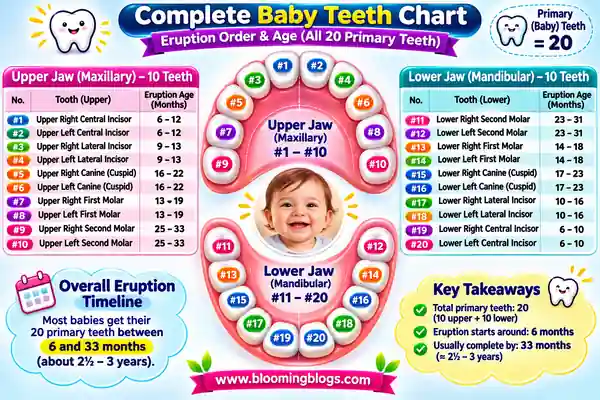
Complete Master Baby Teething Chart (All 20 Primary Teeth)
Here is your complete newborn teeth chart and baby teething age chart covering every single primary tooth from 6 months to 33 months, including when those same teeth eventually fall out:
| Tooth Name (Anatomical) | Jaw Location (Upper / Lower) | Typical Eruption Age (Coming In) | Typical Shedding Age (Falling Out) | Primary Function in Baby’s Mouth |
| Lower Central Incisors (2 teeth) | Bottom Front (Mandibular) | 6 – 10 months | 6 – 7 years | Biting and shearing soft foods; first teeth to come in |
| Upper Central Incisors (2 teeth) | Top Front (Maxillary) | 8 – 12 months | 6 – 7 years | Biting food; shapes the classic “bunny tooth” toddler grin |
| Upper Lateral Incisors (2 teeth) | Top Front Sides (flanking center) | 9 – 13 months | 7 – 8 years | Cutting and slicing food; fills out the top four teeth |
| Lower Lateral Incisors (2 teeth) | Bottom Front Sides (flanking center) | 10 – 16 months | 7 – 8 years | Assists bottom front teeth in biting and tongue guidance |
| Upper First Molars (2 teeth) | Top Back (behind canine gap) | 13 – 19 months | 9 – 11 years | Grinding and mashing solid foods; leaves a gap for canines |
| Lower First Molars (2 teeth) | Bottom Back (behind canine gap) | 14 – 18 months | 9 – 11 years | Crushing food; often causes noticeable gum swelling |
| Upper Canines / Cuspids (2 teeth) | Top Corners (between lateral & molar) | 16 – 22 months | 10 – 12 years | Tearing firmer textures (meat, fibrous fruits); “eyeteeth” |
| Lower Canines / Cuspids (2 teeth) | Bottom Corners (between lateral & molar) | 17 – 23 months | 9 – 12 years | Anchors the bite corner and guides jaw alignment |
| Lower Second Molars (2 teeth) | Very Back Bottom | 23 – 31 months | 10 – 12 years | Heavy-duty chewing; completes the bottom 10-tooth arch |
| Upper Second Molars (2 teeth) | Very Back Top | 25 – 33 months | 10 – 12 years | Heavy-duty chewing; completes the full 20-tooth milk set |
Anatomy of Your Baby’s Mouth: Full Diagram of Total Teeth, Jaws, and Names
Understanding the map of your child’s mouth makes it much easier to spot where the next tooth is hiding when your baby is fussy!
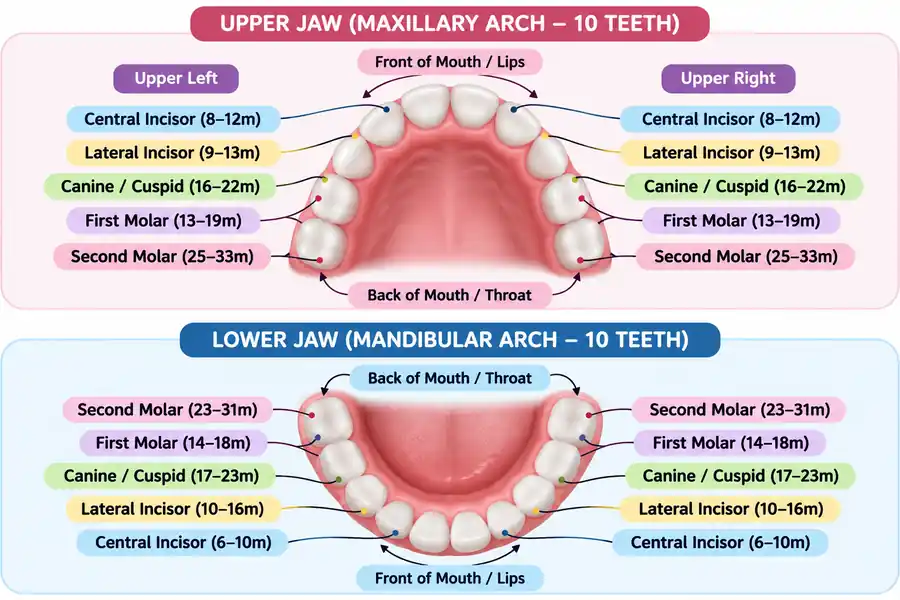
Milk Teeth Count: How Many Baby Teeth Do Humans Get?
The total milk teeth count (also called primary teeth, deciduous teeth, or baby teeth) is 20 teeth in total:
- 10 teeth in the Upper Jaw (Maxillary Arch)
- 10 teeth in the Lower Jaw (Mandibular Arch)
Each side of each jaw (Upper Right, Upper Left, Lower Right, Lower Left) is a mirror image containing 5 specific teeth:
- Central Incisor (front center tooth)
- Lateral Incisor (second tooth from center)
- Canine / Cuspid (pointed corner tooth)
- First Molar (first flat chewing tooth)
- Second Molar (back flat chewing tooth)
(Notice what is missing in babies? Babies do not have premolars/bicuspids or wisdom teeth! Those only appear later as part of the 32-tooth permanent adult set.)
Anatomical Jaw Map (Upper & Lower Arches)
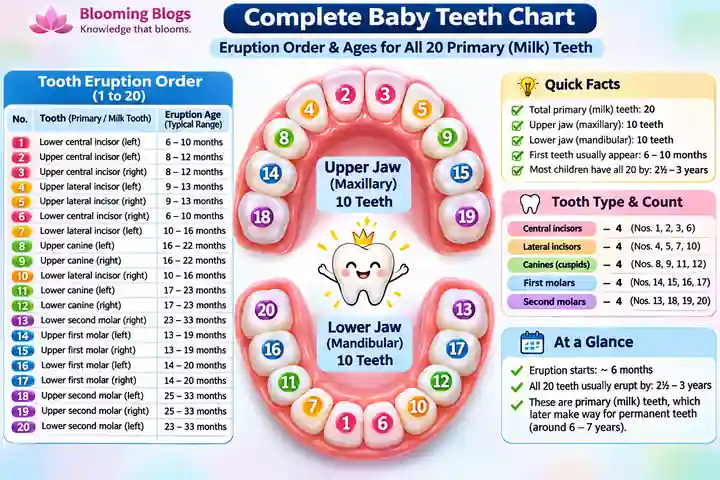
Which Baby Teeth Come In First?
Most babies get their first teeth between 6 and 10 months. However, the exact timing varies from child to child.
Pediatric dentists often use the “Rule of 4” as a rough developmental guide. It suggests that approximately four new teeth may appear during each six-month period after the first six months of life. However, this is only a general guideline, not a strict rule.
Here is the typical baby teeth coming-in order, from the first lower front teeth to the final second molars.
1st Stage: Bottom Two Front Teeth (Lower Central Incisors — 6 to 10 Months)
These are usually the first teeth to come in. Their thin, chisel-shaped edges help them emerge through the gums. As a result, the lower central incisors typically appear before the other baby teeth.
2nd Stage: Top Two Front Teeth (Upper Central Incisors — 8 to 12 Months)
Next, the upper central incisors usually appear. They often emerge 4 to 8 weeks after the lower front teeth. Together, these teeth create your baby’s adorable bunny-tooth smile.
3rd Stage: Top Side Teeth (Upper Lateral Incisors — 9 to 13 Months)
The two upper lateral incisors usually come in next. They appear beside the upper central incisors. Consequently, your baby develops four visible front teeth along the upper jaw.
4th Stage: Bottom Side Teeth (Lower Lateral Incisors — 10 to 16 Months)
After the upper side teeth, the lower lateral incisors begin to emerge. These teeth sit beside the lower central incisors. At this stage, your baby may have four front teeth on each jaw, making eight teeth in total.
5th Stage: First Molars (Upper and Lower First Molars — 13 to 19 Months)
This stage often surprises parents! Instead of filling the gaps beside the front teeth, the first molars emerge further back in the mouth. These broad teeth help toddlers grind and mash solid foods as their diet becomes more varied.
6th Stage: Pointed Canines or Cuspids (Upper and Lower Canines — 16 to 23 Months)
Next come the pointed canine teeth. They emerge between the lateral incisors and first molars. Upper canines are also known as “eyeteeth” because of their anatomical position beneath the eye sockets.
7th Stage: Two-Year Molars (Lower and Upper Second Molars — 23 to 33 Months)
Finally, the second molars appear at the very back of the mouth. The lower second molars typically erupt first, followed by the upper second molars. These teeth complete your child’s set of 20 primary baby teeth, usually by 33 months of age.
Milestone Tooth Counts: How Many Teeth Should My Baby Have?
Parents love clear milestones, so here is what pediatric dentists generally observe (with plenty of room for healthy variation):
- How many teeth should an 8 month old have? Most 8-month-olds have 2 to 4 teeth (typically the two lower central incisors, and sometimes the two upper central incisors just peeking through). Having 0 teeth at 8 months is still completely normal!
- How many teeth should a 12 month old have? By their first birthday, babies typically have 4 to 8 teeth (the four top incisors and four bottom incisors).
- How many teeth should a 14 month old have? A 14-month-old toddler usually has 8 to 12 teeth—all 8 front incisors plus the first set of upper and/or lower molars starting to break through.
- How many teeth should a 24 month old have? By age 2, most toddlers have 16 to 20 teeth.
Baby Teeth Coming In Out of Order: Should You Worry?
What if your baby gets their top lateral incisors (vampire fangs!) before their top center teeth, or cuts a bottom side tooth first? Baby teeth coming in out of order happens all the time—and in 99% of cases, it is completely harmless. Genetic variation in gum thickness or tooth bud alignment can cause a neighbor tooth to win the race to the surface. As long as all 20 teeth eventually arrive by around age 3 and appear reasonably symmetrical, pediatric dentists consider out-of-order eruption a quirky normal variation.
Signs of Teething & Infant Teething Symptoms (Month-by-Month Guide)
One of the hardest parts of parenting is decoding whether your baby is fussy because of first tooth coming in pain—or because of a growth spurt, sleep regression, ear infection, or stomach bug.
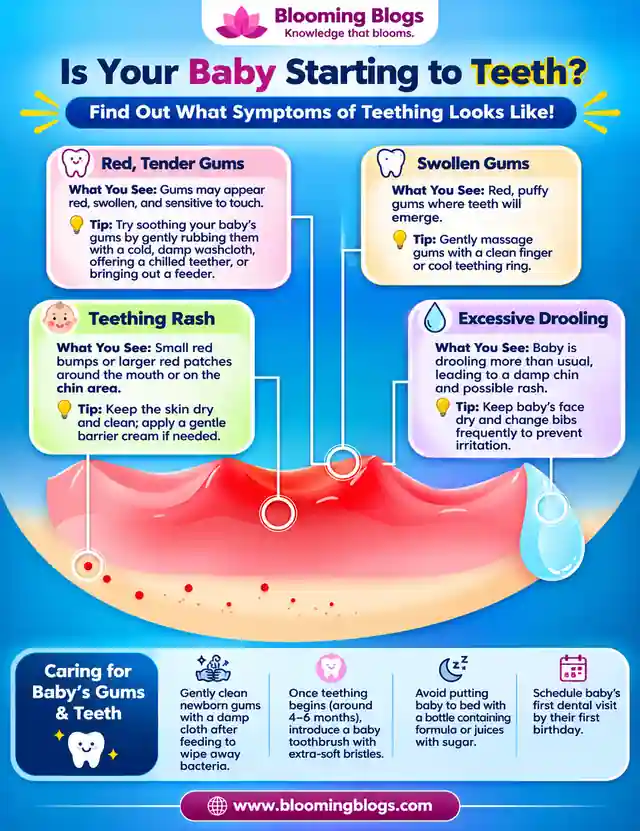
What Are 5 Symptoms That a Baby Is Teething?
When pediatricians describe classic infant teething symptoms, they focus on localized mouth and gum signs rather than whole-body illness:
- Excessive drooling (sialorrhea): Around 3 to 4 months, salivary glands kick into overdrive, soaking shirts and sometimes causing a mild red “drool rash” on the chin, cheeks, and neck.
- Relentless chewing and gnawing: Babies apply counter-pressure to throbbing gums by chewing on fingers, fists, crib rails, burp cloths, and toys.
- Swollen, red, or bulging gums: Looking inside your baby’s mouth, you may see a puffy, tender gum ridge or a faint bluish bubble (an eruption hematoma, which is harmless and resolves once the tooth breaks through).
- Irritability, fussiness, and disrupted sleep: Gum discomfort often feels worse at night when there are fewer distractions and lying flat increases blood flow (and pressure) to the head and gums.
- Ear pulling and cheek rubbing: Because the gums, jaw, and ear canal share the same sensory nerve pathway (the trigeminal nerve), dull gum ache frequently radiates toward the jaw and ear.
How Painful Is a Baby’s First Tooth?
Parents always ask, “How painful is a baby’s first tooth?” The honest answer is that teething ranges from barely noticeable to moderately uncomfortable—usually feeling like a dull, throbbing pressure beneath the gums rather than sharp agony. Interestingly, the 4-day teething window is well documented in pediatric research: discomfort peaks in the 3 to 4 days right before the tooth slices through the gum surface, and drops dramatically the exact day the white edge breaks through!
Once a Baby Tooth Breaks Through, How Long Does It Take to Come Up?
Once you feel that sharp little white ridge poking through the gumline, the hardest part is over! It typically takes 1 to 2 weeks for the crown of the tooth to fully emerge into its visible position, though the root beneath the gums continues growing and strengthening for several months afterward.
Age-Specific Teething Questions Answered
When Does Newborn Start Teething & Can a 2 Month Old Be Teething?
If you are searching when does newborn start teething, signs of teething 2 months, or can a 2 month old be teething, here is what is actually happening:
- At 2 months old, true tooth eruption is rare (though possible in early teethers).
- However, between 2 and 3 months, babies naturally discover their hands and begin shoving their fists into their mouths as a normal developmental milestone, while their salivary glands simultaneously mature—creating buckets of drool! Many parents mistake this normal 2-month oral exploration phase for active teething.
Baby First Tooth Symptoms at 3 Months & 4 Months
- Baby first tooth symptoms 3 months: Teeth begin shifting upward inside the jawbone around 3 months, causing occasional gum itching and fist-chewing weeks or months before a tooth actually pierces the surface.
- Symptoms of teething at 4 months / Is 4 months too early for the first tooth? No, 4 months is not too early! While 6 months is the average age for a baby’s first tooth, cutting a bottom central incisor at 4 months is well within the normal pediatric range.
Signs of Teething in Breastfed Babies
If you are nursing, signs of teething in breastfed babies can look very specific:
- Unlatching and re-latching frequently: Suction increases blood flow to swollen gums, which can make nursing feel uncomfortable for a day or two.
- Clamping down or biting at the end of a feed: Babies do not bite while actively swallowing (their tongue covers their lower gums during active nursing). They usually clamp down when they are finished eating or distracted. Gently inserting a clean finger into the corner of their mouth to break suction and firmly saying “No biting” teaches them quickly.
Teething Symptoms vs. Real Illness: Fever, Loose Motion & Ear Pain
This is the single most critical safety section in this entire guide. Countless parents search for baby first tooth symptoms fever or baby first tooth symptoms loose motion, because old wives’ tales blame teething for everything.
Here is the clear consensus from the American Academy of Pediatrics (AAP):
- Teething does NOT cause a high fever. Swollen gums may cause a tiny, temporary bump in body temperature (around 99°F to 100.0°F / 37.2°C to 37.8°C), never a true fever of 100.4°F (38°C) or higher.
- Teething does NOT cause true diarrhea (loose motion). Swallowing extra saliva can make your baby’s poop slightly softer or more acidic (leading to mild diaper rash), but watery, frequent diarrhea is caused by a viral or bacterial stomach bug—not teeth.
- Why do babies get sick around 6 months anyway? Around 6 months of age—the exact time infant teething starts—passive maternal antibodies passed through the placenta during pregnancy wear off, and babies put every object they touch into their mouths! That overlap makes illness and teething happen simultaneously by coincidence.
| Symptom | True Infant Teething | Possible Illness / Infection (Call Pediatrician) |
| Temperature | Normal or mild warmth under 100.4°F (38°C) | Fever of 100.4°F (38°C) or higher |
| Stool / Poop | Normal or slightly looser from swallowed drool | Watery diarrhea, mucus/blood in stool, or vomiting |
| Ear Symptoms | Occasional ear tugging without fever or cold | Ear tugging plus fever, cold/congestion, or crying when lying flat |
| Feeding | Briefly fussy when latching, still stays hydrated | Refusing all fluids, fewer than 4–6 wet diapers in 24 hours |
| Skin / Rash | Mild red rash on chin/cheeks from drool | Widespread body rash, hives, or blisters |
Safe Teething Remedies & Nighttime Relief by Age
When your baby is miserable, you want safe, evidence-based teething baby remedies that soothe sore gums without risking side effects.
1. Teething Relief for a 2 Month Old (and 3–4 Month Olds)
Because young infants under 6 months cannot hold heavy toys easily and should not receive unprescribed medications:
- Clean Chilled Washcloth: Wet a clean soft cotton washcloth, wring it out, twist one corner, and chill it in the refrigerator (not the freezer!) for 20 minutes. Hold it so your baby can safely gum the cool, textured fabric.
- Clean Finger Gum Massage: Wash your hands thoroughly and gently rub your baby’s swollen gum ridge in small circles with your clean index finger for 1 to 2 minutes. Counter-pressure works wonders.
- Drool Barrier Cream: Apply a thin layer of pure petroleum jelly or lanolin around your baby’s chin and cheeks before naps to prevent painful chapping.
2. Teething Remedies for an 8 Month Old (and 6–12 Month Olds)
Once your baby is sitting up, eating solids, and has stronger hand coordination, 8 month old teething remedies expand significantly:
- Solid Silicone or Natural Rubber Teethers: Choose one-piece, BPA-free, phthalate-free food-grade silicone teethers with varied nubs and ridges (like textured rings or molar-reaching stems). Chill them in the fridge—never freeze them solid, as rock-hard frozen plastic can bruise delicate gums.
- Mesh or Silicone Fresh Food Feeders: Fill a silicone feeder with chilled mashed banana, cold cucumber spears, or frozen breastmilk cubes (for babies already started on solids). As the cold food melts, it numbs throbbing gums naturally.
- Chilled Metal Spoon: Gently press the back of a clean, fridge-chilled baby spoon against the inflamed gum spot for instant localized cooling.
3. Home Remedies for Teething Baby at Night
- Keep the bedtime routine predictable: Warm bath, gentle gum massage, feeding, and white noise signal safety and help tired babies settle despite mild gum ache.
- Offer extra comfort feeds: Nursing or bottle-feeding provides natural endorphins and soothing closeness.
- Wipe away pooled drool: Change damp crib sheets or use a breathable fitted sheet protector so wet fabric doesn’t wake your baby up cold.
4. How to Relieve Ear Pain From Teething
When parents ask how to relieve ear pain from teething, remember that the ear itself isn’t infected—the pain is “referred pain” traveling up the jaw nerve from the back molars or canines:
- Treat the gum, and the ear pain fades: Applying a cool washcloth or cold silicone teether directly to the back gum ridge calms the shared nerve pathway within minutes.
- Gentle warm compress outside the ear: Holding a warm (never hot) washcloth gently against the outer jaw and cheek area relaxes tense jaw muscles.
- Rule out an actual ear infection: If ear pulling happens after a runny nose, comes with a fever, or worsens sharply when you lay your baby flat in the crib, have your pediatrician look inside their ears with an otoscope.
Teething Medicines Explained: Homeopathic Remedies (Belladonna Risks), Ayurvedic Care & Pediatric Options
When a baby is crying inconsolably at 2:00 AM with swollen gums, it is completely natural for exhausted parents to reach for a bottle of drops, tablets, or traditional herbal remedies recommended by elders or pharmacies. However, because an infant’s liver, kidneys, and nervous system are still developing, not every “natural” or over-the-counter teething product is safe.
Understanding exactly what goes inside popular homeopathic, Ayurvedic, and pediatric teething medicines empowers you to protect your baby while giving them genuine relief.
1. Homeopathic Teething Medicines: Denton Tablets vs. Denton Syrup & The Belladonna Risk
Homeopathic teething remedies are widely sold over the counter across pharmacies and online stores. Among Indian parents and families worldwide, SBL Denton is one of the most frequently searched and purchased homeopathic teething brands.
What Is Inside SBL Denton Tablets?
Standard SBL Denton Tablets (biochemic 3X trituration tablets) are formulated using seven mineral and plant-based homeopathic preparations:
- Chamomilla vulgaris (3X): Traditionally used in homeopathy for irritability, crankiness, and gum sensitivity.
- Calcarea phosphorica (3X) & Ferrum phosphoricum (3X): Tissue salts marketed to support tooth and bone mineralization and mild inflammation.
- Kali muriaticum (3X) & Kali phosphoricum (3X): Biochemic salts intended to soothe swollen tissues and restlessness.
- Magnesium phosphoricum (3X) & Silicea (3X): Included for mild tummy cramps (colic) and tooth eruption support.
Bio Combination 21 – Teething Troubles
Bio Combination 21 is a homeopathic product marketed for teething troubles. Some parents have reported positive experiences, while others have not noticed any benefits. Responses vary from baby to baby, and results are not guaranteed. Its effectiveness is not scientifically established. Always consult a paediatrician before giving any remedy to your baby.
A Real Parent’s Perspective: Why Biochemic Tablets Are So Widely Trusted
Many parents have relied on biochemic combination tablets like SBL Denton and Bio Combination 21 for generations, finding them to be an absolute lifesaver when a baby is in the thick of teething pain. Millions of families successfully use Denton tablets following the exact dosage instructions printed on the bottle to help their little ones settle comfortably. When giving any remedy, following the manufacturer’s exact label instructions and discussing your routine with your pediatrician ensures safe, reassuring care.
Why Belladonna in Homeopathic Teething Products Is Dangerous
Belladonna comes from Atropa belladonna—a toxic plant famously known as “deadly nightshade.” While homeopathic manufacturers dilute Belladonna to ease gum redness and throbbing pain, major medical and regulatory bodies including the U.S. Food & Drug Administration (FDA) and the National Institutes of Health (NCCIH) have issued urgent safety warnings against giving Belladonna-containing teething products to infants:
- Unpredictable & Inconsistent Toxicity: Laboratory testing by the FDA on commercial homeopathic teething tablets and liquids revealed that actual Belladonna levels varied wildly from bottle to bottle—sometimes far exceeding the amount claimed on the label.
- Severe Neurological & Physical Side Effects: Infants are uniquely vulnerable to anticholinergic poisoning from Belladonna. Adverse event reports submitted to regulators have linked Belladonna teething products to:
- Seizures and tremors
- Difficulty breathing or slowed respiration
- Extreme lethargy, excessive sleepiness, or muscle weakness
- Flushed red skin, dilated pupils, agitation, constipation, and difficulty urinating
- Lack of Clinical Proof & Choking Risk with Tablets: Both the FDA and the AAP note that homeopathic teething tablets and gels have no proven clinical efficacy beyond placebo, and hard or slow-dissolving tablets can pose an aspiration risk in young infants who cannot swallow solids properly.
Parent Safety Rule for Homeopathy: Always read the active ingredient panel carefully. While biochemic tissue-salt tablets like Denton are widely and successfully used per package instructions, never give your baby any teething syrup, drop, or tablet containing Belladonna (Atropa belladonna) or Aconitum without explicit evaluation by a licensed pediatric physician. Note: Product formulations can vary by country and batch—always check the active ingredients printed on your specific bottle or blister pack with your pediatrician or pharmacist before use.
2. Traditional Herbal Teething Remedies for Newborn Baby Teeth
In Indian households and holistic parenting circles, Ayurvedic teething remedies (Dantodbheda care in classical Ayurveda) have been passed down for generations. However, traditional remedies are not automatically safe for infants.
While certain gentle, food-grade herbs may soothe inflamed gums, modern pediatricians urge caution. This is because babies have immature digestive and liver pathways. Therefore, parents should check the safety of every ingredient before using herbal preparations.
1. Mulethi (Licorice Root – Glycyrrhiza glabra)
In traditional practices, a clean, peeled stick of dried mulethi is sometimes given to older infants to gnaw on. Its natural sweetness and anti-inflammatory properties are among the reasons for its traditional use.
Pediatric Safety Verdict: Use Strict Caution
However, whole licorice roots can splinter or become choking hazards once softened. Additionally, excessive glycyrrhizin in licorice can affect an infant’s blood pressure and potassium levels. Only consider its use under qualified professional supervision. Never leave a baby unattended with a chewing stick.
2. Clove Oil (Laung – Eugenol)
Traditionally, diluted clove oil is occasionally dabbed onto sore gums for its natural numbing effect.
Pediatric Safety Verdict: Avoid Undiluted Use
However, clove oil requires particular caution around infants. According to Tennessee Poison Center / Vanderbilt Medical Center, pure clove oil contains approximately 60%–90% eugenol. This concentrated ingredient can burn delicate gum tissue, trigger allergic reactions, or cause liver toxicity if swallowed.
Therefore, do not apply undiluted clove oil to a baby’s gums.
3. Vacha (Sweet Flag – Acorus calamus) and Honey Pastes
Some traditional preparations involve rubbing herbs on a stone and mixing them with honey or ghee. Families may apply these pastes to the baby’s gums.
Pediatric Safety Verdict: Avoid in Infants
Most importantly, never give honey to a baby under 12 months. According to the Centers for Disease Control and Prevention (CDC), honey can cause infant botulism, a serious illness.
Additionally, Vacha contains beta-asarone, which raises safety concerns. Avoid applying traditional Vacha and honey pastes to an infant’s gums.
4. Commercial Ayurvedic Teething Syrups and Drops
Products such as Balamrit, Janam Ghutti and herbal gripe waters are marketed to ease teething discomfort, colic, loose stools and irritability.
Pediatric Safety Verdict: Consult a Pediatrician First
However, commercial herbal preparations can vary considerably in their ingredients and concentrations. Some may contain added sugar, alcohol or ingredients that are unsuitable for infants.
Therefore, check the complete ingredient list, manufacturer information and quality standards. Consult your pediatrician before giving any herbal syrup or drops to your baby.
5. Chilled Chamomile / Fennel (Saunf) Washcloth
Some traditional approaches use chamomile or fennel infusions for gentle gum comfort. A clean cotton washcloth may be dipped in a cooled, weak, unsweetened infusion and refrigerated before supervised use.
Pediatric Safety Verdict: Prefer Plain Chilled Water
For a safer alternative, use a clean washcloth dampened with cool water. Chill it in the refrigerator, not the freezer, and let your baby gently chew it under direct supervision.
Although mild herbal infusions are sometimes used traditionally, their safety and effectiveness for infant teething are not well established. Also, consider possible plant allergies before using them. Never leave a washcloth or other chewing material with an unattended baby.
Traditional Remedy, Their Uses and Safety Verdict :
| Traditional / Ayurvedic Remedy | How It Is Used | Pediatric & Safety Verdict |
| Mulethi (Licorice Root / Glycyrrhiza glabra) | A clean, peeled stick of dried mulethi is sometimes given to older infants to gnaw on for its natural sweetness and anti-inflammatory properties. | Use Strict Caution: Whole roots can splinter or become a choking hazard once softened, and excessive glycyrrhizin in licorice can affect infant blood pressure and potassium levels. Only use under qualified supervision and never leave baby unattended. |
| Clove Oil (Laung / Eugenol) | Diluted clove oil is occasionally dabbed onto sore gums for natural numbing. | Avoid Undiluted Use: Per Tennessee Poison Center / Vanderbilt Medical Center, pure clove oil contains 60%–90% eugenol, which can burn delicate infant gum tissue, trigger allergic reactions, or cause liver toxicity if swallowed. |
| Vacha (Acorus calamus / Sweet Flag) & Honey Pastes | Traditional pastes made by rubbing herbs on a stone with honey or ghee are sometimes applied to gums. | Strictly Unsafe Under 12 Months: Per the Centers for Disease Control and Prevention (CDC), never give honey to a baby under 1 year old due to the risk of infant botulism. Additionally, Vacha contains beta-asarone, which pediatric safety authorities advise against in infants. |
| Commercial Ayurvedic Teething Syrups / Drops (e.g., Balamrit, Janam Ghutti, Herbal Gripe Waters) | Multi-herb tonics marketed to ease teething colic, loose stools, and irritability. | Consult Pediatrician First: Many commercial herbal tonics contain high amounts of added sugar, alcohol traces, or unregulated heavy-metal/herb concentrations. Always verify batch purity and pediatric approval. |
| Gentle Chilled Chamomile or Fennel (Saunf) Cloth | Dipping a clean cotton washcloth in cooled, weak, unsweetened chamomile or fennel infusion and chilling it in the fridge for baby to chew. | Generally Safe (6+ Months): For babies already eating solids (and with no ragweed/plant allergies), chewing on a chilled washcloth dampened with cooled boiled water or mild unsweetened infusion offers safe, sugar-free gum relief. |
3. Pediatrician-Approved Conventional Teething Medications (When Non-Drug Relief Isn’t Enough)
When chilled washcloths, silicone teethers, and gum massages are not enough—especially during painful molar eruption at night—board-certified pediatricians rely on two well-studied, weight-dosed medications:
- Infant Acetaminophen (Paracetamol):
- Minimum Age: Can be used in infants 2 to 3 months and older only after your pediatrician confirms the exact weight-based dose.
- How It Helps: Reduces dull gum pain and mild irritability without upsetting the stomach.
- Critical Warning: Never exceed the maximum daily dose (no more than 5 doses in 24 hours), and double-check that you are not giving another multi-symptom cold medicine containing acetaminophen/paracetamol at the same time.
- Infant Ibuprofen:
- Minimum Age: Strictly for babies 6 months of age and older (never give ibuprofen to infants under 6 months).
- How It Helps: Because ibuprofen is an anti-inflammatory medication, it directly reduces gum swelling and lasts longer (6 to 8 hours), making it especially helpful for nighttime molar pain. Give with a little milk or food to protect the tummy.
- Medications to Strictly Avoid:
- Benzocaine / Lidocaine Topical Gels (e.g., Orajel, Anbesol): Linked to methemoglobinemia (a dangerous condition that reduces oxygen in the blood) and washes off the gums within minutes anyway.
- Aspirin or Aspirin-Containing Rubs: Never give aspirin to infants or children due to the risk of Reye’s syndrome, a rare but life-threatening condition affecting the liver and brain.
Side-by-Side Comparison: Teething Medicines & Safety Ratings
| Category / Product | Key Ingredients | Pediatric & Regulatory Safety Status | Key Takeaway for Parents |
| Denton Tablets (SBL) & Denton Syrup | Chamomilla 3X, Calcarea phos 3X, Ferrum phos 3X, Kali mur 3X, Kali phos 3X, Mag phos 3X, Silicea 3X | Widely Used / Follow Bottle Instructions | Does not list Belladonna; many families successfully use biochemic tablets following bottle directions, though clinical trial data is limited. |
| Belladonna Drops | Contains Belladonna 3X, Aconitum 3X, Kreosotum 3X, Chamomilla | High Caution / FDA Warning Against Belladonna | Belladonna (deadly nightshade) carries serious toxicity risks in infants; avoid unless explicitly prescribed and monitored by a qualified physician. |
| Ayurvedic Herbal Pastes / Ghutti | Mulethi, Vacha, Clove, Honey, or Multi-Herb Extracts | Mixed — Several Ingredients Unsafe Under Age 1 | Strictly avoid honey (<12 months), undiluted clove oil, and sugary/unregulated tonics. |
| Infant Acetaminophen / Paracetamol | Single-ingredient Acetaminophen / Paracetamol | Pediatrician Approved (Weight-Dosed) | Safe, effective pain relief when dosed strictly by your baby’s current weight. |
| Infant Ibuprofen | Single-ingredient Ibuprofen | Pediatrician Approved (6+ Months Only) | Best anti-inflammatory relief for swollen gums and nighttime molar pain in babies 6 months and older. |
Dangerous Teething Products You Must Strictly Avoid
The baby aisle is packed with tempting teething products, yet major pediatric and dental organizations (including the AAP and FDA) warn strongly against several popular items:
- Benzocaine and Lidocaine Numbing Gels: Topical numbing gels wash off gums within minutes due to saliva. Worse, benzocaine can trigger a rare, life-threatening blood oxygen disorder called methemoglobinemia, while lidocaine can cause heart and nervous system toxicity in infants.
- Homeopathic Teething Tablets (Belladonna): Laboratory testing has repeatedly found inconsistent, toxic levels of belladonna (deadly nightshade) in unapproved teething tablets, posing severe risks of breathing trouble and seizures.
- Amber Teething Necklaces and Bracelets: Despite claims that body heat releases pain-relieving succinic acid, zero scientific evidence supports this. Meanwhile, beaded necklaces pose an extreme strangulation and choking hazard if the string breaks.
- Frozen Solid Plastic Teethers: Freezing solid gel or plastic teethers turns them rock-hard, which can bruise delicate gums or crack if bitten. Always chill teethers in the refrigerator, never the freezer.
Caring for Newborn Baby Teeth: Brushing, Fluoride & Dental Visits
Good oral hygiene starts before the very first tooth even breaks the surface! Establishing a gentle routine early makes brushing effortless when your child reaches the stubborn toddler stage.
Step-by-Step Oral Care Timeline
- Before Teeth Appear (0–6 Months): Once a day, wipe your baby’s gums gently with a clean, damp gauze pad or soft infant washcloth after the last evening feed. This removes milk residue and gets your baby used to having their mouth cleaned.
- First Tooth Emerges (6–12 Months): Switch to a soft-bristled infant toothbrush with a tiny head. Use a smear of fluoride toothpaste the size of a single grain of rice twice daily (morning and right before bed).
- Toddler Years (3 Years and Up): Increase the fluoride toothpaste amount to a pea-sized drop once your child learns to spit reliably. Continue brushing for them until around age 7 or 8 when they have the dexterity to tie their own shoelaces.
How to Prevent Baby Bottle Tooth Decay
Never put your baby to bed with a bottle filled with milk, formula, or juice. When your baby sleeps, saliva flow slows down. Consequently, natural sugars in milk pool around their newborn baby teeth, feeding bacteria that dissolve delicate baby tooth enamel and cause painful cavities. If your baby needs a bottle to fall asleep, fill it strictly with plain water.
When to Schedule the First Dental Visit
Both the American Academy of Pediatrics (AAP) and the American Academy of Pediatric Dentistry (AAPD) recommend scheduling your baby’s first dental visit within 6 months of the first tooth erupting, or by their 1st birthday—whichever comes first. Early checkups build positive familiarity and catch minor enamel issues early.
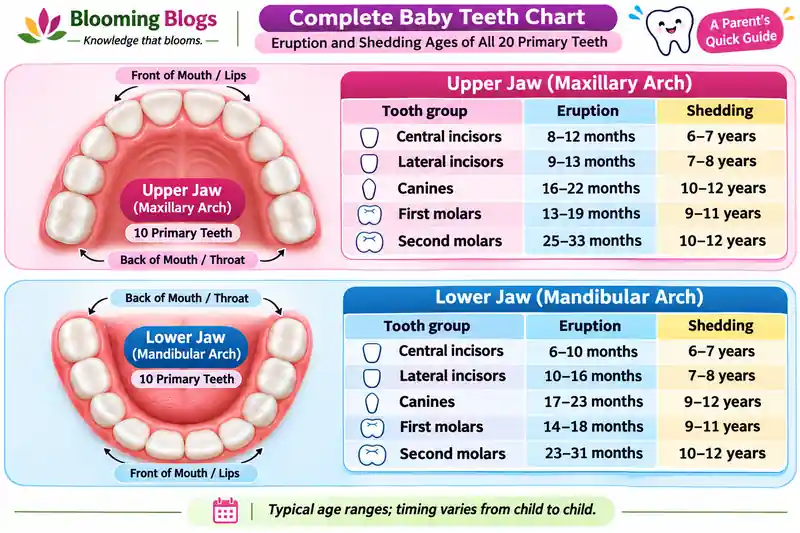
The Complete Order of Milk Teeth Falling Out (Shedding Timeline)
Because you want the full A-to-Z lifecycle of your child’s teeth, let us look ahead to when those twenty milk teeth eventually make way for thirty-two permanent adult teeth. Just like eruption, the order of teeth falling out (exfoliation) follows a neat, predictable schedule!
When Do Baby Milk Teeth Start Falling Out?
Most children lose their very first baby tooth around age 6, though anywhere from age 5 to age 7 is completely normal. Generally, early teethers lose their teeth earlier, while late teethers lose theirs closer to age 7.
The Exact Order That Milk Teeth Fall Out (Ages 6 to 12)
In almost every child, teeth fall out in the exact same order they came in:
- Age 6 – 7 Years: Lower Central Incisors fall out first, closely followed by the Upper Central Incisors. Simultaneously, your child’s permanent 6-year first molars erupt quietly in the very back behind the baby molars—they do not replace any baby teeth!
- Age 7 – 8 Years: Upper and Lower Lateral Incisors loosen and fall out.
- Age 9 – 11 Years: Upper and Lower First Primary Molars shed as permanent premolars push upward beneath them.
- Age 9 – 12 Years: Lower Canines typically fall out slightly before Upper Canines (around age 10–12).
- Age 10 – 12 Years: Upper and Lower Second Primary Molars are the final baby teeth to fall out. Around age 12 to 13, permanent 12-year second molars erupt behind them.
(Note: Around age 10, children’s jaws expand significantly as premolars and canines prepare to replace baby molars—which is why parents often search for 10 year molars during this active transition phase!)
Comparison Chart: Safe vs. Unsafe Teething Products
Choosing safe teething gear matters—especially since the FDA and AAP warn against several popular-looking products sold online.
| Teething Product Type | Best Age Range | Safety Rating & Pediatric Verdict | Pros | Cons |
| 100% Food-Grade Solid Silicone Teether | 3 – 24+ months | Top Recommended (AAP Safe) | Non-toxic, easy to sanitize, lightweight, reaches back molars | Can collect lint if dropped on floors |
| Chilled Cotton Washcloth | 2 – 18 months | Top Recommended (Budget Safe) | Free, soft on delicate gums, absorbs drool while chewing | Warms up quickly; needs frequent washing |
| Silicone Fresh Food Feeder | 6 – 18 months | Recommended (With Supervision) | Combines cold therapy with nutritious fruit/breastmilk | Must be disassembled and cleaned carefully after every use |
| Water-Filled Plastic Teething Rings | 4 – 12 months | Use With Caution | Stays cool in the fridge | Can puncture if baby already has sharp front teeth; cannot be boiled |
| Amber Teething Necklaces / Bracelets | NONE | UNSAFE — Strictly Avoid (FDA/AAP Warning) | None scientifically proven | Severe choking and strangulation hazard; zero evidence of pain relief |
| Benzocaine / Lidocaine Numbing Gels | NONE | UNSAFE — Strictly Avoid (FDA Warning) | None recommended for infants | Can cause methemoglobinemia (a life-threatening blood oxygen disorder) and washes off in seconds |
Neem Wood Teethers for Teething Babies: Benefits, Care & Neem Wood vs. Silicone Comparison
For parents looking for a plastic-free, traditional soothing option, neem wood teethers have become a beloved staple in modern nurseries. Specifically, these teethers are crafted from naturally aged neem hardwood (Azadirachta indica), combining centuries-old wellness with Montessori-inspired design. However, knowing when and how to introduce them is key to keeping your baby safe.
Key Benefits of Neem Wood Teethers
- Firm Counter-Pressure for Sore Gums: First, the dense, smooth hardwood surface provides steady resistance against swollen gums right before a tooth slices through.
- Naturally Antibacterial & Anti-Fungal: Additionally, neem wood contains natural antimicrobial compounds, offering a cleaner alternative to painted plastic toys.
- 100% Chemical-Free & Biodegradable: Furthermore, quality neem wood teethers are hand-sanded to a silky finish using zero paints, synthetic varnishes, BPA, or toxic glues.
- Supports Early Motor Skills: Finally, lightweight, open-loop shapes—such as thin rings or dumbbells—encourage your baby’s palmar grasp and hand-eye coordination.
How to Choose a Neem Wood Teether for 3–4 Month Olds
If you are introducing a wooden teether to a younger infant around 3 to 4 months old, keep these practical guidelines in mind:
- Pick Thin, Open-Loop Shapes First: At 3 months, babies are just learning to bring objects to their mouths. Therefore, look for thin open rings or slim dumbbell handles (around 0.8 cm to 1 cm thick and under 40 grams) that tiny fingers can easily wrap around.
- Respect Your Baby’s Gum Sensitivity: Solid wood feels much firmer than skin or silicone. As a result, if your 3-month-old rejects hard wood at first, simply set it aside and reintroduce it around 5 or 6 months when deeper teething pressure kicks in.
Essential Safety Tips During Teether Play
Because young babies are still building physical coordination, close supervision is vital:
- Always Supervise Every Session: Specifically, 3- and 4-month-olds still have jerky arm movements and can accidentally bump their face while waving a rigid toy. Consequently, you should always stay within arm’s reach during teether time.
- Inspect Before Every Use: Similarly, check the wood grain regularly for any rough spots, cracks, or wear, and retire the teether immediately if the surface ever splinters.
Neem Wood Cleaning & Care Rules (Do Not Boil!)
Wooden teethers require completely different care than plastic or silicone toys. Therefore, follow these three simple steps:
- Wipe Clean Only: First, after each session, wipe the teether with a clean, slightly damp cloth (or a cloth dipped in cooled boiled water) and pat dry immediately.
- Never Soak, Boil, or Steam-Sterilize: Above all, avoid submerging neem wood in water, boiling it, or placing it in a steam sterilizer, because excess heat and moisture cause wood fibers to swell, crack, or splinter.
- Air-Dry Thoroughly: Afterwards, let your wooden teether air-dry completely in a shaded, well-ventilated spot before storing it, since direct sunlight can dry out natural wood.
Neem Wood vs. Soft Food-Grade Silicone Teethers: Which Is Better?
Many parents wonder whether to buy a neem wood teether or a soft food-grade silicone teether. In fact, each shines at a different stage, so keeping one of each in your diaper bag covers every mood!
| Feature | Neem Wood Teethers | Soft Food-Grade Silicone Teethers |
| Texture & Gum Feel | Hard and rigid. Delivers strong counter-pressure for throbbing gums. | Soft, flexible, and chewy. Gentle on tender outer gums and mimics skin texture. |
| Safety for Young Infants (3–4 Months) | Requires close supervision. Babies with developing motor control can bump their face with firm wood. | Forgiving and lightweight. Soft edges will not bruise or hurt if dropped on the face. |
| Hygiene & Sterilization | Surface wipe only. Naturally antibacterial, yet cannot be boiled, soaked, or steam-sterilized. | Fully sterilizable. Non-porous and safe for boiling, steam sterilizers, and dishwashers. |
| Cooling Relief | Room temperature only. Do not chill in the fridge or freezer due to moisture absorption. | Chillable. Can be chilled in the refrigerator (never freezer) for extra numbing comfort. |
| Durability & Wear | Long-lasting with proper care. Can crack or splinter if exposed to excess water. | Unbreakable. Will not chip or splinter; choose 100% certified BPA- and phthalate-free silicone. |
| Eco-Friendliness | 100% biodegradable. Natural, sustainable hardwood with zero plastic. | Synthetic material. Non-biodegradable, though long-lasting and reusable. |
*Disclaimer – Always supervise teething babies, inspect teethers for cracks or wear before use, and follow age safety labels.
Which Teether Should You Choose for Your Baby?
- Start with Soft Food-Grade Silicone if: Your baby is 3 to 4 months old, has uncoordinated arm movements, or loves chilled relief from the fridge. Additionally, silicone is ideal if your baby drops toys frequently on the floor where boiling is a must.
- Choose Neem Wood if: Your baby loves biting down hard on firm surfaces and you want a 100% plastic-free, naturally antimicrobial option. However, remember to supervise every chewing session closely.
- Try a Hybrid Teether for the Best of Both Worlds: Meanwhile, combo teethers that pair a smooth neem wood gripping ring with textured silicone chewing ears give your baby easy grasping and soft gum relief in one toy.
Practical Tips, Hacks & Common Mistakes to Avoid
Helpful Teething Tips
- Keep a “Teether Rotation” in the Fridge: Keep 2 to 3 clean silicone teethers in a sealed zip-top bag inside your refrigerator door so you always have a cold one ready the second fussiness strikes.
- Start Brushing From Tooth #1: The very day that first tiny lower incisor pokes through, start brushing twice daily with a soft baby toothbrush and a tiny smear (the size of a grain of rice) of fluoride toothpaste.
- Schedule the First Dental Visit by Age 1: Both the AAP and the American Academy of Pediatric Dentistry (AAPD) recommend your baby’s first dental checkup within 6 months of their first tooth appearing, or by their first birthday—whichever comes first.
Did You Know? 💡
- 💡 Baby teeth are actually whiter than adult teeth: Primary milk teeth have thinner enamel and less dentin density, which gives them their bright, milky-white appearance—and is literally why they are called “milk teeth.”
- 💡 Tooth enamel forms before birth: Your baby’s primary tooth enamel starts mineralizing during the second trimester of pregnancy, which is why maternal nutrition, calcium, and vitamin D during pregnancy support strong baby teeth.
- 💡 Baby teeth act as natural braces: Even though primary teeth eventually fall out, they hold open the exact space needed in the jawbone for larger permanent adult teeth. Losing a baby tooth too early to decay can cause adult teeth to crowd or come in crooked.
Smart Parent Hacks
- The Frozen Breastmilk / Formula Popsicle Hack: Pour a small amount of expressed breastmilk or prepared formula into a clean ice cube tray, pop a frozen cube into a silicone mesh feeder, and let your 6+ month old gnaw on it during a tough teething evening.
- The Burp-Cloth Bib Swap: Instead of changing your baby’s outfit five times a day from heavy teething drool, layer soft, waterproof-backed bandana bibs over their shirt and swap the bib every couple of hours.
- The Pre-Feed Gum Cool-Down: If your baby is refusing to nurse or take a bottle because their gums ache, let them chew on a fridge-chilled washcloth for 3 minutes right before feeding. It dulls the gum throbbing just long enough for them to latch comfortably and get a full feed.
Common Mistakes to Avoid
- Putting Teethers in the Freezer: Frozen teethers become as hard as ice cubes and can actually cause minor frostbite or bruising to sensitive infant gums. Always chill in the refrigerator, never the freezer.
- Rubbing Alcohol, Honey, or Numbing Gels on Gums: Never rub whiskey/brandy on a baby’s gums (alcohol is toxic to infants), never give honey to a baby under 12 months (risk of infant botulism), and never use over-the-counter benzocaine gels.
- Dismissing a High Fever as “Just Teething”: Assuming a 101°F fever or watery diarrhea is caused by teeth can delay treatment for a real ear infection, UTI, or viral illness.
- Putting Baby to Bed With a Milk or Juice Bottle: Once teeth emerge, pooling milk or juice in the mouth overnight feeds cavity-causing bacteria and leads to severe early childhood tooth decay.
Frequently Asked Questions (FAQs) About Newborn Baby Teeth & Teething
1. When does a newborn start teething?
Most babies start active teething between 4 and 7 months of age, with the average first tooth erupting around 6 months. However, teeth begin shifting inside the gums around 3 months, and in rare cases (1 in 2,000–3,500 births), babies are born with natal teeth or cut neonatal teeth in their first 30 days.
2. What is the average age for a baby’s first tooth?
The average age for a baby’s first tooth is 6 months, though anything between 4 months and 12 months is considered completely normal by pediatricians.
3. Which are the first teeth to come in?
The lower central incisors (the two bottom front teeth) are almost always the first teeth to come in, usually between 6 and 10 months of age.
4. When do upper teeth come in?
The upper central incisors (the two top front teeth) typically come in between 8 and 12 months, usually about 1 to 2 months after the bottom two front teeth appear.
5. Is 4 months too early for the first tooth?
No, 4 months is not too early! While slightly ahead of the 6-month average, cutting a first tooth at 4 months is completely normal and often runs in families.
6. Can a 2 month old be teething?
True tooth eruption at 2 months is uncommon, though possible in early teethers. More often, 2-month-olds begin drooling heavily and chewing their hands as a normal developmental milestone rather than active tooth eruption.
7. What are 5 symptoms that a baby is teething?
The five most reliable signs of teething are: (1) excessive drooling, (2) constant chewing or gnawing on hands and objects, (3) visibly red, swollen, or tender gums, (4) mild fussiness or disrupted sleep, and (5) rubbing cheeks or tugging at ears due to referred jaw nerve pain.
8. How painful is a baby’s first tooth?
Most babies experience mild-to-moderate dull gum pressure rather than severe pain. Discomfort peaks in the 3 to 4 days right before the tooth slices through the gum surface and disappears once the tooth breaks through.
9. Once a baby tooth breaks through, how long does it take to come up?
Once the sharp white tip pierces the gumline, it usually takes 1 to 2 weeks for the full crown of the tooth to emerge into place.
10. How many teeth should an 8 month old have?
An 8-month-old typically has 2 to 4 teeth (the bottom two front teeth, and sometimes the top two front teeth), though having 0 teeth at 8 months is still normal.
11. How many teeth should a 14 month old have?
A 14-month-old toddler usually has 8 to 12 teeth—all 8 upper and lower front incisors plus the first set of molars beginning to emerge.
12. What is a baby born with teeth called?
Teeth present at birth are called natal teeth, while teeth that erupt during the first 30 days of life are called neonatal teeth.
13. Are humans born with teeth?
Every human baby is born with all 20 primary teeth hidden beneath the gums inside their jawbones, though only 1 in 2,000–3,500 babies is born with an erupted tooth visible at birth.
14. Can you be born with a full set of teeth?
Being born with a full set of 20 erupted teeth is extraordinarily rare and almost never occurs in medical history; babies born with teeth almost always have just one or two bottom front teeth.
15. Should natal teeth be removed?
Only if a pediatric dentist determines the tooth is extremely loose (posing a choking/aspiration risk) or is an extra (supernumerary) tooth. Over 90% of natal teeth are true primary teeth and are kept in place if stable.
16. What is Riga-Fede disease in newborns with teeth?
Riga-Fede disease is a benign ulcer on the underside of a newborn’s tongue caused by the tongue repeatedly rubbing against the sharp edge of a lower natal tooth during nursing or bottle-feeding. Smoothing the tooth edge usually heals it quickly.
17. Does a newborn with natal teeth need an X-ray?
A pediatric dentist may take a quick, low-radiation dental X-ray to check whether the natal tooth has a developing root anchoring it in the bone and to confirm whether it is a true primary tooth.
18. How do you clean newborn baby teeth?
Wrap a clean, damp sterile gauze pad or soft washcloth around your clean finger and gently wipe the tooth and gums after feedings. Transition to a soft baby toothbrush with a rice-grain smear of fluoride toothpaste once multiple teeth appear.
19. Is being born with teeth good or bad luck?
Medically, it is simply a harmless anatomical variation. Culturally, traditions vary—some European legends view it as a sign of future greatness and good fortune, while modern Indian, Islamic, and Christian teachings encourage celebrating the baby without superstition.
20. What are the reasons for early teething in babies?
Genetics is the #1 reason—if parents cut teeth early, their baby likely will too. Superficial positioning of the tooth bud near the gum surface also causes earlier eruption.
21. Is baby teeth coming in out of order normal?
Yes! While most babies follow the classic bottom-to-top incisor sequence, cutting teeth out of order (such as lateral incisors before central incisors) is very common and rarely indicates any dental issue.
22. How many milk teeth do children get in total?
Children get 20 primary milk teeth in total: 10 in the upper jaw and 10 in the lower jaw.
23. What are the names of all 20 baby teeth?
In each jaw (upper and lower), children get: 2 central incisors, 2 lateral incisors, 2 canines (cuspids), 2 first molars, and 2 second molars.
24. At what age do molars come in?
First molars erupt between 13 and 19 months, and second molars (“two-year molars”) erupt between 23 and 33 months.
25. What are 10 year molars?
“10-year molars” usually refer to the permanent second molars (commonly called 12-year molars, which can emerge anywhere between ages 10 and 13) or the shedding of baby molars around ages 9 to 12 as permanent premolars push through.
26. Does teething cause a fever?
No. Teething can cause a slight temperature bump below 100.4°F (38°C), but a true fever of 100.4°F or higher is caused by infection or illness—not teething.
27. Does teething cause loose motion or diarrhea?
No. Swallowing extra drool may soften stools slightly, but true watery diarrhea is caused by a viral or bacterial bug and requires monitoring for hydration.
28. How do I relieve ear pain from teething?
Because the gums and ear share the trigeminal nerve pathway, chilling the swollen back gums with a cold silicone teether or cool washcloth relieves referred ear ache quickly. Always rule out an ear infection if fever or cold symptoms are present.
29. What are the safest teething remedies for a 2 month old?
For a 2-month-old, stick to gentle clean-finger gum massages and letting them chew on a clean, refrigerator-chilled cotton washcloth while you hold it.
30. What are the best teething remedies for an 8 month old?
An 8-month-old benefits from refrigerated 100% solid silicone teethers, silicone fresh food feeders with chilled fruit or breastmilk cubes, cold spoons, and pediatrician-approved weight-based pain relief if needed at night.
31. What are the best home remedies for a teething baby at night?
Offer a cool washcloth chew before feeding, gently massage the gums for 1–2 minutes, keep the bedtime routine calm and consistent, and ask your pediatrician about evening acetaminophen or ibuprofen (for babies 6+ months) on severe nights.
32. What are signs of teething in breastfed babies?
Breastfed babies may unlatch frequently due to suction pressure on swollen gums, drool more during feeds, or clamp down gently at the end of a nursing session.
33. Is Denton homeopathic medicine safe for teething babies?
Many families successfully use SBL Denton Tablets & SBL Denton syrup (which contain biochemic tissue salts and Chamomilla without Belladonna) following the exact dosage instructions on the bottle. Always read the active ingredient label and consult your pediatrician.
34. Why is Belladonna dangerous in homeopathic teething medicines?
Belladonna comes from the toxic deadly nightshade plant. FDA lab testing revealed that homeopathic teething products often contain inconsistent, unpredictable levels of Belladonna, which has been linked to seizures, breathing difficulties, extreme lethargy, and muscle weakness in infants.
35. What is the difference between Denton Tablets and Denton Syrup?
SBL Denton Tablets vs SBL Denton Syrup: Key Differences
SBL Denton Tablets and SBL Denton Syrup are two different formulations of a homeopathic product marketed for teething-related discomfort in infants and children. Both are promoted for symptoms such as swollen gums, irritability, excessive drooling and digestive discomfort.
Although they are marketed for similar teething concerns, they differ in their physical form, formulation, potency, base ingredients and method of administration.
Key Differences Between SBL Denton Tablets and SBL Denton Syrup
| Feature | SBL Denton Tablets | SBL Denton Syrup |
|---|---|---|
| Physical Form | Small, dissolvable tablets (25 g bottle). | Liquid formulation (115 ml bottle). |
| Active Ingredients | Contains seven homeopathic ingredients, including Silicea in 3X potency. | Contains the same seven homeopathic ingredients, including Silicea in 6X potency. |
| Base & Excipients | Lactose-based formulation. | Sweet syrup base containing 0.45% v/v alcohol, as stated in the supplied product information. |
| Administration | Tablets may be administered according to the product instructions. | Liquid formulation is measured using the supplied measuring device or an appropriate measuring spoon. |
| Dosage Information | The supplied product information lists different doses for children below and above three years. | The supplied product information lists 2.5–5 ml, 3–4 times daily, depending on age and weight. |
Which One Should Parents Consider?
The main difference between these two products is their formulation. Denton Tablets are a solid preparation, whereas Denton Syrup comes in liquid form.
- Denton Tablets: A solid formulation for parents who prefer tablets.
- Denton Syrup: A liquid formulation for parents who prefer a measured liquid preparation.
Neither formulation should be assumed to be more effective than the other. Homeopathic products have not been established through reliable scientific evidence to relieve teething symptoms.
Important Safety Note: Always check the current product packaging and consult your paediatrician before giving either formulation to an infant or young child. Do not rely on online dosage information, particularly for newborns and young babies. Teething symptoms should also not be used to explain fever, persistent diarrhoea or other signs of illness.
References
- SBL Group India – Denton Tablets and Denton Syrup
- FirstCry Parenting – Denton and Dentonic Discussion
- SBL Group India – Product Information
36. Are Ayurvedic medicines safe for teething infants?
Not all Ayurvedic or traditional remedies are safe for babies. Never apply honey (risk of infant botulism under 12 months), undiluted clove oil (gum burns), or unverified herbal pastes/tonics. Always consult your pediatrician before giving any herbal formulation to an infant.
37. What is the safest medicine a pediatrician recommends for teething pain?
When non-drug remedies (chilled teethers and gum massage) are not enough, pediatricians recommend single-ingredient, weight-dosed infant acetaminophen/paracetamol (or infant ibuprofen for babies 6 months and older).
38. Should I put teething toys in the freezer?
No. Frozen teethers become rock-hard and can bruise or injure delicate infant gums. Always chill teethers in the refrigerator instead.
39. Are amber teething necklaces safe?
No. Both the FDA and the American Academy of Pediatrics strongly advise against amber teething necklaces due to severe choking and strangulation hazards and zero proven medical benefit.
40. Are baby numbing gels like Orajel safe?
No. Over-the-counter benzocaine and lidocaine gels are unsafe for infants and toddlers because they can trigger methemoglobinemia, a rare but dangerous blood oxygen condition.
41. What is an eruption cyst or blue bubble on my baby’s gum?
An eruption hematoma (cyst) is a harmless, tiny fluid- or blood-filled blister that sometimes forms right over an emerging tooth—especially molars. It pops and disappears naturally as the tooth breaks through.
42. What is the exact order of teeth falling out?
The order of teeth falling out mirrors the order they came in: lower central incisors fall out first (around ages 6–7), followed by upper central incisors (6–7), lateral incisors (7–8), first molars (9–11), canines (9–12), and second molars (10–12).
43. At what age do baby teeth start falling out?
Most children lose their very first baby tooth around age 6, though anywhere from age 5 to 7 is completely normal.
44. When should my baby see a dentist for the first time?
Schedule your baby’s first dental visit within 6 months of their first tooth erupting, or by their first birthday (12 months) at the latest.
45. What if my baby has no teeth at 12 months?
Having no teeth at 12 months is still within the normal range for late teethers! Mention it at your 12-month pediatrician checkup; dentists usually only investigate further if no teeth have appeared by 15 to 18 months.
46. Why do baby teeth have gaps between them?
Gaps between primary baby teeth (called primate spaces) are actually a great sign! They reserve extra room in the jaw so larger permanent adult teeth can grow in straight without crowding.
47. How do I stop my teething baby from biting while breastfeeding?
Watch for the end of active swallowing—when your baby slows down and prepares to clamp, slip a clean finger into the corner of their mouth to break suction, unlatch calmly, and offer a cool teether instead.
48. What causes a drool rash during teething, and how do I treat it?
Constant moisture and digestive enzymes in saliva irritate delicate facial skin. Gently pat (don’t rub) the chin dry throughout the day and apply a thin barrier of plain petroleum jelly or lanolin before naps and bedtime.
49. Do canines or molars hurt more when coming in?
First and second molars usually cause the most noticeable discomfort because they have wide, flat surfaces that push through a larger area of gum tissue compared to sharp front incisors.
50. How much toothpaste should I use on baby teeth?
From the first tooth until age 3, use a smear the size of a single grain of rice of fluoride toothpaste twice a day. From ages 3 to 6, increase to a pea-sized amount.
51. Are Neem Wood Teethers Safe for Babies, and How Do You Clean Them?
Yes, 100% natural, unpainted, smooth-sanded neem wood teethers are safe when used under adult supervision—especially once your baby has steady hand-to-mouth control around 4 to 6 months. To clean a neem wood teether properly, simply wipe it with a slightly damp cloth and let it air-dry in the shade. Conversely, never boil, soak, or steam-sterilize wooden teethers, because excess water causes wood to crack or splinter.
Quick Summary & Final Thoughts
Navigating newborn baby teeth and infant teething becomes far less stressful once you know what is normal and what is not. Babies develop 20 primary teeth—10 in the upper jaw and 10 in the lower jaw—usually beginning with the bottom two front teeth between 6 and 10 months and finishing with the second molars around age 2.5. Even rare natal teeth present at birth or signs of teething at 4 months follow predictable dental biology.
By pairing our complete teething chart with safe, refrigerated soothing remedies, checking ingredient labels carefully on homeopathic or Ayurvedic products, and knowing when to rule out fever or ear infections, you can support your little one comfortably from their very first tooth all the way until those baby teeth fall out starting around age 6. Every tiny white tooth poking through your baby’s gums is proof that your little one is growing, thriving, and gearing up for their next big adventure!
Share Your Experience: How old was your baby when their very first tooth popped through—or which safe teething remedy saved your sleep? Drop your story in the comments below to help fellow parents in the Blooming Blogs community!
Disclaimer & Medical Safety Notice:
The information provided in this Blooming Blogs guide is intended for educational and informational purposes only and does not constitute medical or dental advice, diagnosis, or treatment. Every infant develops at their own unique pace. Always consult your pediatrician or a board-certified pediatric dentist before administering any over-the-counter pain relievers, homeopathic remedies, Ayurveda preparations, or topical gels—especially for infants under 6 months of age or babies born with natal/neonatal teeth. Seek immediate medical care if your baby develops a rectal fever of 100.4°F (38°C) or higher, severe diarrhea, lethargy, refusal to feed, or bleeding around a loose natal tooth.
External Authoritative References & Citations
- U.S. Food & Drug Administration (FDA) – Consumer Health Updates: Safely Soothing Teething Pain in Infants and Children
- American Academy of Pediatrics (AAP) – HealthyChildren.org: Teething Pain Relief: How to Soothe Your Baby’s Discomfort
- American Academy of Pediatrics (AAP) – AAP News: FDA Confirms Toxic Substance in Homeopathic Teething Products
- American Dental Association (ADA) – MouthHealthy.org: Baby Teeth Eruption Charts & Primary Tooth Development
- American Academy of Pediatric Dentistry (AAPD): Guideline on Perinatal and Infant Oral Health Care
- Centers for Disease Control and Prevention (CDC) – Infant and Toddler Nutrition: Foods and Drinks to Avoid or Limit (Honey Before 12 Months)
- U.S. National Institutes of Health (NIH) – National Library of Medicine (StatPearls): Natal and Neonatal Teeth: Clinical Evaluation and Management
- U.S. National Institutes of Health (NIH) – NCCIH: Homeopathy: What You Need To Know
- Vanderbilt University Medical Center / Tennessee Poison Center: Toxicology Question of the Week: Main Toxic Component of Oil of Cloves
🔗 Related Articles
If you are preparing for a newborn, these helpful Blooming Blogs guides can help you plan, prepare, and care for your baby with greater confidence:
- 1. Best Infant Formula for Newborns: Types, Choices & Safety Guide
- 2. Newborn Baby Essentials Checklist for Soon-to-Be Parents
- 3. How to Prepare Formula Milk for a Newborn Baby
- 4. Newborn Baby Care: Complete Guide for New Parents
- 5. Formula Mixing & Bottle Ratio Calculator
- 6. Hospital Bag for Delivery: Complete Checklist for Mom and Baby
- 7. The Ultimate Pregnancy Hospital Bag & Registry Checklist: Your Stress-Free Delivery Guide
- 8. Hospital Bag Checklist Tool
- 9. Rompers for Newborn: Ultimate Guide to Safe Baby Clothes
- 10. Onesies and Rompers: How to Dress Your Newborn Right
- 11. Baby Onesies Buying Guide: Best Soft Outfits for Newborns
🛠️ Try Our Free Interactive Baby Care Tools
Planning your nursery or setting up daily routines? Check out these handy calculators designed to simplify baby care:
🌱 Continue Exploring…
Whether you’re nurturing a newborn, curating a sanctuary for your home and garden, or simply looking to level up your day-to-day life, there’s always a new perspective waiting to be discovered. From practical everyday parenting guidance, women’s wellness information, ideas to make your home more beautiful, tips for caring for pets and plants, or inspiration for your spiritual journey, Blooming Blogs brings useful knowledge together in one place.
Blooming Blogs — knowledge that blooms.
🌸 Blooming Blogs Promise
We’re here to bring you thoughtful, reliable, and helpful insights you can truly count on. Every article on Blooming Blogs is thoroughly researched, crafted with care, and written with genuine empathy to support you in your everyday journey. Your trust means everything to us, and we are dedicated to sharing content that informs, inspires, and makes your life a little easier.
📰 Editorial Notes
Our team strives for clarity, accuracy, and depth in every piece we publish. Content is periodically updated to ensure facts, recommendations, and guides stay relevant over time. While we consult trusted sources and expert research, our goal is always to present complex topics in a simple, practical, and conversational way that works for real life.
⚠️ Disclaimer
The content provided on Blooming Blogs is for informational and educational purposes only and should not be considered professional medical, legal, or financial advice. Always consult with a qualified expert or licensed professional before making decisions related to your health, family, or personal finances. Blooming Blogs is not liable for any actions taken based on the information provided on this website. (For full details, please visit our Disclaimer Policy Page).
💬 Share Your Experience — Leave a Comment
We’d love to hear from you! Did this article help you, or do you have a personal tip or story to share with our community? Drop your thoughts, questions, or feedback in the comment section below. Every voice enriches our community, and we read every single comment!