
Blooming Blogs
www.bloomingblogs.comBlooming Blogs
www.bloomingblogs.com
NEWBORN ESSENTIAL CHECKLIST
Hospital Bag & Baby Registry Master Checklist
Welcome, Parent-to-Be!
Organize everything you need for delivery and baby's arrival. Check items off, filter by pregnancy timeline, or add your personalized items.
0 of 0 items completed
No matching items found
Try adjusting your timeline filter, status filter, or search keywords to view items.
Hospital Bag Checklist: Complete Delivery Bag List for Mom & Baby
The Hospital Bag Checklist Tool helps expectant parents organize every essential item needed for delivery, recovery, and newborn care without stress or confusion. Preparing for the arrival of a new baby represents one of the most exciting, life-changing milestones a family can experience. However, as your estimated due date draws near, the sheer volume of packing decisions, logistical tasks, and nursery preparations can quickly turn excitement into overwhelming anxiety. Knowing what to pack and when to pack it is essential for an empowering, smooth labor experience.
Consequently, we created the Hospital Bag Checklist Tool on Blooming Blogs to eliminate guesswork, streamline prep work, and bring complete peace of mind to expectant parents, partners, and birth support teams. Designed as an interactive, fully customizable digital planner, this tool tracks every single item needed for the birthing parent, partner, newborn baby, and delivery room environment—all categorized by pregnancy timeline and care priority.
In this comprehensive guide, we will explore how you can maximize the Hospital Bag Checklist Tool. Furthermore, we will break down trimester-by-trimester packing strategies, provide expert postpartum prep tips, compare registry items with hospital needs, and answer the most frequently asked questions about hospital stays.
1. Why Proper Planning with a Hospital Bag Checklist Matters
Labor frequently begins without warning. Although full-term pregnancies span anywhere from 37 to 42 weeks, spontaneous labor, sudden rupture of membranes, or medical inductions can arise quickly between weeks 34 and 36.
If you scramble to pack your bags during active contractions in the middle of the night, you will likely leave critical items behind—such as extra-long phone chargers, government identification, prescribed medications, or the car seat base.
Therefore, pre-organizing your supplies with a structured hospital bag checklist provides several immediate benefits:
- Reduced Cortisol & Stress: Because your packed bags rest safely by the front door, you can focus entirely on early labor relaxation techniques rather than frantic packing.
- Streamlined Hospital Intake: Admission staff require specific insurance details, identification, and medical forms immediately upon arrival. As a result, keeping these documents pre-organized speeds up check-in significantly.
- Optimal Postpartum Comfort: Standard hospital gowns and basic mesh underwear fulfill clinical needs; however, your own button-down pajamas, soothing peri bottles, and favorite lip balms dramatically boost physical comfort post-delivery.
- Partner Alignment: When your birth support person understands the exact layout of your packed bags, they can retrieve birth plans, massage oils, or phone chargers instantly without interrupting your contraction rhythm.
2. How to Use the Interactive Hospital Bag Checklist Tool
We built the Hospital Bag Checklist Tool for seamless operation on mobile smartphones, tablets, and desktop computers alike. Whether you review items at home or cross-check nursery setup on the go, the interactive interface makes tracking simple and intuitive.
HOSPITAL BAG CHECKLIST TOOL – QUICK STEPS
| Step | What You Need to Do |
|---|---|
| 1. Select List | Choose Hospital Bag (Short Stay) or Baby Registry (Home Prep). |
| 2. Set Timeline | Filter items by Weeks 28–32, Weeks 33–36, or Week 37+. |
| 3. Set Status | Switch between All, Remaining, or Completed Items to track your packing progress. |
| 4. Customize | Click + Add Item to add and save your personal checklist entries. |
| 5. Save / Print | Your checklist automatically saves in your browser. Click Print / PDF to get a printable copy. |
Helpful Tip: Start preparing your hospital bag around Weeks 28–32, review your checklist regularly, and keep your essential documents ready before your due date.
Step 1: Choose Your Target List
First, switch between two master checklists at the top of the interface:
- Hospital Bag Tab: Focuses strictly on delivery room essentials, partner overnight items, birth plans, newborn going-home outfits, and postpartum recovery gear.
- Baby Registry Tab: Focuses on home nursery equipment, feeding gear, long-term diapering supplies, travel systems, and baby health items. Explore our companion guide on baby feeding and formula calculators to plan your feeding setup effectively.
Step 2: Filter by Pregnancy Timeline
Next, use the timeline navigation pills to organize your prep work according to your gestational week:
- Wks 28–32 Prep: Early organization phase (administrative forms, major nursery gear, car seat safety checks).
- Wks 33–36 Ready: Active packing phase (pajamas, partner clothes, personal toiletries, baby bottles).
- Wk 37+ Final: Last-minute additions (going-home clothes, fresh snacks, final diaper bag checks).
Step 3: Filter by Status or Search
- Tap the All, Remaining, or Done buttons to view remaining tasks instantly.
- Use the real-time Search Bar to locate specific items immediately, such as “Lip Balm”, “Car Seat”, or “Nipple Cream”.
Step 4: Check Off Completed Items
Click any checklist checkbox to mark an item complete. Consequently, progress bars for both overall completion and individual categories update automatically in real time.
Step 5: Add Custom Personal Items
If you require unique personal items, religious texts, specific prescription medications, or custom snacks, simply click the green + Add Item button. You can assign priority tags and add custom pro-tips to any new entry.
Step 6: Browser Persistence & PDF Printing
- Auto-Save: The tool stores all checkmarks and custom entries safely in your web browser’s local storage. Thus, you will not lose progress when you refresh the page.
- Print / PDF: Click the Print / PDF button at any time to generate a clean, printer-friendly paper checklist to attach to your hospital bag or share with your midwife.
3. Key Features of the Hospital Bag Checklist Tool
- Dual-List Architecture: Seamlessly manages both immediate hospital bag preparation and long-term baby registry tracking within a single platform.
- Color-Coded Visual Categories: Distinct card colors clearly separate birthing parent needs, support person items, delivery room supplies, baby clothing, and health essentials.
- Priority Classification System: Visual badges highlight items as ESSENTIAL (required for safety or hospital policy), RECOMMENDED (significantly improves comfort), or OPTIONAL (nice-to-have luxury upgrades).
- Actionable Pro-Tips: Built-in guidance notes provide practical real-world context for every item (for example, explaining why 10-foot charging cords are necessary due to distant hospital wall outlets).
- Zero Privacy Tracking: Your personal data remains strictly inside your local device browser without requiring account registration or personal tracking.
4. Master Packing Breakdown by Category
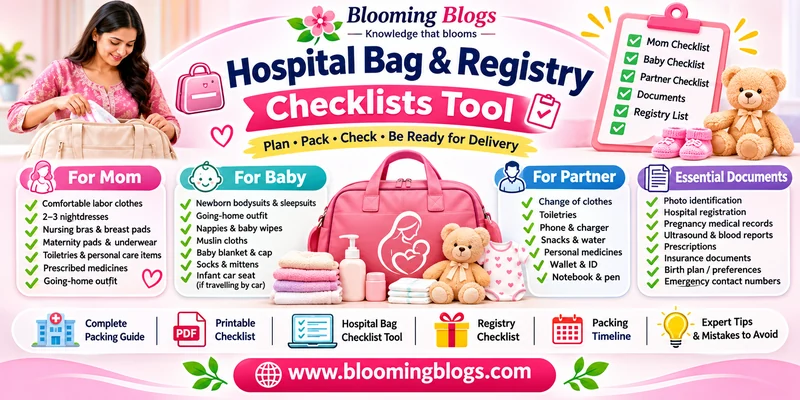
To ensure you never leave critical items behind, our hospital bag checklist divides packing requirements into five primary hospital categories and five registry categories.
Hospital Bag Checklist – Master Categories
| Master Category | Checklist Items |
|---|---|
| 1. Birthing Parent | ☐ IDs & Forms ☐ Birth Plans ☐ Button-Down Pajamas ☐ Grip Slippers |
| 2. Partner / Support | ☐ Change of Clothes ☐ Toiletries Kit ☐ 10ft+ Phone Charger ☐ High-Energy Snacks |
| 3. Delivery Room | ☐ Bluetooth Speaker ☐ Lip Balm & Face Mist ☐ Hair Scrunchies ☐ Massage Oils |
| 4. Baby Items | ☐ Installed Car Seat ☐ Going-Home Outfits ☐ Swaddles & Mittens ☐ Pediatrician Contact |
| 5. Post-Delivery Supplies | ☐ Disposable Postpartum Underwear ☐ Perineal Cleansing Peri-Bottle ☐ Cooling Ice Packs / Padicles ☐ Lanolin Nipple Cream |
Packing Reminder: Use this master checklist to organize essentials for the birthing parent, support partner, delivery room, newborn and post-delivery recovery. Check each item as you pack it.
Category 1: Birthing Parent Essentials
The birthing parent requires items that prioritize medical readiness, physical comfort during active labor, and immediate nursing access post-delivery.
1. ID, Insurance Cards & Hospital Forms
- Timeline: Weeks 28–32 | Priority: ESSENTIAL
- Why You Need It: Hospital intake staff need government identification, health insurance policy cards, pre-admission paperwork, and consent forms to register you promptly upon arrival.
- Pro-Tip: Place these items in a clear document pouch inside the outer front pocket of your main bag for instant access.
2. Birth Plan Copies (3–4 Printouts)
- Timeline: Weeks 33–36 | Priority: ESSENTIAL
- Why You Need It: Shift changes occur frequently in maternity wards. Therefore, physical paper copies help incoming physicians, nurses, and anesthesiologists understand your preferences regarding pain management, mobility, room atmosphere, and cord clamping.
- Pro-Tip: Tape one copy near your bedside table so incoming staff can review your preferences at a glance.
3. Comfortable Gowns or Button-Down Pajamas (2–3 Sets)
- Timeline: Weeks 33–36 | Priority: ESSENTIAL
- Why You Need It: Front-buttoning or snap-shoulder gowns allow rapid access for fetal monitoring, epidural administration, skin-to-skin bonding, and breastfeeding.
- Pro-Tip: Choose soft, breathable modal or cotton fabrics in dark colors to conceal postpartum bleeding or fluid leaks effortlessly.
4. Non-Skid Socks or Grip Slippers
- Timeline: Weeks 33–36 | Priority: RECOMMENDED
- Why You Need It: Walking during early labor helps promote cervical dilation and baby positioning. However, hospital corridor floors remain cold and slick; grip socks effectively prevent accidental slips.
5. Nursing Bras & Organic Breast Pads
- Timeline: Weeks 33–36 | Priority: ESSENTIAL
- Why You Need It: Soft, wire-free maternity bras support sensitive, engorging breasts as colostrum production begins. Meanwhile, absorbent breast pads protect clothes from unexpected leaks.
6. Loose, Soft Going-Home Outfit
- Timeline: Week 37+ | Priority: ESSENTIAL
- Why You Need It: Your postpartum belly will approximate a 5- to 6-month pregnancy shape after delivery. Soft joggers, high-waisted maternity leggings, or loose maxi dresses avoid pressuring tender abdomens or C-section incision sites.
Category 2: Partner & Support Person Gear
A well-prepared support person can advocate for the birthing parent, manage family communications, and assist with physical labor counter-pressure techniques.
🧳 PARTNER PACKING ESSENTIALS CHECKLIST
Use this checklist to help your birth partner stay comfortable, prepared and organized throughout the hospital stay.
| Done | Packing Essentials | Details & Recommendations |
|---|---|---|
| ☐ | 2–3 Days of Layered Clothes | Pack comfortable clothing in layers. Hospitals can feel very warm or very cold. |
| ☐ | Complete Toiletries | Toothbrush, deodorant, face wipes and other personal hygiene essentials. |
| ☐ | Extra-Long Phone Charger | Carry a 10 ft (3 m) braided charging cable for convenient access to power outlets. |
| ☐ | High-Protein Snacks & Refillable Water Bottle | Pack nutritious, high-protein snacks and a reusable water bottle to stay energized and hydrated. |
| ☐ | Comfortable Pillow & Light Travel Blanket | Bring a supportive pillow and lightweight blanket for rest during the hospital stay. |
Helpful Reminder: Keep your partner’s essentials together in a separate, easily accessible bag so everything is ready when needed.
1. Comfortable Change of Clothes (2–3 Days)
- Timeline: Weeks 33–36 | Priority: ESSENTIAL
- Why You Need It: Hospital stays typically last 24–48 hours for vaginal deliveries and 48–96 hours for C-section births. Pack versatile layers (hoodies, t-shirts, sweatpants) to adjust to changing room temperatures effortlessly.
2. Extra-Long Phone Charger Cables (10ft+)
- Timeline: Weeks 28–32 | Priority: ESSENTIAL
- Why You Need It: Hospital wall outlets are located behind heavy medical equipment or far from patient seating. Standard 3-foot cables will not reach your chair or bed comfortably.
3. High-Energy Snacks & Refillable Water Bottle
- Timeline: Weeks 33–36 | Priority: ESSENTIAL
- Why You Need It: Hospital cafeterias often close early in the evening. Consequently, packing energy bars, mixed nuts, dried fruits, electrolyte powders, and reusable water bottles keeps your energy high throughout labor.
4. Home Pillow & Travel Blanket
- Timeline: Week 37+ | Priority: RECOMMENDED
- Why You Need It: Support couches and recliner chairs in hospital rooms are notoriously firm. Bringing a bright pillow from home provides physical support and familiar comfort. (Use colorful pillowcases so hospital staff do not confuse them with hospital linens).
Category 3: Delivery Room & Comfort Items
Creating a peaceful, sensory-friendly delivery environment helps reduce adrenaline, encouraging natural oxytocin production during labor contractions.
1. Portable Bluetooth Speaker & Relaxing Playlists
- Timeline: Weeks 28–32 | Priority: OPTIONAL
- Why You Need It: Calming audio tracks, white noise, guided meditations, or upbeat music can anchor your focus during labor.
2. Hydrating Lip Balm & Facial Mist
- Timeline: Weeks 33–36 | Priority: ESSENTIAL
- Why You Need It: Hospital HVAC systems constantly circulate dry air. Furthermore, continuous labor breathing rapidly dries out your lips and skin. Parents consistently rank lip balm as their most used item.
3. Hair Ties, Scrunchies & Headbands
- Timeline: Weeks 33–36 | Priority: ESSENTIAL
- Why You Need It: Keeping long hair pulled back from your face helps regulate body temperature and eliminates distractions during intense labor pushing.
Category 4: Newborn Baby Gear & Outfits
1. Properly Installed Infant Car Seat
NEWBORN ESSENTIALS AT A GLANCE
| Item | Key Consideration |
|---|---|
| Infant Car Seat | MUST be properly installed before hospital exit. |
| Going-Home Outfits | Bring both Newborn and 0–3 Month sizes. |
| Soft Swaddles & Mittens | Prevents facial scratches; keeps baby warm. |
| Pediatrician Details | Required for birth notification and follow-up. |
- Timeline: Weeks 33–36 | Priority: ESSENTIAL
- Why You Need It: Hospitals strictly enforce safety protocols: staff will not discharge a newborn without verifying a safely installed infant car seat.
- Pro-Tip: Install the car seat base by week 35 and request an inspection from a certified Child Passenger Safety Technician (CPST).
2. Going-Home Outfits (Newborn & 0–3 Months Sizes)
- Timeline: Week 37+ | Priority: ESSENTIAL
- Why You Need It: Ultrasound weight estimates frequently vary. Packing one outfit in Newborn size and one in 0–3 Months size ensures baby has comfortable clothes regardless of actual birth weight.
- Pro-Tip: Choose outfits with footies and two-way zippers to make diaper changes effortless.
3. Pediatrician Contact Details
- Timeline: Weeks 28–32 | Priority: ESSENTIAL
- Why You Need It: Hospital pediatric teams require your doctor’s contact information to transmit newborn exam records, blood test screenings, and hearing results prior to discharge.
Category 5: Post-Delivery & Recovery Supplies
Although hospitals supply basic postpartum items, specialized recovery products make a noticeable difference in your daily physical comfort.
1. High-Waisted Disposable Postpartum Underwear
- Timeline: Weeks 33–36 | Priority: ESSENTIAL
- Why You Need It: Soft, stretchy mesh briefs hold heavy postpartum pads securely in place without rubbing against abdominal C-section incisions or tender pelvic areas.
2. Ergonomic Perineal Cleansing Bottle (Peri Bottle)
- Timeline: Weeks 33–36 | Priority: ESSENTIAL
- Why You Need It: Standard hospital squirt bottles feature straight necks that are difficult to maneuver. Conversely, an angled-neck peri bottle allows gentle, precise washing with warm water during urination without painful wiping.
3. Cooling Perineal Ice Packs (Padicles)
- Timeline: Week 37+ | Priority: RECOMMENDED
- Why You Need It: Absorbent ice packs soothe inflammation, reduce vaginal tissue swelling, and provide immediate localized pain relief after birth.
4. Organic Nipple Cream / Lanolin Ointment
- Timeline: Week 37+ | Priority: ESSENTIAL
- Why You Need It: Applying nipple cream after nursing sessions helps prevent and soothe dry, tender, or cracked nipples during the initial latching phase.
5. Trimester & Pregnancy Timeline Strategy (Weeks 28 to 37+)
To eliminate last-minute panic, structure your preparation using this three-phase timeline approach within our hospital bag checklist tool:
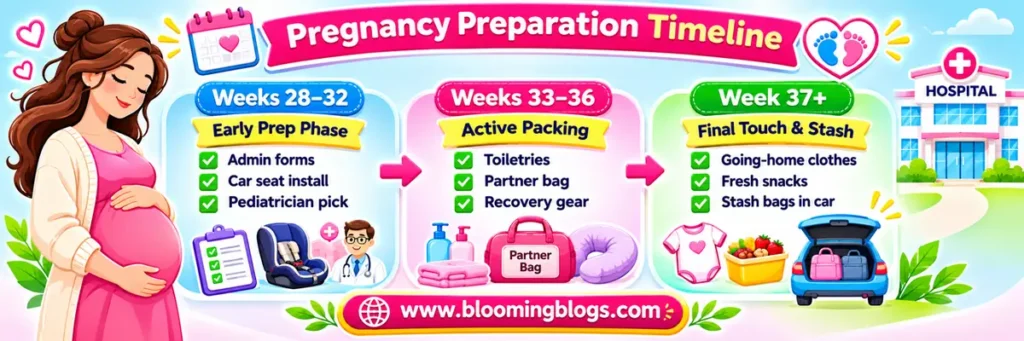
1st Phase: Weeks 28–32 (Early Planning & Research)
- Complete your hospital pre-registration forms online or on paper.
- Select a pediatrician and record their clinic phone number.
- Order your infant car seat, stroller system, and primary bedside bassinet.
- Confirm insurance coverage details for electric breast pumps.
2nd Phase: Weeks 33–36 (Active Packing & Car Seat Safety)
- Wash all newborn clothing, swaddles, and crib sheets using fragrance-free baby detergent.
- Pack primary hospital bags for both the birthing parent and partner.
- Install the car seat base securely into your primary vehicle.
- Print 3–4 physical copies of your detailed birth plan.
3rd Phase: Week 37+ (Full-Term Readiness & Final Touches)
- Add daily-use items to your bag (cell phones, eyeglasses, final toiletries).
- Pack fresh, unopened high-energy snacks and refillable water bottles.
- Place your packed bags near the front exit door or directly in your car trunk.
- Double-check car seat harness straps and base angle indicators.
6. Baby Registry Essentials vs. Hospital Bag Checklist Items
First-time parents often confuse Hospital Bag Needs with Baby Registry Items.
Specifically, Hospital Bag Checklist Items comprise minimal, immediate comfort necessities intended for a 1- to 3-day medical stay. In contrast, Baby Registry Items cover long-term infant care, nursery setup, bulk diapering, and feeding gear across baby’s first year.
Review this comparison table to guide your planning:
| Category | Packed in Hospital Bag | Included on Baby Registry |
| Nursery & Sleeping | 1–2 Soft Swaddle Blankets | Crib, Firm Mattress, Bassinet, Sheets, Sound Machine, Blackout Curtains |
| Feeding & Nursing | Nipple Cream, Nursing Bra | Breast Pump, Sterilizer, Drying Rack, Bottles, Burp Cloths (10–12 pack), Nursing Pillow |
| Clothing & Diapering | 2 Outfits (NB & 0–3M), Going-Home Clothes | 8+ Onesies/Sleepsuits, Diaper Pail, Water Wipes, Wipe-Clean Changing Pad, Diaper Cream |
| Travel & Safety | Car Seat (Installed in car) | Convertible Stroller, Baby Carrier/Wrap, Diaper Bag Backpack, Rain Cover |
| Health & Grooming | Basic Pediatrician Contact Card | Digital Thermometer, Electric Nail Trimmer, Nasal Aspirator, Baby Bathtub |
For comprehensive guidance on nursery safety standards and feeding schedules, explore our detailed parenting guides and calculators.
7. Step-by-Step Guide for Partners and Birth Support Teams
Partners and support people play a crucial role during labor, delivery, and immediate postpartum recovery. Follow this clear action plan:
PARTNER ACTION CHECKLIST
1. Learn the Layout: Know which pocket holds the birth plan, snacks, and chargers.
2. Fuel Up: Eat and hydrate regularly so you can stay energetic and attentive.
3. Manage Communication: Act as the main liaison for family updates so mom can rest.
4. Support Mobility: Guide hallway walks, offer counter-pressure, and pass water.
- Master the Bag Layout: Familiarize yourself with every pocket in both hospital bags so you can retrieve items instantly when nurses or the birthing parent request them.
- Manage Check-In Logistics: Keep IDs, insurance cards, and parking passes in your personal jacket or front bag pocket to handle registration quickly.
- Control the Environment: Adjust room lighting, manage the Bluetooth speaker, apply lip balm, and offer water between contractions.
- Coordinate Discharge & Loading: Upon discharge approval, fetch the car seat from the vehicle, bring it to the room, and manage luggage loading.
8. Practical Uses & Real-World Applications
The Hospital Bag Checklist Tool adapts to diverse birth scenarios and family needs:
- First-Time Parents: Provides a clear roadmap with expert tips to prevent overpacking or underpacking.
- Scheduled C-Section Deliveries: Enables parents to focus specifically on high-waisted briefs, loose gowns, and extended 3- to 4-day stay requirements.
- Multiples & High-Risk Pregnancies: Helps parents of twins or those facing bed rest organize hospital necessities earlier (around weeks 26–30).
- Doulas & Midwives: Serves as a digital reference checklist to share with clients during prenatal planning sessions.
- Baby Shower Planning: Helps friends and family review practical registry items to buy high-value gifts that parents truly need.
9. Frequently Asked Questions (FAQs)
Q1: When should I have my hospital bag fully packed?
Answer: You should have your hospital bag fully packed and ready between weeks 34 and 36 of pregnancy. Although full-term status begins at 37 weeks, labor can start unexpectedly. Therefore, packing by week 35 guarantees readiness for early arrivals.
Q2: What items does the hospital provide for postpartum care?
Answer: Most hospitals provide basic clinical necessities, including standard mesh underwear, heavy postpartum pads, squeeze peri bottles, baby diapers, wipes, receiving blankets, and infant hats. However, many parents bring angled peri bottles, high-waisted disposable briefs, and personal toiletries for superior physical comfort.
Q3: How many outfits should I pack for my newborn baby?
Answer: Pack 2 to 3 outfits in Newborn (NB) size and 2 to 3 outfits in 0–3 Months size. Because ultrasound size estimates can vary by a pound or more, bringing both sizes ensures your baby has comfortable clothing. Choose footed sleepers with two-way zippers for easy diaper changes.
Q4: Should I bring my own breast pump to the hospital?
Answer: Generally, no. Hospitals provide hospital-grade electric breast pumps in maternity wards if immediate pumping or lactation support becomes necessary. However, bringing your personal pump helps if you want the hospital lactation consultant to verify your flange fit and assembly.
Q5: What should I wear home from the hospital after delivery?
Answer: Wear soft, loose clothing similar to what you wore around 5 to 6 months of pregnancy. High-waisted maternity joggers, loose drawstring pants, or maxi dresses are ideal. Avoid tight waistbands that could press against C-section incisions or tender pelvic areas.
Q6: How long do hospital stays typically last after delivery?
Answer: Uncomplicated vaginal deliveries typically require a 24 to 48-hour stay. Conversely, Cesarean section (C-section) deliveries require 48 to 96 hours (2 to 4 days) to ensure proper pain management and post-operative recovery.
Q7: Can I customize this hospital bag checklist for my personal needs?
Answer: Yes! The interactive Hospital Bag Checklist Tool includes a + Add Item feature. You can add custom items to any category, set priority tags, write personal notes, and save them to your browser instantly.
Q8: Does the tool save my progress if I close my browser?
Answer: Yes. The checklist utilizes your browser’s local storage to save checked items and custom entries automatically. Therefore, when you return to the page on the same device, your progress remains intact.
10. Final Words & Medical Disclaimer
Packing your hospital bag represents a meaningful milestone that marks the final stretch of your pregnancy journey. By organizing administrative documents, recovery gear, partner supplies, and newborn outfits in advance, you create space to approach birth with calm, confidence, and complete peace of mind.
- Save or Print Your Checklist: Click the Print / PDF button on our interactive tool to generate a portable paper copy for your hospital bag or nursery door.
- Explore More Parenting Tools: Visit www.bloomingblogs.com for more practical guides, baby feeding calculators, and family wellness tools.
Medical & Informational Disclaimer
This checklist and accompanying guide are provided strictly for general informational, educational, and organizational purposes. It does not constitute medical advice, diagnosis, or clinical treatment. Pregnancy, labor, delivery, postpartum recovery, and newborn care vary significantly for every individual. Always consult your obstetrician, certified nurse-midwife, pediatrician, or qualified healthcare provider for personalized medical recommendations and hospital-specific guidelines.
📚 External Authoritative References
The following sources support the hospital preparation and newborn safety guidance included in this article.
- NHS – Hospital Bag Checklist
https://www.nhs.uk/best-start-in-life/pregnancy/preparing-for-labour-and-birth/hospital-bag-checklist/ - University College London Hospitals – What to Bring to Hospital
https://www.uclh.nhs.uk/our-services/find-service/womens-health-1/maternity-services/giving-birth/what-bring-hospital - National Childbirth Trust – Hospital Bag Checklist
https://www.nct.org.uk/information/labour-birth/planning-birth/hospital-bag-checklist-what-do-i-need - American Academy of Pediatrics – Safe Sleep
https://www.aap.org/en/patient-care/safe-sleep/ - National Highway Traffic Safety Administration – Rear-Facing Car Seat Installation
https://www.nhtsa.gov/car-seats-and-booster-seats/how-install-rear-facing-car-seats
Use the relevant references alongside the claims they support. Check them periodically for updates.ersally best, and that specialised formulas require more careful consideration.
🔗 Related Articles
If you are preparing for a newborn, these helpful Blooming Blogs guides can help you plan, prepare, and care for your baby with greater confidence:
- Best Infant Formula for Newborns: Types, Choices & Safety Guide
https://bloomingblogs.com/best-infant-formula-for-newborns/ - Newborn Baby Essentials Checklist for Soon-to-Be Parents
https://bloomingblogs.com/newborn-baby-essentials-checklist-for-soon-to-be-parents/ - How to Prepare Formula Milk for a Newborn Baby.
https://bloomingblogs.com/newborn-baby-essentials-how-to-prepare-formula-milk-for-a-newborn-baby/ - Newborn Baby Care: Complete Guide for New Parents
https://bloomingblogs.com/newborn-baby-care/ - Formula Mixing & Bottle Ratio Calculator
https://bloomingblogs.com/formula-mixing-bottle-ratio-calculator/
🌱 Continue Exploring…
Whether you’re nurturing a newborn, curating a sanctuary for your home and garden, or simply looking to level up your day-to-day life, there’s always a new perspective waiting to be discovered. From practical everyday parenting guidance, women’s wellness information, ideas to make your home more beautiful, tips for caring for pets and plants, or inspiration for your spiritual journey, Blooming Blogs brings useful knowledge together in one place.
Blooming Blogs — knowledge that blooms.
🌸 Blooming Blogs Promise
We’re here to bring you thoughtful, reliable, and helpful insights you can truly count on. Every article on Blooming Blogs is thoroughly researched, crafted with care, and written with genuine empathy to support you in your everyday journey. Your trust means everything to us, and we are dedicated to sharing content that informs, inspires, and makes your life a little easier.
📝 Editorial Notes
Our team strives for clarity, accuracy, and depth in every piece we publish. Content is periodically updated to ensure facts, recommendations, and guides stay relevant over time. While we consult trusted sources and expert research, our goal is always to present complex topics in a simple, practical, and conversational way that works for real life.
⚠️ Disclaimer
The content provided on Blooming Blogs is for informational and educational purposes only and should not be considered professional medical, legal, or financial advice. Always consult with a qualified expert or licensed professional before making decisions related to your health, family, or personal finances. Blooming Blogs is not liable for any actions taken based on the information provided on this website. (For full details, please visit our Disclaimer Policy Page).
💬 Share Your Experience — Leave a Comment
We’d love to hear from you! Did this article help you, or do you have a personal tip or story to share with our community? Drop your thoughts, questions, or feedback in the comment section below. Every voice enriches our community, and we read every single comment!