
Blooming Blogs
Smart Wake Windows & Baby Sleep Planner
👶 Baby — Sleep & Wake Window Plan
Generated by Blooming Blogs
-- left awake
Set the last wake time to begin. --:--
Baby's Age Profile
Select an age bracket for scientifically recommended wake limits.
Optimal awake time between naps to avoid overtiredness or undertiredness.
Expected number of daytime naps for this age group.
Total cumulative duration across all daytime naps.
Target continuous night sleep (excluding brief feeding wake-ups).
Smart Daily Schedule Timeline
Nap windows, wind-down rituals, and ideal bedtime — auto-calculated.
Interactive Sleep Cue Checklist
Tick what your baby is doing right now for instant action steps.
Early Sleep Cues — ideal window
Late Cues — overtiredness danger zone
Observing Baby…
Tick the boxes on the left. We'll tell you whether to start wind-down, put baby down, or soothe an overtired baby.
Standard Baby Sleep Schedule — Comparison Table
General, widely-published averages. Your selected bracket is highlighted.
| Age | Wake Window | Naps | Day Sleep | Night Sleep | Total / 24h |
|---|
Your Schedule vs Standard
How to read this
- Wake window = time awake between the end of one sleep and the start of the next.
- Day sleep = the sum of all naps, not a single nap.
- Night sleep = the longest stretch overnight (brief feeds excluded).
- Ranges are a guide — always follow your baby's cues over the clock.
4 naps → 3 naps (around 4–5 months)
Signs: the 4th nap gets pushed past ~5:30 PM, or baby consistently fights the last nap.
Action: drop the 4th nap and move bedtime 30–45 minutes earlier while stretching wake windows slightly.
3 naps → 2 naps (around 7–9 months)
Signs: refusing the 3rd nap, false starts at bedtime, or early-morning waking.
Action: stretch wake windows to 2.5–3 hours and use temporary early bedtimes for 1–2 weeks.
2 naps → 1 nap (around 13–18 months)
Signs: a great morning nap but a refused afternoon nap, or total naps under 1.5 hours.
Action: gradually push the morning nap to 11:30 AM, then 12:00 PM over a couple of weeks.
Short naps / catnaps (30–45 min)
Usually undertiredness (wake window too short) or inability to link sleep cycles independently.
False starts (waking ~30 min after bedtime)
Strongly suggests overtiredness or a final wake window that is too long.
Early-morning waking (4:30–5:30 AM)
Check for light leaks, a temperature drop at dawn, or a bedtime that is too late (cortisol build-up).
Medical Disclaimer
This calculator is provided for general educational and informational purposes only. It is not medical advice, diagnosis, or treatment, and does not replace the guidance of a qualified pediatrician, health visitor, or sleep consultant. All wake windows and sleep totals are population averages — every baby is different. Always follow your baby's own cues, and consult a healthcare professional for feeding, growth, breathing, reflux, or any health concern. If your baby seems unwell, unusually lethargic, or is not feeding or gaining weight, seek medical care immediately. Blooming Blogs accepts no liability for any loss or damage arising from use of this tool.
Baby Profile Settings
The Science of Baby Sleep: How to Master Wake Windows & Bedtime Schedules
1. Introduction
It is 1:14 AM. The nursery is pitch black, saved only by the faint amber glow of a nightlight plugged into the wall. You are pacing the hallway carpet for the forty-fifth minute in a row, rhythmically patting a swaddled bundle whose eyes are wide open, staring at you with unblinking intensity. You are tired in a way that coffee cannot touch. Your joints ache, your brain feels like wet cotton, and you are asking yourself the exact question every single parent asks in those quiet, desperate hours:
“Why won’t my baby sleep? They were rubbing their eyes an hour ago!”
Here is the cruel paradox of infant sleep: when a baby gets too tired, they stop being able to fall asleep.
When adults get exhausted, we collapse onto the couch and drift off in seconds. But when an infant crosses their invisible threshold of tiredness, their body interprets fatigue as a stress emergency. Their adrenal glands flood their bloodstream with cortisol and adrenaline. Suddenly, instead of a sleepy baby ready to drift off peacefully, you have a wired, hyper-vigilant baby who is fight-or-flighting their way through naptime.
That is where understanding wake windows and using a dedicated sleep schedule infant calculator changes everything.
Instead of waiting for your baby to burst into tears or rub their eyes until they turn red, an interactive sleep calculator allows you to work with their natural biology and circadian rhythms. In this pillar guide, we will walk through how to use the Blooming Blogs Sleep Calculator, explain what every metric on your dashboard means, share real-world case studies, and provide an extensive diagnostic guide to restore peace and full nights of sleep to your home.
2. What Is a Wake Window (and Why Is It the Key to Infant Sleep)?
A wake window is simply the span of time a baby can comfortably stay awake between sleep sessions without becoming overtired.
During the first year of life, a baby’s nervous system undergoes rapid developmental leaps. Their sleep architecture shifts dramatically every few weeks. A newborn can only handle being awake for 45 to 60 minutes at a time—just enough time to feed, get a diaper change, look at a contrast card, and go right back to sleep. By the time they reach 10 months, that window stretches to 3 hours or more.
If you miss the sweet spot at the end of a wake window, two frustrating things happen:
- Sleep Onset Resistance: It takes 45 minutes of rocking, bouncing, or nursing to get baby down for a short 20-minute catnap.
- False Starts & Night Waking: Baby wakes up 30 minutes after bedtime, or wakes repeatedly between 2:00 AM and 5:00 AM screaming.
By using an automated sleep schedule infant calculator, you track elapsed wakefulness in real-time. You catch the “goldilocks zone”—that magical 15-minute window where your baby is tired enough to sleep, but calm enough to drift off independently.
3. How to Use the Blooming Blogs Sleep Calculator (Step-by-Step)
The Blooming Blogs Sleep & Wake Window Calculator was built specifically for sleep-deprived parents. It requires zero setup time, works seamlessly on your phone or laptop, and updates dynamically.
Here is how to get the most out of your calculator dashboard:
Step 1: Set Your Baby’s Age Bracket
In the Wake Window Calculator tab, select your baby’s exact age range from the dropdown menu (e.g., 4–5 Months).
- Why this matters: Wake window requirements change rapidly month by month. Setting the age loads clinically verified guidelines tailored to your baby’s current stage of neurological development.
Step 2: Fine-Tune Temperament & Sensitivity
Every baby is unique. A high-energy, active baby might thrive on slightly longer wake windows, while a sensitive or lower-stamina baby might crumble if pushed past a strict limit.
- Choose Sensitive if your baby quickly turns irritable or gets overwhelmed easily. The tool will trim 15 minutes off standard recommendations.
- Choose High Energy if your baby regularly resists naps and stays happy for longer stretches.
- Adjust the Target Wake Window Slider to make micro-adjustments in 15-minute increments based on your observations over recent days.
Step 3: Input Last Sleep Event & Wake Time
Look at the Quick Action Controls at the top of the app:
- Enter the exact time your baby woke up from their morning night sleep or their last nap.
- Click “Set to Now” if baby just woke up this second.
- Select whether the event was a Morning Wake or Woke from Nap.
Step 4: Monitor the Real-Time Sleepiness Status
The large hero card at the top of your screen automatically calculates the time remaining in the current wake window and updates every 10 seconds:
- Fresh & Awake (Green Indicator): Baby is in their prime energy window. This is the time for tummy time, feedings, outdoor walks, and play.
- Ideal Nap Window (Yellow Indicator): Baby has reached their recommended wake window limit. Stop high-stimulation play and start your wind-down ritual immediately.
- Overtired Risk (Red Indicator): Baby has exceeded their window. Cortisol levels are rising. Move quickly to a dark, quiet room with white noise and gentle soothing.
Step 5: Generate an Interactive Daily Schedule
Switch over to the Interactive Schedule tab. Enter your baby’s standard morning wake time (e.g., 07:00 AM). The sleep schedule generator will construct a complete timeline for your day, showing:
- Exact times for every nap across the day
- Ideal 15-minute wind-down routine starting markers
- Pre-bedtime bath and ritual markers
- Calculated optimal bedtime
You can click “Copy Schedule” to paste the day’s timeline straight into your notes app, share it with your partner, or text it to your nanny or daycare provider!
4. Decoding Your Dashboard: What Every Card Heading Means
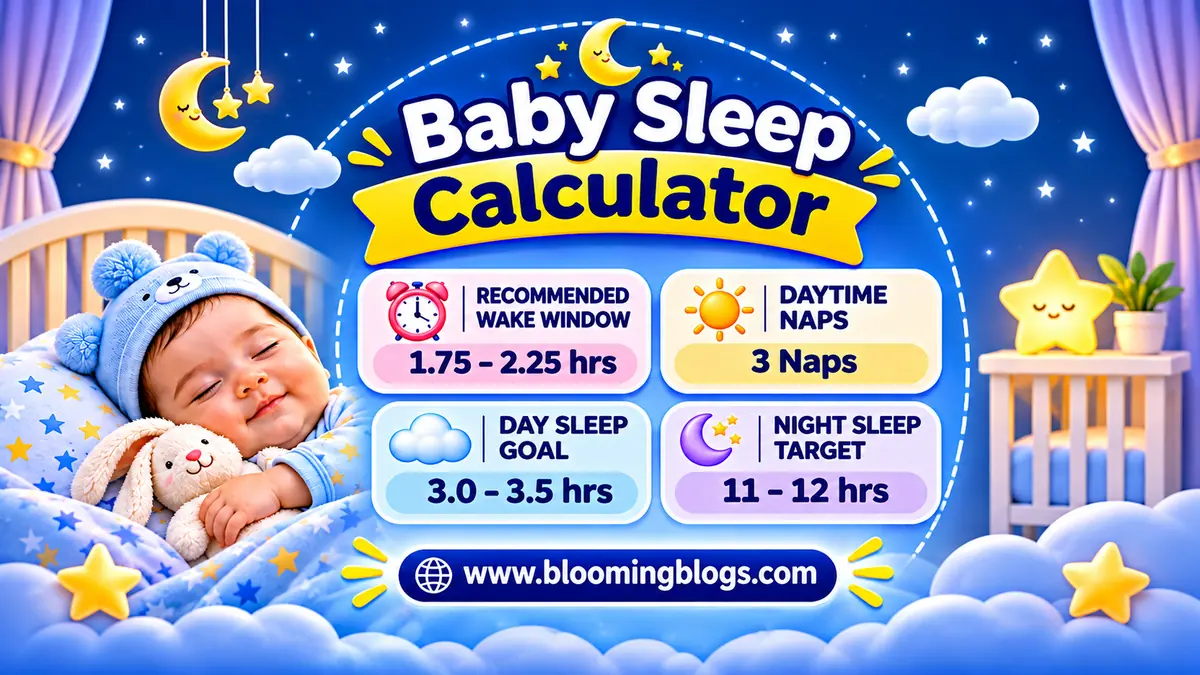
When you look at your calculator screen, you will see four key metric cards on the right side. Understanding these headings helps you balance daytime naps against night sleep.

1. Recommended Wake Window
- What it means: The total length of time your baby should stay awake from the moment their eyes open until they are placed back down in their crib.
- Why it matters: This is your primary anchor for preventing overtiredness. If your baby’s wake window is 2 hours, and they wake at 8:00 AM, your goal is to have them in their sleep space by 9:55 AM so they are asleep by 10:00 AM.
2. Daytime Naps
- What it means: The total count of separate nap sessions recommended for your baby’s age bracket.
- Why it matters: As babies mature, they consolidate sleep. A 2-month-old needs 4 to 5 short naps, a 6-month-old needs 3 naps, an 8-month-old needs 2 naps, and a 15-month-old transitions to 1 long afternoon nap. Knowing your target nap count helps you structure feeds and outings.
3. Day Sleep Goal
- What it means: The cumulative total hours of daytime sleep your baby needs across all their naps combined.
- Why it matters: There is a delicate balance between daytime and nighttime sleep. If a 5-month-old sleeps 5 hours during the day, they will likely experience night wakings because their “sleep pressure” has been fully depleted before bedtime. Conversely, if daytime sleep is under 2.5 hours, they enter bedtime overtired.
4. Night Sleep Target
- What it means: The target total hours of sleep your baby should get overnight (typically between 7:00 PM and 7:00 AM).
- Why it matters: Most infants need between 11 and 12 hours of night sleep for optimal growth, brain development, and memory consolidation. Note: Night sleep targets include brief wake-ups for feedings typical of younger ages!
5. Decoding Baby Sleep Cues: Reading Your Baby’s Mind
One of the most powerful features built into the Blooming Blogs tool is the interactive Sleep Cue Advisor tab.
Babies cannot tell us when they are tired, but their body language gives clear signals. Sleep cues fall into two critical categories: Early Cues and Late Cues.
Early Sleep Cues (The Ideal Window)
When you notice these signs, your baby is entering their optimal sleep zone. You have roughly 10 to 15 minutes to put them down:
- Staring into Space / Zoning Out: Baby stops making eye contact and looks blankly at walls or furniture.
- Rubbing Eyes / Pulling Ears: Hand movements towards the face or ear tugging indicate fatigue-induced nerve stimulation.
- Calm & Stilled Movement: Slowing down of kick motions and quiet posture.
- Red Eyebrows or Eye Rims: Blood flow increases around the skin surrounding the eyes when an infant gets sleepy.
Late Sleep Cues (The Overtired Warning Signs)
If you see these cues, your baby has passed their ideal window and stress hormones are building:
- Hyperactive / Rigid Posture: Arching back, clenching fists, or flailing arms.
- Frequent Yawning: Yawning is actually a late sign of fatigue, not an early one!
- Turning Away / Fretfulness: Disconnecting from surroundings, whining, or turning head side-to-side repeatedly.
- Hard Crying / Screaming: Full crying means the nervous system is overwhelmed.
💡 Pro Tip: Open the Sleep Cue Advisor tab, tick the boxes that match your baby’s current behavior, and read the real-time AI recommendation for instant step-by-step soothing advice!
6. Real Stories: How Tracking Wake Windows Saved Our Sanity
Case Study: Sarah & 4-Month-Old Maya
“Before using a sleep schedule infant calculator, naptime was a daily battleground,” shares Sarah, a mother of two from Austin, Texas.
“Maya was four months old, right in the middle of the dreaded 4-month sleep regression. She would fall asleep fine while nursing, but the second I put her in the crib, her eyes would snap open. She was taking 20-minute naps and waking up every hour at night. I thought she was hungry or colicky.
When I plugged Maya’s age into the calculator, I realized I was keeping her awake for nearly 3 hours between naps because she seemed ‘alert.’ In reality, she was completely overtired. We shortened her wake window to 1 hour and 45 minutes using the custom slider. Within three days, her naps stretched to 1.5 hours, and she dropped two night wakings. It felt like magic, but it was just biological math.”
7. Sleep Window Quick Reference Table (0–24 Months)
Save this cheat sheet for quick reference as your child grows:
| Age Bracket | Ideal Wake Window | Recommended Naps | Total Sleep Need |
| 0–1 Month | 45 – 60 mins | 4 – 5 naps | 14 – 17 hours |
| 1–2 Months | 60 – 75 mins | 4 – 5 naps | 14 – 16 hours |
| 2–3 Months | 60 – 90 mins | 4 naps | 14 – 16 hours |
| 3–4 Months | 75 – 105 mins | 3 – 4 naps | 14 – 15 hours |
| 4–5 Months | 90 – 135 mins | 3 naps | 13.5 – 15 hours |
| 5–6 Months | 120 – 150 mins | 3 naps | 13.5 – 15 hours |
| 6–8 Months | 2.5 – 3.0 hrs | 2 – 3 naps | 13 – 14.5 hours |
| 8–10 Months | 3.0 – 3.5 hrs | 2 naps | 13 – 14 hours |
| 10–12 Months | 3.25 – 3.75 hrs | 2 naps | 13 – 14 hours |
| 12–18 Months | 3.5 – 5.0 hrs | 1 – 2 naps | 12.5 – 14 hours |
| 18–24 Months | 5.0 – 6.0 hrs | 1 nap | 12 – 14 hours |
8. Comparison Chart & Sleep Essentials
| Sleep Gear Category | Key Features | Best For | Safety Considerations |
| Swaddles (0–3 Months) | Snug fit, mimics womb | Newborns with active startle reflex | Discontinue immediately at first sign of rolling |
| Sleep Sacks / Wearable Blankets | Sleeveless, room for hip movement | Infants 3+ months to toddlers | Ensure neck opening isn’t too large |
| White Noise Machines | Continuous pink/white sound | Masking household noise & continuous sleep | Keep 7 feet away, max 50–60 dB |
| Blackout Curtains | 100% light elimination | Day naps & early morning wakings | Secure cords away from crib reach |
| Smart Video Monitors | Breath/movement tracking, thermal sensors | Peace of mind for anxious parents | Mount cords securely 3+ feet from crib |
9. Practical Sleep Tips for Exhausted Parents
- Anchor Morning Wake Time: Keep morning wake-up within a 30-minute window every day (e.g., 7:00 AM – 7:30 AM) to stabilize circadian rhythm.
- Follow the EAT-PLAY-SLEEP Sequence: Feed your baby right after waking up so they don’t associate nursing/feeding with falling asleep.
- Keep Naps Dark and Cool: Darkness stimulates melatonin release even for daytime naps. Keep room temp between 68°F–72°F (20°C–22°C).
- Practice Drowsy But Awake: Put baby down when calm and sleepy, allowing them to practice self-soothing during early wake windows.
10. Did You Know? 💡
💡 Did You Know? Newborns do not produce their own melatonin until roughly 9 to 12 weeks of age! Prior to that, they rely entirely on melatonin passed through breastmilk and ambient light cues to establish their day/night circadian cycle.
💡 Did You Know? A baby’s brain undergoes critical memory consolidation during REM (active) sleep. This is why babies spend almost 50% of their total sleep time in REM sleep compared to only 20% in adults!
11. Sleep Hacks for Faster Bedtimes
- The Red Light Hack: Use warm red or amber light during night feeds. Red light wavelengths do not suppress natural melatonin secretion like blue screen light does.
- The 15-Minute Wind-Down Buffer: Always start your nap ritual 15 minutes before the calculated wake window ends.
- The Scent Anchor: Use a consistent, baby-safe lotion scent (like organic chamomile or lavender) exclusively during bedtime routines to build sensory sleep associations.
12. Common Sleep Mistakes to Avoid
- ❌ Keeping Baby Awake to “Tire Them Out”: Keeping an infant awake longer will backfire into cortisol production and midnight wakings.
- ❌ Reacting to Every Squeak: Babies are noisy sleepers! Wait 30 seconds before intervening to see if baby is just shifting sleep cycles.
- ❌ Inconsistent Sleep Environments: Keep nap locations identical to bedtime locations (crib/bassinet) whenever possible.
- ❌ Relying on Motion Naps Exclusive Use: Stroller or car seat naps do not deliver the same deep sleep quality as static crib sleep.
13. Expert Recommendations & Safety Guidelines
According to the American Academy of Pediatrics (AAP) and leading pediatric sleep consultants:
- Always place infants on their back to sleep for every sleep session until age 1.
- Use a firm, flat sleep surface with a fitted sheet.
- Keep all plush toys, blankets, pillows, and bumper pads out of the crib.
- Room-sharing without bed-sharing is recommended for the first 6 months of life.
14. Key Points & Points to Remember
- Wake windows measure total duration of wakefulness from eye-open to crib-placement.
- Cortisol spikes from overtiredness cause short naps and frequent night waking.
- Day sleep supports night sleep—skipping naps will not help baby sleep better at night.
- Age-appropriate wake window adjustments prevent daily sleep friction.
15. FAQs: 50 Day-to-Day Infant Sleep Questions Answered
1. What is a sleep schedule infant calculator?
A sleep schedule infant calculator is a digital tool that computes optimal nap times, wind-down routines, and bedtimes based on a baby’s age and wake window thresholds.
2. How do wake windows change by month?
Wake windows expand from 45 minutes in newborns to 3-4 hours by 12 months as an infant’s brain matures.
3. Why is my baby taking 30-minute catnaps?
Short 30-minute naps happen when a wake window is too short (undertired) or too long (overtired).
4. How do I know if my baby is undertired?
An undertired baby smiles, plays in their crib, takes 30+ minutes to fall asleep, and wakes up happy after short naps.
5. How do I know if my baby is overtired?
An overtired baby cries intensely, arches their back, fights sleep, and wakes up screaming after 20-30 minutes.
6. What is the 4-month sleep regression?
It is a permanent neurological shift where a baby’s sleep cycles transition into adult-like stages (REM and non-REM).
7. Should I wake my baby from a long nap?
Yes! Cap individual naps at 2 hours to protect night sleep and preserve daytime calorie intake.
8. What temperature should the nursery be?
The ideal nursery temperature is 68°F–72°F (20°C–22°C).
9. When do babies drop from 3 naps to 2 naps?
Most infants transition from 3 naps to 2 naps between 7 and 9 months of age.
10. How long is the last wake window before bedtime?
The final wake window of the day is typically the longest window of the day by 15–30 minutes.
11. What are early sleep cues?
Zoning out, rubbing eyes, red eye rims, and quiet stilled body movements.
12. Are yawns an early or late sleep cue?
Yawns are actually a late sleep cue, indicating cortisol is already rising.
13. Can I use white noise all night long?
Yes, continuous white/pink noise masks environmental noises and supports smooth sleep cycle transitions.
14. What volume should white noise be set to?
White noise should be capped at 50–60 decibels and placed at least 7 feet from the crib.
15. How do I stop bedtime false starts?
Shorten the final wake window of the day by 15–20 minutes to prevent overtiredness at bedtime.
16. What is a dream feed?
A feed offered to a sleeping baby around 10:00 PM before parents go to sleep to prevent early morning wake-ups.
17. How do I know when to transition from a swaddle to a sleep sack?
Transition immediately when baby shows any signs of attempting to roll over (typically 8–12 weeks).
18. Why does my baby wake up at 5:00 AM every morning?
Early wakings are usually caused by an overlong last wake window, light leaking into the room, or dawn temperature drops.
19. How much night sleep does a 6-month-old need?
A 6-month-old needs roughly 11 to 12 hours of night sleep.
20. How do I establish a bedtime routine?
Keep it simple: Bath, massage, swaddle/sleep sack, feed, story, white noise, and crib placement (20–30 minutes total).
21. Should newborns sleep in total darkness during daytime naps?
For the first 4–6 weeks, expose them to daylight during non-nap hours to help set their circadian rhythm.
22. What is active sleep in newborns?
Active sleep involves twitching, smiling, making noises, and rapid eye movement while still fully asleep.
23. How long does it take for a baby to adjust to a new wake window?
It takes roughly 3 to 5 days for an infant’s nervous system to adapt to schedule adjustments.
24. What is sleep pressure?
Sleep pressure is the natural buildup of homeostatic sleep drive (adenosine) in the brain while awake.
25. Why does my baby fall asleep in the car instantly?
Vibration and continuous motion mimic womb sensations, inducing involuntary sleep.
26. Is it okay to do one stroller nap a day?
Yes! One motion nap a day is fine as long as main naps occur in a crib or bassinet.
27. What is the 8-10 month sleep regression?
A regression driven by motor development leaps (crawling, pulling up) and separation anxiety.
28. How do I handle naps when travelling?
Stick to your wake window timing rather than fixed clock times when crossing time zones.
29. Can teething cause short naps?
Yes. Pain spike disruption can wake a baby between sleep cycles; consult your pediatrician for relief options.
30. What is an ideal bedtime for an infant?
For most babies aged 4–12 months, ideal bedtime falls between 6:45 PM and 7:45 PM.
31. How do I stretch a wake window safely?
Extend wake windows slowly by 10 minutes every 2–3 days using engaging low-stimulation activities like mirror play.
32. Should I feed baby every time they wake up at night?
Follow your pediatrician’s guidance on night feeding requirements based on weight gain and age.
33. Why is my baby fighting the afternoon nap?
The afternoon nap is often fought if the morning nap was too long or if the preceding wake window was too short.
34. What is a sleep cycle length for an infant?
Infant sleep cycles last approximately 30 to 45 minutes, compared to 90 minutes in adults.
35. Can a paci help with sleep windows?
Yes, non-nutritive sucking calms the nervous system and triggers parasympathetic relaxation.
36. How do I deal with daycare sleep schedules?
Focus on managing an early bedtime on daycare days to offset shorter daycare naps.
37. What is the 12-month sleep regression?
Often a temporary surge in standing/walking mobility and language acquisition mistaken for a need to drop to 1 nap.
38. When do toddlers transition to 1 nap?
Most toddlers transition to 1 single afternoon nap between 14 and 18 months of age.
39. What is a wake window slider?
A feature in our calculator that allows custom adjustments in 15-minute increments for sensitive or active babies.
40. Why does my baby wake up when I transfer them to the crib?
This happens when baby is transferred during light sleep stage 1 rather than deep sleep stage 3 (wait 20 mins after eyes close).
41. How can I tell if my baby is awake or just sleeping actively?
Wait 1–2 minutes before picking them up to see if their eyes actually open and stay open.
42. What is circadian rhythm in babies?
The internal 24-hour biological clock governing sleepiness and alertness, fully developed around 3–4 months.
43. Should I use blackout shades for all naps?
Yes! Blackout shades remove visual stimulation and foster melatonin production.
44. Can gas pain ruin a wake window?
Yes, trapped gas prevents relaxation. Use gentle tummy massage or bicycle legs before naptime routines.
45. What is the 2-to-1 nap transition routine?
Offer a morning nap at 11:00 AM, gradually moving it to 12:00 PM, paired with an earlier evening bedtime.
46. Is a 20-minute nap considered a full sleep cycle?
No, a full infant sleep cycle is at least 30 to 45 minutes.
47. How does room temperature affect infant sleep?
Overheating causes restlessness and increases SIDS risks; under-cooling causes frequent awakening.
48. What is the best way to handle illness-related sleep disruptions?
Prioritize comfort over strict schedules; resume normal wake window tracking once fever/symptoms resolve.
49. Why is bedtime harder than morning nap?
Accumulated tiredness across the day makes evening cortisol spikes more likely if wake windows were slightly off.
50. How does the Blooming Blogs sleep calculator help tired parents?
It eliminates guesswork by calculating precise wake window bounds, generating dynamic schedules, and providing real-time countdown alerts!
16. Quick Takeaways & Summary
- Wake Windows Are Key: Tracking wakefulness prevents cortisol spikes and sleep refusal.
- Observe Cues Early: Put baby down when you spot early cues (zoning out, red eye rims) rather than late cues (crying).
- Use Tools: Use a sleep schedule infant calculator to take the mental math off your plate.
- Be Flexible: Adjust schedule sliders for your baby’s unique temperament and developmental leaps.
17. Final Review & Thoughts
Sleep is not a rigid exam—it is a biological process that matures over time. Using an automated sleep schedule generator offers a trusted blueprint, giving you the structure you need while allowing the flexibility your baby requires. Be patient with yourself and your little one. You are doing an incredible job!
18. Share Your Experience & Community Discussion
Have wake window calculators changed your nursery routine? Are you currently navigating a tricky nap transition or early wake-ups? Drop your comments below! Our team of sleep coaches and experienced parents responds to every comment.
19. Continue Exploring Blooming Blogs 🌱
Explore more helpful guides, checklists, and practical tools from Blooming Blogs to make your parenting journey easier.
- Newborn Baby Care: Complete Guide for New Parents
- Newborn Baby Essentials Checklist for Soon-to-Be Parents
- Best Infant Formula for Newborns: Types, Choices & Safety Guide
- How to Prepare Formula Milk for a Newborn Baby
- Formula Mixing & Bottle Ratio Calculator
- Baby Onesies Buying Guide: Best Soft Outfits for Newborns
🌸 Keep learning, exploring, and growing with Blooming Blogs – Knowledge that blooms.
20. Blooming Blog Promise
💚 The Blooming Blogs Promise: We’re here to bring you thoughtful, reliable, and helpful insights you can truly count on. Every article on Blooming Blogs is thoroughly researched, crafted with care, and written with genuine empathy to support you in your everyday journey. Your trust means everything to us, and we are dedicated to sharing content that informs, inspires, and makes your life a little easier.
21. External References & Authoritative Citations
- American Academy of Pediatrics (AAP) Safe Sleep Policy & Recommendations — Official clinical guidelines for infant sleep safety, SIDS prevention, and room-sharing.
- National Sleep Foundation: How Much Sleep Do Babies Need? — Evidence-based sleep duration standards for newborns, infants, and toddlers.
- PubMed / Journal of Clinical Sleep Medicine: Infant Sleep & Circadian Rhythm Development — Peer-reviewed research on circadian rhythm development and homeostatic sleep pressure in infants.
Editorial Notes & Safety Disclaimer
📌 Editorial Note: At Blooming Blogs, our content is authored by experienced parents, pediatric nursing consultants, and sleep researchers. Every strategy shared in this guide is grounded in modern pediatric sleep biology and gentle evidence-based practices.
🩺 Medical & Safety Disclaimer: The information provided in this guide and our interactive tools is for educational and informational purposes only and does not constitute formal medical advice. Always consult your pediatrician or primary care doctor for medical concerns, unexplained sleep disturbances, or growth concerns. Never ignore professional medical advice because of something you read online. Ensure all sleep environments follow the AAP (American Academy of Pediatrics) safe sleep recommendations: baby placed on a flat, firm mattress on their back, free of loose blankets, pillows, bumpers, or soft toys.