

Introduction
A turtle carries an entire world on its back. That quiet shell holds millions of years of ocean history. Today, human choices decide whether that story continues.
You do not need a glass tank to welcome a turtle into your life. Symbolic adoption and wildlife conservation let you protect wild turtles where they belong. Every small step helps sea turtles and land species survive.
Let’s explore why these ancient reptiles matter, what threatens them, and how you can help today.
Turtles survived the age of dinosaurs, continued to thrive for millions of years, but today human activities are pushing them towards extinction. It is our responsibility to protect them – Blooming Blogs.
What Is Turtle Adoption Day?
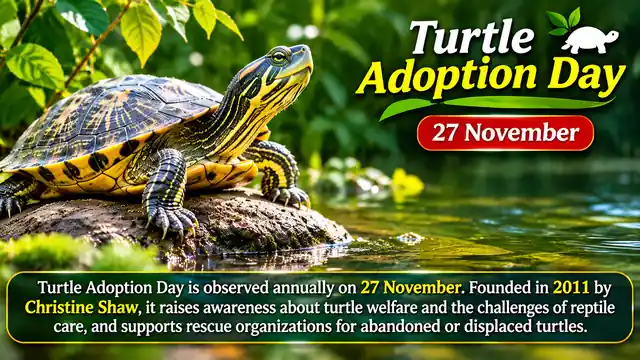
Turtle Adoption Day takes place every year on November 27. Animal advocate Christine Shaw founded this awareness day in 2011 to spotlight neglected, abandoned, and threatened turtles worldwide.
Originally, the day focused on finding permanent, loving rescue homes for surrendered domestic turtles. Today, wildlife supporters around the world also use Turtle Adoption Day to champion symbolic wild turtle adoptions. By sponsoring a wild sea turtle or river tortoise through a verified conservation charity, you fund anti-poaching patrols, nesting beach protection, and veterinary rescue clinics without removing a single animal from nature.
Key Takeaways for Turtle Adoption Day
- Turtles Are Ancient Survivors: Every turtle belongs to the reptile order Testudines, having survived on Earth for more than 200 million years.
- Global Comebacks Are Possible: Strict beach protection and turtle-safe fishing gear helped the green sea turtle rebound by roughly 28 percent, earning an IUCN Red List upgrade to Least Concern.
- Most Sea Turtle Species Still Need Urgent Help: Five of the seven sea turtle species remain threatened globally, including the Critically Endangered hawksbill and Kemp’s ridley.
- Symbolic Adoption Beats Wild Capture: Never take a turtle from a beach, river, or pond. Sponsoring a wild turtle through a trusted charity protects habitats and obeys wildlife protection laws.
- Small Daily Habits Save Lives: Cutting single-use plastics, keeping nesting beaches dark at night, and supporting local river cleanups directly protect wild turtles year-round.
What Is a Turtle? Exploring the World’s Oldest Shelled Reptiles
Have you ever paused to watch a turtle slowly cross a garden path or glide effortlessly beneath ocean waves? These quiet, armored creatures feel strangely familiar, yet they carry one of the greatest survival stories on Earth. Before dinosaurs ever walked the planet, ancient turtles were already swimming in prehistoric seas and resting along muddy riverbanks. Today, when people ask what a turtle truly is, the answer connects biology, survival, and over 200 million years of natural history.
Scientifically, every turtle belongs to the reptilian order Testudines. While everyday conversation often separates sea turtles, land-dwelling tortoises, and freshwater terrapins, science groups all of them under this single umbrella. What unites every member of this family is a remarkable piece of natural engineering: a permanent, bony shell fused directly to their ribs and spine. Unlike a hermit crab that swaps homes as it grows, a turtle wears its skeleton on the outside for its entire life.
Despite their slow and steady reputation on land, turtles are astonishingly adaptable reptiles. You can find them thriving in deep tropical oceans, quiet backyard ponds, rushing rivers, and dry, sun-baked deserts across almost every continent. Whether you are a curious nature lover, a student researching wildlife, or someone simply fascinated by ancient animals, understanding turtles opens a window into how life adapts and endures.
Quick Scientific Overview of Turtles
| Classification & Trait | Scientific & General Details |
|---|---|
| Scientific Order | Testudines (includes all turtles, tortoises, and terrapins) |
| Animal Class | Reptilia (cold-blooded vertebrates) |
| Total Living Species | Over 350 recognized species worldwide |
| Key Physical Feature | Permanent bony shell made of an upper carapace and lower plastron |
| Primary Habitats | Oceans, freshwater rivers, ponds, marshes, and dry land |
| Reproduction | Oviparous (all species lay eggs on land, even marine turtles) |
Why Turtles Stand Out in the Animal Kingdom
- Built-in Armor: Their two-part shell protects vital organs from predators while acting as a natural shield against harsh environments.
- Toothless Beaks: Instead of teeth, turtles use sharp, keratin-lined beaks shaped specifically to tear plants, crush shells, or catch small prey.
- Ectothermic Bodies: As cold-blooded animals, they rely on warm sunlight and water temperatures to regulate their daily energy.
- Incredible Longevity: Many species live for several decades, with certain giant tortoises and sea turtles surviving well past a century.
Turtle – Ancient Reptiles, Shell Anatomy
A turtle is an ancient, cold-blooded reptile from the scientific order Testudines. You can recognize any turtle right away by the sturdy bony shell fused straight to its skeleton.
These remarkable animals have roamed Earth for over 200 million years. They survived the mass extinction that wiped out the dinosaurs. Today, roughly 360 living species thrive across oceans, freshwater rivers, and dry land on every continent except Antarctica.
Four Defining Traits of Every Turtle
Whether a turtle swims in deep seas or walks across forest floors, four core traits unite the entire reptile group:
- Permanent Bony Shell: A turtle cannot crawl out of its shell like a hermit crab. Its ribs and spine fuse together to form the top shell (carapace) and bottom shell (plastron). Tough keratin plates called scutes cover most shells, while softshell and leatherback turtles sport smooth, leathery skin instead.
- Toothless Beaks: Turtles lack teeth completely. Instead, they slice and crush food with sharp, keratin-lined beaks tailored to their diet. Plant-eating turtles use serrated edges to tear seagrass, while reef-dwelling species rely on hooked beaks to crunch sponges and crabs.
- Cold-Blooded (Ectothermic) Bodies: Turtles cannot generate their own internal body heat. They depend on warm sunlight, heated rocks, or tropical ocean currents to stay active and digest food.
- Egg-Laying on Dry Land: Every turtle species lays eggs on land. Even ocean-going mothers swim ashore to dig nests in warm sand or soil before returning to the water.
The Three Main Turtle Groups
In science, the word turtle covers all ~360 species in the order Testudines. In everyday speech, however, people separate turtle vs tortoise and freshwater species based on where they live and how their bodies move.
| Turtle Group | Primary Habitat | Key Physical Traits |
| Sea Turtles | Marine waters (oceans and coastal seas) | Streamlined, flattened shells and long, paddle-like flippers; cannot pull their heads inside their shells. |
| Tortoises (Land Turtles) | Terrestrial environments (deserts, grasslands, and forests) | High-domed, heavy shells and sturdy, elephant-like legs with claws built for walking and digging on turtle in land habitats. |
| Freshwater Turtles & Terrapins | Ponds, rivers, lakes, and brackish coastal marshes | Webbed feet with sharp claws, flatter shells built for agile swimming, and necks that retract inside their shells. |
What Is a Sea Turtle? A Complete Guide to All 7 Sea Turtle Species
Beneath the sunlit surface of the world’s oceans glides one of nature’s most graceful travelers: the sea turtle. Unlike their land-dwelling cousins, sea turtles are marine reptiles built almost entirely for life in saltwater. From the moment hatchlings scramble across warm sand into the breaking waves, they spend nearly their entire lives swimming, feeding, and migrating thousands of miles across open ocean basins. Only adult females ever return to land, coming ashore briefly under the cover of darkness to dig nests and lay the next generation of eggs.
Scientifically, sea turtles belong to the order Testudines and are divided into two families: Cheloniidae (hard-shelled sea turtles) and Dermochelyidae (the leathery-shelled leatherback). Their bodies are marvels of underwater engineering. Over millions of years, their legs evolved into long, paddle-like flippers that propel them effortlessly through strong currents, while their shells flattened into sleek, teardrop shapes that reduce water resistance. Unlike freshwater turtles or tortoises, a sea turtle cannot pull its head or flippers inside its shell—trading defensive hiding for speed and agility in the open sea.
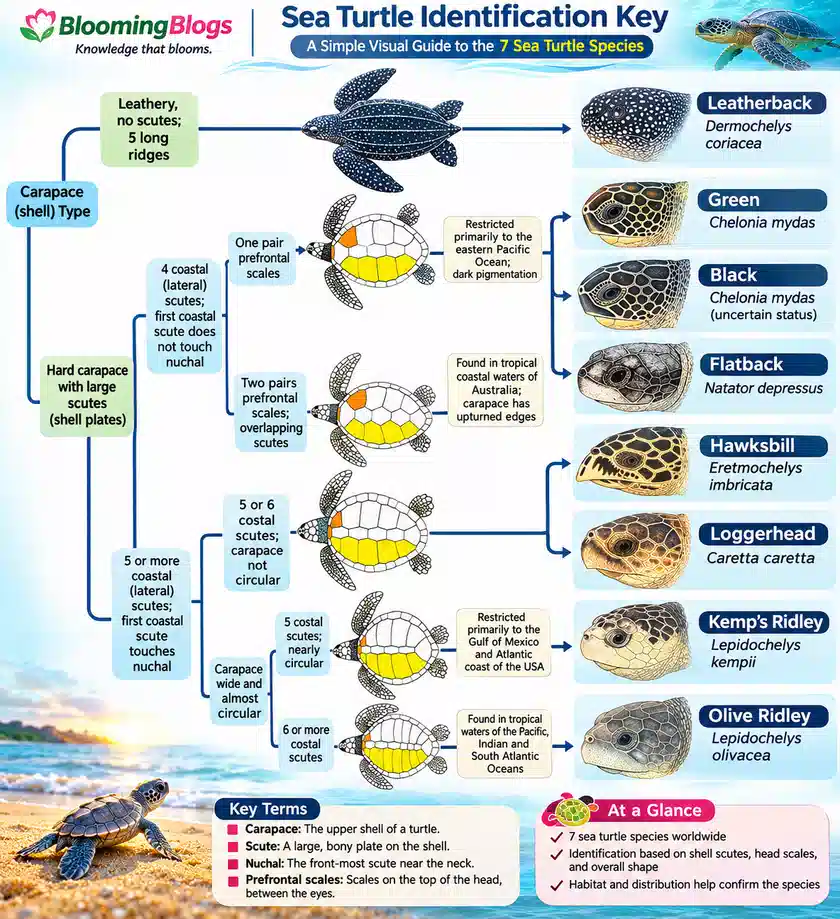
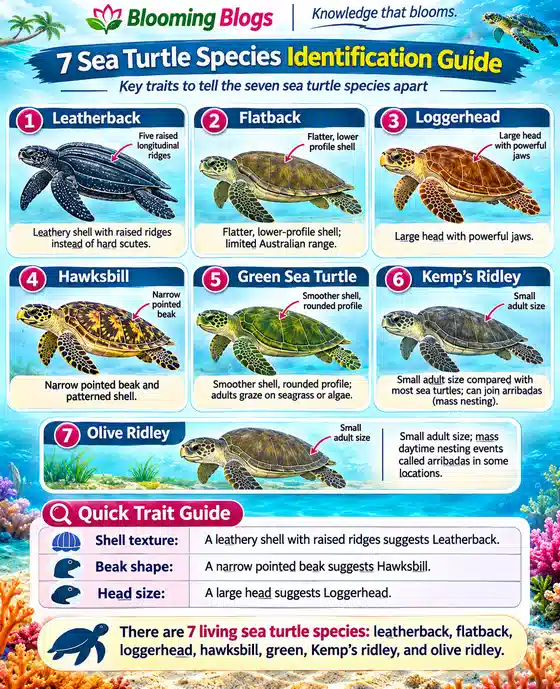
Today, marine biologists recognize seven living sea turtle species across the globe. Each species plays an irreplaceable role in keeping coral reefs, seagrass beds, and ocean food webs healthy.
Quick Comparison of All 7 Sea Turtle Species
| Common Name | Scientific Name | Average Adult Weight | Primary Diet | Key Habitat |
|---|---|---|---|---|
| Leatherback | Dermochelys coriacea | 250 to 700 kg (up to 900+ kg) | Jellyfish and soft-bodied invertebrates | Open ocean (pelagic waters worldwide) |
| Green | Chelonia mydas | 110 to 190 kg | Seagrass and marine algae | Shallow coastal waters and lagoons |
| Loggerhead | Caretta caretta | 80 to 200 kg | Crabs, conchs, clams, and hard-shelled prey | Coastal bays, estuaries, and open ocean |
| Hawksbill | Eretmochelys imbricata | 45 to 70 kg | Sea sponges, anemones, and coral reef invertebrates | Tropical coral reefs and rocky shores |
| Olive Ridley | Lepidochelys olivacea | 35 to 50 kg | Crabs, shrimp, jellyfish, and algae | Coastal waters and open tropical oceans |
| Kemp’s Ridley | Lepidochelys kempii | 35 to 45 kg | Crabs, shellfish, and jellyfish | Shallow coastal waters of the Gulf of Mexico |
| Flatback | Natator depressus | 70 to 90 kg | Sea cucumbers, jellyfish, soft corals, and shrimp | Murky coastal waters of northern Australia |
Detailed Profile of the 7 Sea Turtle Species
1. Leatherback Sea Turtle (Dermochelys coriacea)
The leatherback is the largest of all living turtles and one of the deepest-diving reptiles on Earth. Instead of a hard, bony shell covered in scales, it has a flexible, rubbery black carapace reinforced with tiny interlocking bones and seven distinct ridges running down its back. Leatherbacks possess a unique ability to regulate their body heat, allowing them to swim in freezing sub-polar waters where other sea turtles cannot survive. Their diet consists almost entirely of jellyfish, helping keep ocean jellyfish populations in natural balance.
2. Green Sea Turtle (Chelonia mydas)
Named not for the color of its shell—which is usually olive, brown, or black—but for the greenish tint of its body fat caused by a plant-rich diet, the green sea turtle is the largest hard-shelled species. While young green turtles eat small ocean invertebrates, adults become strict herbivores. Using finely serrated jaws, they graze constantly on seagrass meadows and algae. This regular grazing keeps seagrass beds healthy and productive, creating vital nursery grounds for fish and shellfish.
3. Loggerhead Sea Turtle (Caretta caretta)
Easily recognized by its massive head and extraordinarily strong jaw muscles, the loggerhead is built to crush hard-shelled prey. Adult loggerheads patrol coastal bays and continental shelves in search of crabs, whelks, horseshoe crabs, and clams. Their reddish-brown, heart-shaped shells often carry hitchhikers like barnacles and algae, turning each older turtle into a moving mini-ecosystem.
4. Hawksbill Sea Turtle (Eretmochelys imbricata)
The hawksbill takes its name from its narrow, pointed head and sharp, bird-like beak. This specialized beak allows it to reach deep into narrow cracks in coral reefs to pull out sea sponges—its favorite food. Because many sea sponges are toxic to other marine animals, hawksbills play a crucial role in preventing sponges from overgrowing and smothering fragile coral reefs. Their shells feature overlapping amber-and-brown scales that were historically targeted for decorative tortoiseshell items.
5. Olive Ridley Sea Turtle (Lepidochelys olivacea)
The olive ridley is the most abundant sea turtle species in the world, named for the olive-green hue of its heart-shaped shell. They are famous across the globe for a breathtaking reproductive phenomenon called an arribada (Spanish for “arrival”). During an arribada, tens of thousands—and sometimes hundreds of thousands—of female olive ridleys come ashore simultaneously on the exact same stretch of beach to lay their eggs over just a few nights.
6. Kemp’s Ridley Sea Turtle (Lepidochelys kempii)
The Kemp’s ridley holds the dual distinction of being both the smallest and the most endangered sea turtle species on Earth. Closely related to the olive ridley, it also nests in synchronized daytime groups along sandy beaches, primarily in the Gulf of Mexico. Adults forage in shallow, muddy coastal bottoms where they hunt blue crabs and other crustaceans.
7. Flatback Sea Turtle (Natator depressus)
Unlike the other six species that cross entire oceans, the flatback sea turtle stays close to home. It lives exclusively in the shallow coastal waters of northern Australia and southern Papua New Guinea. As its name suggests, its shell is noticeably flatter and smoother than other marine turtles, with edges that curl slightly upward. Flatbacks also lay fewer, larger eggs than any other sea turtle, producing bigger hatchlings that have a better chance of escaping coastal predators.
Where Do Sea Turtles Live? Global Sea Turtle Habitat & Species Range
Sea turtles swim through almost every major ocean basin on Earth. You can find these ancient reptiles in warm tropical and subtropical waters across the globe. Only the freezing polar seas remain off-limits to them.
Most sea turtles spend nearly their entire lives underwater. However, adult females still need dry land to reproduce. Every nesting season, mothers swim back to sandy beaches within 30 degrees north and south of the equator. Warm sand keeps their buried eggs safe until hatchlings break free.
Understanding sea turtle habitat and sea turtle species helps us protect their favorite feeding grounds and nesting shores.
Global Distribution by Ocean Basin
Marine biologists group global sea turtles into Regional Management Units across four main ocean zones. Each region supports distinct populations that migrate thousands of miles between feeding reefs and nesting beaches.
- Atlantic Ocean and Connected Seas: Six species swim through the North and South Atlantic, the Caribbean Sea, and the Gulf of Mexico. The southeastern United States and the Wider Caribbean serve as major global hotspots. Meanwhile, the Kemp’s ridley lives almost exclusively in the Gulf of Mexico and along the U.S. East Coast. Across the Atlantic, the Mediterranean Sea provides vital feeding and nesting shores for loggerhead and green sea turtles.
- Indian Ocean: Five widespread species thrive across the eastern and western Indian Ocean. These include the green, olive ridley, hawksbill, leatherback, and loggerhead turtles. Major nesting strongholds line the coast of Odisha in India, Oman, Sri Lanka, the Andaman and Nicobar Islands, and islands across the Southwest Indian Ocean.
- Pacific Ocean: Six species span the vast Pacific basin. Indonesia, Malaysia, Papua New Guinea, and the Philippines form the Coral Triangle, which shelters massive green and hawksbill populations. Australia’s Great Barrier Reef, including Raine Island, also hosts thousands of nesting green turtles. On the eastern side, hundreds of thousands of olive ridleys gather each year along the Pacific coasts of Mexico and Costa Rica.
- Australasian Shelf: The shallow waters between northern Australia and southern Papua New Guinea form a unique marine zone. This continental shelf is the sole global home of the flatback turtle. Unlike other sea turtles, flatbacks stay close to shore and never cross deep open oceans.
Types of Sea Turtles in Detail: Range, Habitat & Nesting Hotspots
Seven living sea turtle species glide through our oceans today. Five travel across multiple ocean basins, while two stay within specific geographic boundaries.
| Sea Turtle Species | Global Range & Occurrence | Key Sea Turtle Habitat | Primary Nesting Hotspots |
| Green Sea Turtle | Circumglobal across tropical and subtropical oceans; nests in over 80 countries. | Shallow coastal waters, lagoons, and lush seagrass beds. | Raine Island (Australia), Tortuguero (Costa Rica), and Michoacán (Mexico). |
| Leatherback | Widest global range; crosses entire ocean basins into cool sub-polar waters off Alaska, Canada, and Northern Europe. | Deep open ocean (pelagic zones) far from shore. | Trinidad, Suriname, French Guiana, Gabon, and the Western Pacific. |
| Loggerhead | Temperate and tropical waters across the Atlantic, Pacific, and Indian Oceans. | Coastal bays, estuaries, continental shelves, and open ocean. | Florida (USA), Masirah Island (Oman), Japan, Australia, and Greece. |
| Hawksbill | Strictly tropical waters across the Atlantic, Pacific, and Indian Oceans. | Healthy coral reefs, rocky outcrops, and shallow lagoons. | Caribbean islands, Seychelles, Indonesia, and northern Australia. |
| Olive Ridley | Tropical regions of the Pacific, Indian, and South Atlantic Oceans. | Coastal waters and open ocean; famous for massive group nesting (arribadas). | Odisha (India), Pacific Mexico, and Pacific Costa Rica. |
| Kemp’s Ridley | Geographically restricted to the Gulf of Mexico and the eastern U.S. seaboard. | Shallow coastal waters with muddy or sandy seafloors. | Rancho Nuevo (Tamaulipas, Mexico) and Padre Island (Texas, USA). |
| Flatback | Endemic exclusively to the Australian continental shelf and southern Papua New Guinea. | Turbid inshore waters, shallow bays, and coastal reefs. | Northern Australia (Queensland, Northern Territory, and Western Australia). |
Indian Sea Turtles and the Gujarat Coastline
India plays a vital role in global turtle conservation. Five Indian sea turtles swim in the country’s coastal waters: the olive ridley, green, hawksbill, leatherback, and loggerhead.
Four of these species actively nest on Indian sand. Odisha and Andhra Pradesh welcome the world’s largest mass nesting gatherings of olive ridley turtles every winter.
On India’s western edge, Gujarat offers a 1,600-kilometer coastline along the Arabian Sea and the Gulf of Kutch. These shallow reefs, mangroves, and sandy beaches create an essential sea turtle habitat. Four species—olive ridley, green, hawksbill, and leatherback turtles—forage and nest along Gujarat’s shores.
How Sea Turtle Habitats Change by Life Stage
A sea turtle does not stay in one neighborhood throughout its life. Instead, its habitat shifts across three distinct stages as the animal grows:
- Pelagic (Open Ocean) Stage: Newly hatched babies sprint into the surf and swim toward deep ocean currents. Young turtles spend their early “lost years” drifting inside floating seaweed mats, such as Sargassum, far from predators near shore.
- Neritic (Coastal) Stage: Once juveniles grow larger, most species swim back toward shallow continental shelves. Here, green sea turtles graze on underwater seagrass meadows, while hawksbills hunt sponges among coral reefs. Only open-ocean specialists like leatherbacks and olive ridleys remain largely in deeper waters.
- Terrestrial (Beach) Stage: Adult males rarely touch land again after hatching. Only nesting females return to sandy beaches to dig nests, lay eggs, and cover them before heading back to sea.
Notable Range Shifts in 2026
Warming ocean temperatures are slowly redrawing the map for sea turtles. As waters heat up, tropical species sometimes travel farther north or south than usual.
In September 2026, wildlife researchers documented two natural olive ridley nests in Southern California. That discovery marked the first confirmed natural sea turtle nesting event on the U.S. West Coast. Tracking these shifts helps conservation teams protect new nesting beaches before coastal development disrupts them.
The Sea Turtle Life Cycle: From Sandy Nests to Open Ocean Journeys
The sea turtle life cycle is an extraordinary, multi-decade ocean journey. Every turtle begins life buried beneath warm coastal sand, travels thousands of miles across open waters, and eventually navigates back to the exact beach where it hatched.
Because predators, rough seas, and human threats surround them from day one, only about 1 in 1,000 hatchlings survives all stages to reach adulthood. Understanding these sea turtle facts reveals why protecting nesting beaches matters so deeply on Turtle Adoption Day.
The 5 Stages of the Sea Turtle Life Cycle
A sea turtle passes through five distinct growth phases over several decades, shifting habitats as its body grows stronger:
| Life Stage | Age / Duration | Primary Habitat | Key Activities |
| 1. Egg | ~45 to 70 days (incubation) | Underground sandy nest | Embryos develop safely inside buried eggs; sand temperature decides whether hatchlings become male or female. |
| 2. Hatchling | First few weeks of life | Nesting beach to open ocean | Babies slice open their shells, crawl to the surf at night, and swim nonstop into deep currents. |
| 3. Juvenile (“Lost Years”) | ~1 to 10+ years | Open ocean (pelagic zone) | Young turtles drift inside floating seaweed mats (Sargassum), eating plankton and tiny marine invertebrates. |
| 4. Sub-Adult | ~10 to 25+ years | Shallow coastal waters | Growing turtles move closer to shore to feed in seagrass beds, coral reefs, and coastal estuaries. |
| 5. Adult | ~20 to 50+ years to mature | Coastal feeding grounds & nesting beaches | Adults mate offshore; females migrate every 2 to 4 years to lay multiple clutches of eggs on their birth beach. |
Step-by-Step: The Sea Turtle Nesting Process
Watching a mother sea turtle build her nest is one of nature’s most moving sights. Here is how the seven-step nesting cycle unfolds:
- Mating Offshore: Adult males and females gather in shallow coastal waters near nesting shores during breeding season to mate. Males never return to dry land after hatching, whereas females swim ashore to lay their eggs.
- Emerging onto the Beach: Most females crawl ashore under the cover of darkness, though Kemp’s ridleys and some olive ridleys also nest during daylight. Using all four flippers, the mother pulls her heavy body past the high-tide mark.
- Digging the Body Pit and Egg Chamber: She clears away dry surface sand with all four flippers to form a shallow body pit. Next, she uses her rear flippers like gentle shovels to dig a flask-shaped egg chamber roughly 1.5 to 2 feet deep.
- Laying the Clutch: The mother deposits about 80 to 120 soft, leathery eggs that look like white ping-pong balls. While she lays, special salt glands near her eyes release thick tears that clear blowing sand and excess ocean salt.
- Camouflaging the Nest and Returning to Sea: She packs damp sand firmly over the eggs with her rear flippers, then flings loose dry sand across the area to hide the nest from predators. Afterward, she crawls back into the waves, repeating this entire routine 2 to 8 times per season about two weeks apart.
- Incubation and Temperature-Dependent Sex: Warm beach sand incubates the hidden eggs for roughly two months. Cooler sand produces mostly male hatchlings, while warmer sand produces mostly female hatchlings.
- The Hatchling Boil and Swimming Frenzy: Baby turtles use a temporary sharp tip on their beaks called an egg tooth (caruncle) to slice open their shells. Working together as a team, they dig upward for days and erupt from the sand all at once in a dramatic “boil,” usually at night when the sand cools. Guided by bright moonlight reflecting over the ocean horizon, hatchlings sprint into the surf and swim nonstop for 24 to 48 hours in a “swimming frenzy” to escape nearshore predators.
How You Can Protect Nesting Beaches Today
Protecting fragile nesting shores gives thousands of baby sea turtles a fighting chance at survival. If you want to donate to sea turtles or sponsor hatchling protection directly, you can support vetted conservation programs such as SEE Turtles (Billion Baby Turtles) internationally or coastal hatchery initiatives run by TREE Foundation India.
What Are Land Turtles? A Short Guide to Tortoises and Their Species
When people talk about land turtles, they are usually referring to tortoises—the terrestrial members of the turtle family (Testudines) that spend their entire lives on dry ground. While all tortoises are scientifically turtles, not all turtles are tortoises. Unlike their ocean and pond-dwelling cousins, land turtles cannot swim and will avoid deep water, returning to shallow puddles only to drink or cool down in the mud.
Built for life on solid earth, land turtles are instantly recognizable by their physical adaptations. They carry heavy, high-domed shells that protect them from predators and extreme temperatures. Instead of webbed feet or flippers, they walk on sturdy, column-like legs with thick, elephant-like feet and blunt claws designed for digging burrows and traveling across rough terrain. Most land turtles are peaceful herbivores, spending their days grazing on grasses, weeds, leafy greens, flowers, and fallen fruit.
Quick Overview of Popular Land Turtle Species
| Common Name | Scientific Name | Native Region | Notable Trait |
|---|---|---|---|
| Galápagos Giant Tortoise | Chelonoidis niger | Galápagos Islands (Ecuador) | Largest living land turtle; can weigh over 400 kg and live past 150 years. |
| Aldabra Giant Tortoise | Aldabrachelys gigantea | Aldabra Atoll (Seychelles) | Massive, long-necked giant that thrives in coastal grasslands and scrub. |
| Sulcata (African Spurred) Tortoise | Centrochelys sulcata | Sahara Desert edge (Africa) | Largest mainland tortoise; famous for digging deep underground burrows. |
| Indian Star Tortoise | Geochelone elegans | India, Pakistan, and Sri Lanka | Known for striking yellow star-shaped patterns on its dark, high-domed shell. |
| Russian (Horsfield’s) Tortoise | Testudo horsfieldii | Central Asia | Small, hardy burrower adapted to harsh winters and dry, rocky steppes. |
| Box Turtle (Terrestrial Turtle) | Terrapene species | North America | Technically a pond turtle adapted to land, with a hinged shell that closes shut. |
Notable Land Turtle Species Explained Briefly
- Galápagos Giant Tortoise (Chelonoidis niger)
Famous for inspiring Charles Darwin, this gentle giant is the largest land turtle in the world. Depending on which island they inhabit, they develop either rounded dome shells for grazing low grass or “saddleback” shells that let them stretch their long necks toward high cactus pads. - Sulcata Tortoise (Centrochelys sulcata)
Also called the African spurred tortoise because of the thick spurs on its front legs, the sulcata is the largest tortoise living on a continental mainland. To escape the scorching heat of the Sahara fringe, it uses its powerful claws to excavate underground tunnels up to 10 feet deep. - Indian Star Tortoise (Geochelone elegans)
Native to dry forests and scrublands across India and Sri Lanka, this medium-sized land turtle features radiating yellow lines on each scute of its shell. Far from just looking decorative, these geometric star patterns act as natural camouflage among dry grasses and dappled sunlight. - Russian Tortoise (Testudo horsfieldii)
Small, round, and remarkably resilient, the Russian tortoise thrives in extreme environments across Central Asia. It spends much of the year dormant underground to survive both freezing winters and blistering summers, emerging only when tender spring plants appear. - Eastern Box Turtle (Terrapene carolina)
Although closely related to freshwater pond turtles, box turtles live almost entirely on forest floors. They stand out because of a unique hinge on their lower shell (plastron) that lets them pull their head and legs inside and snap their shell completely shut like a protective box.
Freshwater Turtles and Terrapins: River Guardians & Brackish Survivors
Freshwater turtles and terrapins are aquatic and semi-aquatic reptiles from the order Testudines. Unlike marine sea turtles or land-dwelling tortoises, these species live in inland waters such as rivers, lakes, ponds, and coastal marshes.
Every turtle in this group shares core traits with its ocean and land cousins. However, their bodies carry specialized tools built for calm freshwater currents, muddy riverbanks, and tidal estuaries. Learning about these river guardians is essential on Turtle Adoption Day, especially since freshwater habitats face heavy pollution and illegal pet dumping.
Freshwater Turtles vs. Terrapins: What Is the Difference?
Scientifically, freshwater turtles and terrapins belong to the same reptile families. Regional naming also varies across the globe—for example, people in the UK often call almost any freshwater turtle a “terrapin.”
In North America and general biology, however, researchers separate the two based on water salinity and coastal lifestyle:
| Feature | Freshwater Turtles | Terrapins |
| Water Type | Strictly fresh water (rivers, lakes, ponds, and inland streams). | Brackish water (tidal marshes, estuaries, and coastal swamps where fresh and salt water mix). |
| Feet & Claws | Webbed toes with sharp claws built for agile swimming and climbing logs. | Webbed feet with claws, plus specialized glands that help manage moderate salt levels. |
| Shell Design | Flatter, streamlined shells (either hard-shelled or smooth and leathery in softshell species). | Sculpted, moderately domed shells featuring distinct growth rings (such as the Diamondback terrapin). |
| Daily Behavior | Spend hours basking on sunny rocks and fallen logs to warm their bodies. | Divide their time between tidal creeks, mudflats, and sunny coastal marsh banks. |
Five Notable Freshwater Turtles and Terrapins Worldwide and in India
From North American marshes to major Indian sea turtles and river basins, these five species highlight the diversity of inland turtles:
- Red-Eared Slider (Trachemys scripta elegans): Native to North America, this turtle became the world’s most common non-native pet. Unfortunately, when owners dump unwanted sliders into local ponds and rivers, they turn into one of the most destructive invasive species on Earth, crowding out native turtles.
- Diamondback Terrapin (Malaclemys terrapin): This is the only turtle in North America adapted exclusively to brackish coastal marshes. It is famous for the striking diamond-shaped patterns etched across its upper shell.
- Indian Softshell Turtle (Nilssonia gangetica): This large freshwater turtle thrives across the Ganges, Indus, and Mahanadi river systems in India. Instead of hard keratin scutes, it sports a smooth, leathery olive-green shell that helps it bury quickly in riverbed sand.
- Indian Roofed Turtle (Pangshura tecta): Found across major Indian rivers, this small, colorful freshwater turtle gets its name from the raised, roof-like ridge running straight down the center of its shell.
- Northern River Terrapin (Batagur baska): Ranked among the world’s most critically endangered turtles, this rare species lives in the mangrove estuaries and tidal rivers of the Sundarbans across India and Bangladesh.
Three Remarkable Adaptations for Freshwater Life
Surviving in rivers, ponds, and marshes requires clever biology. Freshwater turtles and terrapins rely on three extraordinary adaptations:
- Cloacal Respiration (“Butt-Breathing”): Many freshwater turtles absorb dissolved oxygen directly from the water through specialized blood vessels near their tails. This unusual skill lets them stay underwater for months while hibernating in winter mud.
- Retractable Necks: Unlike ocean-going sea turtles, freshwater turtles and terrapins can pull their heads and legs inside their shells for protection. Depending on their family, they either pull their necks straight back (Cryptodira) or tuck them sideways beneath the shell rim (Pleurodira, often called side-necked turtles).
- Omnivorous River Diets: Most freshwater species eat a balanced mix of aquatic plants, algae, snails, insects, tadpoles, and small fish. By eating dead plants and decaying matter, they act as natural “clean-up crews” that keep rivers and ponds clean and healthy.
How to Support Freshwater Turtle Conservation Today
Never release an unwanted non-native turtle into a local pond or river, and never capture native turtles from the wild. To help protect endangered river turtles and tortoises across India and worldwide, you can donate directly to science-backed conservation groups like the Turtle Survival Alliance (TSA).
Difference Between Turtle and Tortoise: How to Tell Them Apart Easily
At first glance, turtles and tortoises look remarkably alike. Both carry a protective shell on their backs, move at a steady pace, and belong to the ancient reptilian order Testudines. Because they share so many features, people often use their names interchangeably in everyday conversation. However, once you look closely at how they live and where they spend their time, the difference between turtle and tortoise becomes clear and fascinating.
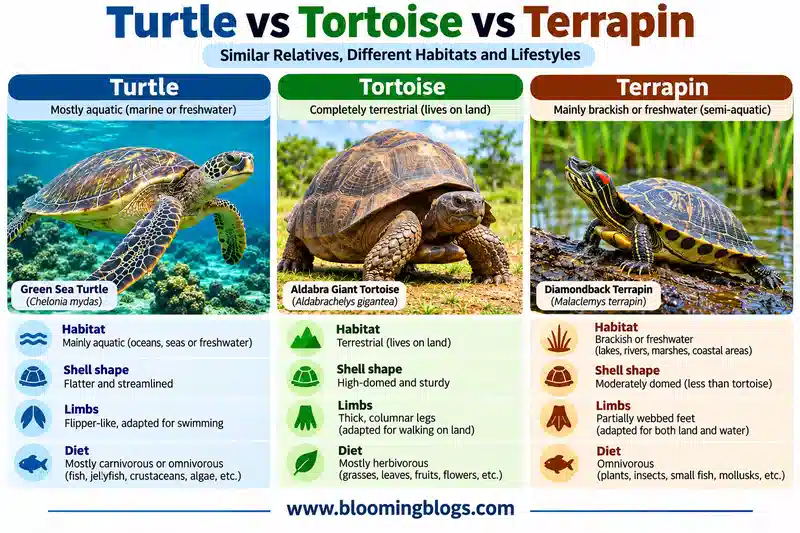
The simplest way to remember the distinction comes down to habitat: turtles live mostly in water, while tortoises live exclusively on land. Scientifically speaking, every tortoise is actually a type of turtle, much like every square is a rectangle. Yet millions of years of evolution shaped these two groups for completely different worlds—one built for swimming through oceans and rivers, and the other engineered for walking across dry forests, grasslands, and deserts.
Turtle vs. Tortoise: Side-by-Side Comparison
| Feature | Turtle | Tortoise |
|---|---|---|
| Primary Habitat | Lives mainly in water (oceans, rivers, ponds, and marshes). | Lives strictly on dry land (deserts, grasslands, and forests). |
| Shell Shape | Flatter, lighter, and streamlined for gliding easily through water. | High-domed, rounded, and heavy for strong ground protection. |
| Feet and Limbs | Webbed feet with claws (freshwater) or long paddle-like flippers (sea turtles). | Sturdy, column-like, elephant-style legs with short, thick toes and claws. |
| Diet | Mostly omnivorous (eats plants, insects, fish, jellyfish, and snails). | Mostly herbivorous (eats grasses, weeds, leafy greens, flowers, and cacti). |
| Swimming Ability | Strong, natural swimmers built for aquatic life. | Cannot swim; only enters shallow water to drink or soak. |
| Lifespan | Typically 20 to 50 years (though some sea turtles live 80+ years). | Often 80 to 150+ years, making them some of the longest-living land animals. |
| Geographical Range | Found across oceans and continents worldwide, except Antarctica. | Found on most continents, with huge diversity in Asia, Africa, and the Americas. |
6 Key Differences Between a Turtle and a Tortoise
1. Habitat and Lifestyle
Turtles spend nearly their entire lives in or near water. Sea turtles stay in the ocean and only come ashore to lay eggs, while freshwater turtles divide their time between swimming and basking on sunny logs or rocks. Tortoises, on the other hand, are strictly terrestrial animals that stay on solid ground and dig burrows to escape extreme heat or cold.
2. Shell Design and Weight
A turtle’s shell is thin, flat, and aerodynamic so it can slice through water with minimal drag. By contrast, a tortoise carries a thick, heavy, dome-shaped shell. This high dome makes it difficult for land predators to bite around the shell or flip the tortoise onto its back.
3. Feet and Flippers
Look at their legs and you will immediately spot the difference. Freshwater turtles have webbed feet with sharp claws that help them paddle in water and climb onto riverbanks, while sea turtles have long, muscular flippers. Tortoises have thick, pillar-like legs that support their heavy shells on dry ground, complete with blunt claws built for digging into soil and sand.
4. Diet and Feeding Habits
Because water environments offer varied food sources, most turtles are omnivores that eat aquatic plants, small fish, insects, crabs, or jellyfish depending on the species. Tortoises are dedicated plant-eaters. They graze steadily on low-growing grasses, wildflowers, leafy weeds, and juicy fruits.
5. Lifespan and Growth
While both reptiles live much longer than most household pets, tortoises hold the crown for longevity. Many freshwater turtles live between 20 and 40 years, whereas giant tortoises—such as the Aldabra and Galápagos species—regularly live well over a century.
6. How They Handle Danger
When threatened, many freshwater turtles quickly dive underwater to escape, while certain box turtles pull their limbs inside a hinged shell. Sea turtles rely on swimming speed to outrun predators. Tortoises cannot run away quickly, so they pull their heads and scaly front legs tightly inside their thick shells, using their tough scales like a locked door until danger passes.
Turtle Facts for Kindergarten and Sea Turtle Fun Facts
Kids love animals with built-in armor, and turtles are some of the most fascinating creatures on Earth! Whether they are paddling slowly in a backyard pond or gliding gracefully through deep blue ocean waves, turtles always spark curiosity in young minds. Sharing turtle facts for kindergarten learners is a wonderful way to introduce children to nature, reptiles, and ocean life using simple words they can easily understand and remember.
Unlike furry puppies or feathered birds, turtles are cold-blooded reptiles that carry their homes right on their backs. They have been walking and swimming on our planet since the time of the dinosaurs! Below, you will find easy, exciting facts about everyday turtles alongside amazing sea turtle fun facts that will make any young explorer smile.
Simple Turtle Facts for Kindergarten Kids
- A Turtle Cannot Leave Its Shell
Many cartoons show turtles stepping out of their shells like a coat, but in real life, a turtle’s shell is attached to its spine and ribs. Their shell grows with them for their entire life! - Turtles Have No Teeth
Even though turtles love crunching on crunchy lettuce, berries, or bugs, they do not have a single tooth in their mouths. Instead, they use a hard, sharp beak—just like a bird—to bite their food. - Turtles Are Older Than Dinosaurs
Turtles have lived on Earth for more than 200 million years. That means ancient turtles were already swimming in rivers and oceans before giant dinosaurs even existed. - Turtles Love Sunbathing
Because turtles are cold-blooded, they cannot warm up their own bodies like humans do. You will often see pond turtles climbing onto sunny rocks or floating logs to soak up warm sunshine. - Some Turtles Live for Over 100 Years
Turtles grow very slowly and live a very long time. Many pet and wild turtles live for 30 to 50 years, and giant tortoises can celebrate more than 100 birthdays! - Turtles Are Found Almost Everywhere
Turtles live on every continent in the world except freezing Antarctica, because it is way too cold there for them to stay warm.
Amazing Sea Turtle Fun Facts
- Sea Turtles Have Flippers Instead of Feet
While pond turtles have webbed feet with little claws, sea turtles have long, flat flippers that work just like paddles to help them swim fast through ocean water. - Sea Turtles Cannot Hide Inside Their Shells
Unlike land turtles that tuck their heads inside when scared, sea turtles cannot pull their heads or flippers into their shells. They stay safe by swimming swiftly away from danger. - Sea Turtles Cry Salty Tears
When sea turtles swim in salty ocean water, they swallow a lot of salt. Special glands near their eyes push out the extra salt, making it look like they are crying big tears on the beach! - Baby Sea Turtles Follow the Moonlight
When baby sea turtles hatch from eggs buried in warm beach sand, they immediately crawl toward the ocean by following the bright reflection of the moon and stars on the water. - Sea Turtles Can Hold Their Breath for Hours
Sea turtles breathe air with lungs just like humans, so they must swim up to the surface for air. However, when they are resting or sleeping underwater, they can hold their breath for several hours at a time! - Sea Turtles Travel Thousands of Miles
Every year, sea turtles swim huge distances across entire oceans to find yummy food like jellyfish and seagrass, yet mother sea turtles always remember how to swim back to the exact beach where they were born to lay their own eggs.
Why Are Sea Turtles Endangered Animals? Understanding the Biggest Threats
Sea turtles have glided smoothly through Earth’s oceans for more than 100 million years, surviving massive climate shifts and even the extinction of the dinosaurs. Yet today, almost every living species faces a serious fight for survival. When people ask why are sea turtles endangered, the honest answer points almost entirely to rapid changes caused by human activity along beaches and out at sea.
Of the seven living sea turtle species, six are classified as threatened with extinction on the IUCN Red List—ranging from Vulnerable to Critically Endangered—while the seventh (the flatback) lacks enough global data to confirm its exact status. Because sea turtles grow slowly and take decades to reach adulthood, losing even a small number of breeding adults can cause entire populations to shrink for generations.
Conservation Status of All 7 Sea Turtle Species
| Sea Turtle Species | Scientific Name | Global IUCN Conservation Status |
|---|---|---|
| Kemp’s Ridley | Lepidochelys kempii | Critically Endangered |
| Hawksbill | Eretmochelys imbricata | Critically Endangered |
| Green | Chelonia mydas | Endangered |
| Loggerhead | Caretta caretta | Vulnerable |
| Leatherback | Dermochelys coriacea | Vulnerable |
| Olive Ridley | Lepidochelys olivacea | Vulnerable |
| Flatback | Natator depressus | Data Deficient (Protected in Australia) |
7 Main Reasons Why Sea Turtles Are Endangered
1. Accidental Capture in Fishing Gear (Bycatch)
The single biggest threat to sea turtles worldwide is getting accidentally caught in commercial fishing nets, shrimp trawls, and longline hooks. Because sea turtles breathe air with lungs, getting trapped underwater in fishing gear prevents them from surfacing, causing hundreds of thousands of turtles to drown each year.
2. Plastic Pollution and Marine Debris
Oceans are filled with floating plastic bags, balloons, straws, and abandoned fishing nets. To a hungry leatherback or green turtle, a floating plastic bag looks identical to a jellyfish. Swallowing plastic blocks their digestive tracts, causes starvation, and often proves fatal, while lost “ghost nets” entangle and injure swimming turtles.
3. Loss and Destruction of Nesting Beaches
Female sea turtles must return to sandy beaches to dig nests and lay their eggs. Rapid coastal construction—such as beachfront hotels, seawalls, ports, and sand mining—destroys the quiet, natural beaches they need. Without safe sandy shores, mothers are forced to lay eggs in poor locations where tides wash the nests away.
4. Artificial Beachfront Lighting
Newly hatched baby sea turtles rely on natural moonlight reflecting off the ocean waves to guide them safely into the water. Bright streetlights, resort lights, and coastal buildings confuse hatchlings, causing them to crawl inland toward roads and predators instead of heading toward the sea.
5. Illegal Hunting and Egg Poaching
Despite strict international laws, sea turtles are still hunted in several parts of the world for their meat, skin, and shells. Hawksbill turtles, in particular, have been heavily poached for their patterned shells to make jewelry and decorative souvenirs. In many regions, coastal poachers also dig up freshly laid eggs to sell in illegal markets.
6. Climate Change and Warming Sand
Rising global temperatures affect sea turtles in two major ways. First, stronger storms and rising sea levels erode nesting beaches and flood underground nests. Second, the temperature of the sand determines whether hatchlings become male or female—warmer sand produces mostly females, creating an alarming shortage of male turtles in many regions.
7. Boat Strikes and Water Pollution
As coastal boat traffic increases, fast-moving vessels frequently collide with sea turtles coming up to breathe, causing severe shell injuries. At the same time, chemical runoff, oil spills, and sewage pollute coastal waters, destroying the coral reefs and seagrass beds where sea turtles feed.
How Everyone Can Help Protect Sea Turtles
1. Reduce Single-Use Plastics
Carrying reusable bags, bottles, and straws keeps harmful plastic waste out of rivers and oceans.
2. Keep Beaches Clean and Dark
If you visit a nesting beach, take all trash home, fill in sand holes so hatchlings do not get trapped, and turn off bright lights facing the ocean at night.
3. Support Sustainable Seafood
Choosing seafood caught with turtle-safe fishing gear, such as Turtle Excluder Devices (TEDs), helps lower accidental bycatch.
4. Never Buy Tortoiseshell Products
Avoid purchasing souvenirs made from turtle shells, coral, or protected marine wildlife.
Sea Turtle Conservation Efforts in India and Worldwide: A Brief Overview
Protecting sea turtles requires teamwork across borders because these marine travelers swim through the waters of dozens of countries during their lifetimes. Today, governments, marine scientists, and coastal communities are leading powerful sea turtle conservation efforts in India and across the globe to bring vulnerable populations back from the brink of extinction.
From strict wildlife protection laws to community-run beach hatcheries, conservation programs focus on guarding nesting mothers, protecting buried eggs, and making the open ocean safer for swimming turtles.
Key Sea Turtle Conservation Efforts in India
India’s vast coastline—especially along Odisha, Gujarat, Tamil Nadu, Maharashtra, Andhra Pradesh, and the Andaman and Nicobar Islands—serves as a critical nesting sanctuary for millions of sea turtles, particularly Olive ridleys and green turtles.
1. Strict Legal Protection Under Schedule I
All five sea turtle species found in Indian waters are listed under Schedule I of the Indian Wildlife (Protection) Act of 1972. This gives them the highest possible legal protection, making hunting, egg collection, or trading turtle products a serious punishable offense.
2. Mass Nesting Protection in Odisha (Operation Kachhapa)
Odisha’s Gahirmatha Marine Sanctuary and Rushikulya rookery host some of the largest mass nesting events (arribadas) in the world. Forest departments, the Indian Coast Guard, and conservation groups patrol these shores, set up temporary fencing to stop stray animals from digging up nests, and enforce seasonal fishing bans near nesting beaches.
3. Community Beach Hatcheries in Gujarat, Maharashtra, and Tamil Nadu
Along the coasts of Gujarat (such as Madhavpur and Dwarka), Maharashtra’s Konkan coast, and Chennai, local villagers and forest officials relocate vulnerable eggs into protected beach hatcheries. Once the baby turtles hatch, volunteers safely release them into the sea at night.
4. Mandatory Turtle Excluder Devices (TEDs)
Coastal states require mechanized shrimp trawlers to fit Turtle Excluder Devices into their nets. These simple metal grids create an escape hatch that lets trapped sea turtles swim out safely while keeping the fishermen’s catch inside.
Major Global Sea Turtle Conservation Initiatives
1. International Trade Bans (CITES)
Under the Convention on International Trade in Endangered Species (CITES), all seven sea turtle species are listed in Appendix I, which strictly bans commercial international trade in sea turtle shells, meat, leather, and eggs.
2. Satellite Tracking and Marine Protected Areas
Marine biologists worldwide attach harmless satellite tags to sea turtles to map their hidden ocean migration routes. Governments use this data to create Marine Protected Areas (MPAs) and restrict heavy shipping or industrial fishing in vital feeding corridors.
3. Lights-Out Beach Ordinances
Many coastal towns in countries like the United States, Costa Rica, Australia, and Greece enforce “lights-out” laws during nesting season, requiring beachfront hotels and homes to use turtle-friendly red lighting or close curtains so hatchlings are not drawn away from the ocean.
4. Global Ocean Cleanup and Ghost-Net Recovery
International organizations partner with local fishers to retrieve abandoned “ghost” fishing nets from coral reefs and open waters, while running beach cleanup drives to keep deadly plastic waste out of sea turtle habitats.
India vs. Worldwide Conservation
| Focus Area | Conservation Action in India | Conservation Action Worldwide |
|---|---|---|
| Legal Framework | Wildlife (Protection) Act, 1972 (Schedule I protection). | CITES Appendix I ban and regional treaties like IOSEA. |
| Beach Protection | Seasonal fishing bans in Odisha and protected hatcheries in Gujarat and Maharashtra. | Protected national parks (such as Tortuguero in Costa Rica) and lights-out laws. |
| Fishing Safety | Mandatory Turtle Excluder Devices (TEDs) on coastal trawlers. | Circle hooks on longlines and TEDs in international shrimp fisheries. |
| Public Involvement | Local fisherfolk and youth volunteers guarding nests and releasing hatchlings. | Ecotourism programs and global citizen-science nesting patrols. |
Green Sea Turtle: Endangered Facts, Status & Are Sea Turtles Going Extinct?
For decades, the green sea turtle (Chelonia mydas) stood as a global symbol of endangered ocean wildlife. Divers, coastal villagers, and biologists love watching this calm reptile glide across sunlit seagrass beds and coral reefs. Behind that peaceful look lies a dramatic survival story of steep decline followed by a hard-won recovery.
If you want to understand green turtle endangered facts or ask are sea turtles going extinct, recent wildlife data delivers both great news and an urgent warning. Global green sea turtle numbers have rebounded after decades of strict protection. Yet sea turtles as a whole still face heavy human threats that require constant care.
Quick Profile of the Green Sea Turtle
| Feature | Details |
| Common Name | Green sea turtle (also called green turtle, or black turtle in the Eastern Pacific) |
| Scientific Name | Chelonia mydas |
| Average Adult Size | 80 to 120 cm (3 to 4 feet) in shell length |
| Average Adult Weight | 110 to 190 kg (reaching up to 300 kg in large adults) |
| Primary Diet | Herbivorous adults (seagrass and marine algae); omnivorous hatchlings |
| Turtle Life Span | 70 to 80+ years in the wild |
| Global IUCN Status | Least Concern (upgraded from Endangered after a ~28% global population rise) |
Green Sea Turtle Endangered Status: A Historic Comeback
The green sea turtle endangered status shifted dramatically after years of global teamwork. Here is how the species bounced back and why local vigilance still matters:
- Upgraded from Endangered to Least Concern: The IUCN Red List classified the green sea turtle as Endangered starting in 1982. After global numbers rose by roughly 28 percent since the 1970s, the IUCN reclassified the species to Least Concern.
- Why Green Turtle Numbers Recovered: This comeback happened because people took strong action across more than 80 nesting countries. Governments banned turtle hunting and egg poaching, guards protected beach hatcheries, and fishing boats adopted Turtle Excluder Devices so millions of hatchlings could reach open water safely.
- Regional Subpopulations Still Face Danger: Global recovery does not mean every population is safe. Out of 11 distinct regional subpopulations worldwide, several groups—including those in the Central South Pacific and parts of the Indian Ocean—still decline and need strict local protection.
Four Fascinating Green Sea Turtle Facts
Sharing sea turtle fun facts helps kids and adults appreciate why every turtle deserves protection:
- Their Name Comes from Body Fat, Not Shell Color: A green sea turtle actually has a brown, olive, or dark black upper shell. Scientists named the species after the greenish fat and cartilage under its shell, which turns green from a lifelong diet of seagrass and algae.
- They Act as Gardeners of the Ocean: Adult green sea turtles are the only strict plant-eaters among all seven sea turtle species. By grazing on the tips of seagrass blades, they keep underwater meadows healthy and maintain safe nurseries for young fish and crabs.
- Mothers Return to Their Exact Birthplace: Female green sea turtles use Earth’s magnetic field like a built-in GPS. They swim thousands of miles across open oceans to lay eggs on the very beach where they hatched decades earlier.
- They Take Decades to Reach Adulthood: Wild green sea turtles grow at a slow, steady pace. A young turtle needs 20 to 40 years before it reaches adulthood and lays its first clutch of eggs.
Are Sea Turtles Going Extinct? The Bigger Picture
Asking why are sea turtles endangered reveals a sobering truth about the wider reptile family. While one species celebrated a milestone, the broader group still fights for survival:
- Most Sea Turtle Species Remain Threatened: Out of seven living sea turtle species, two—the Kemp’s ridley and the hawksbill—remain Critically Endangered. Three more—the loggerhead, leatherback, and olive ridley—carry Vulnerable status.
- Human Threats Continue Every Day: Hundreds of thousands of sea turtles still die each year in commercial fishing nets as accidental bycatch. Many others swallow drifting plastic bags that look like jellyfish or lose nesting beaches to bright coastal hotels and seawalls.
- Climate Change Creates New Survival Hurdles: Rising seas wash away low-lying coastal nests before eggs can hatch. Hotter beach sand also skews hatchling gender ratios, producing far more females than males and threatening future breeding.
- Active Conservation Prevents Extinction: Sea turtles are not doomed to vanish when communities step up to protect them. Whenever laws stop poaching, beaches stay dark and clean, and fishers use turtle-safe gear, wild populations prove they can recover.
Turtle Adoption Day: How to Adopt a Sea Turtle Today & Protect Wild Shells
People celebrate Turtle Adoption Day every year on November 27. This special day raises awareness about turtle welfare, promotes ethical rescue care, and funds global conservation programs.
Wild turtles and tortoises belong in nature, and strict laws protect most species worldwide. Because of this, modern celebrations focus on symbolic wild adoptions rather than taking animals from the wild. Sponsoring a turtle’s rescue, medical treatment, or nest protection lets you make a real impact from anywhere.
Five Meaningful Things Everyone Should Do on Turtle Adoption Day
You do not need to live near an ocean beach to help save wild turtles. Here are five practical actions anyone can take right now:
- Symbolically Adopt a Wild Turtle: Skip the glass tank and sponsor a wild sea turtle or tortoise through a verified charity for turtles. Most programs send you a personalized adoption certificate, a species fact sheet, and updates on your turtle’s medical recovery or nesting beach.
- Choose Ethical Rescue Over Pet Shops (Where Legal): Never buy wild-caught turtles from shops or markets. If you live in a region where keeping non-native pet turtles is legally permitted, consider adopting an abandoned turtle from a licensed reptile rescue shelter instead. Remember that turtles live 30 to 50 years and require specialized UV lighting, heavy filtration, and expert veterinary care. (Important legal note: In India, keeping native Indian turtles or tortoises as pets is strictly illegal under the Wildlife Protection Act, 1972.)
- Cut Down on Single-Use Plastics: Floating plastic bags and abandoned fishing lines rank among the deadliest threats to marine and freshwater turtles. Switching to reusable shopping bags, cloth produce sacks, and refillable bottles directly keeps oceans and rivers safer.
- Support Turtle-Safe Beaches and Rivers: When you visit coastal areas or riverbanks, join local cleanup drives and stay clear of marked nesting zones. Keep beachfront lights dim or off during hatching season so baby turtles do not crawl inland by mistake.
- Spread Verified Facts Online: Use your social media channels to explain why wild turtles should never be removed from ponds, rivers, or beaches. Highlighting vetted rescue teams inspires friends and family to donate to sea turtles instead.
Trusted Charities to Donate or Symbolically Adopt a Sea Turtle Today
Linking directly to verified, registered non-profit conservation charities is completely Google AdSense compliant and adds high trust value for readers. Before giving, always verify that the charity publishes transparent conservation reports.
International Sea Turtle & Turtle Conservation Charities
- Sea Turtle Conservancy (STC): As one of the world’s oldest sea turtle research and protection groups, STC offers symbolic adoptions complete with personalized certificates and educational conservation guides. Visit the official Sea Turtle Conservancy website to explore adoption kits.
- Olive Ridley Project: This team rescues sea turtles entangled in ghost fishing nets across the Indian Ocean and treats injured patients at marine veterinary clinics. You can name and symbolically adopt a wild turtle or recovering clinic patient on the official Olive Ridley Project site.
- SEE Turtles (Billion Baby Turtles): SEE Turtles protects endangered hatchlings across more than 50 nesting beaches worldwide, where every $1 donated helps save at least 10 baby sea turtles. Learn more or sponsor hatchlings through SEE Turtles.
- Turtle Survival Alliance (TSA): TSA works globally to prevent extinction among the world’s rarest freshwater turtles and land tortoises through science-based breeding and habitat protection. Explore their conservation programs on the Turtle Survival Alliance website.
- Turtle Foundation: This organization protects endangered sea turtles and guards nesting beaches in Indonesia and Cape Verde, offering both general donations and one-year symbolic adoptions.
Verified Turtle Charities & Conservation Groups in India
- Turtle Survival Alliance Foundation India (TSA India): TSA India protects threatened freshwater turtles and tortoises across major Indian river basins, and donations by Indian citizens qualify for Section 80G tax deductions.
- TREE Foundation India: TREE Foundation runs community-based Sea Turtle Protection Forces, coastal hatcheries, and marine rescue centers along India’s coastline. Visit TREE Foundation India to support their coastal conservation work.
- Dakshin Foundation: Dakshin conducts long-term sea turtle monitoring and partners with fishing communities across Odisha, the Andaman and Nicobar Islands, and Lakshadweep. Explore their marine projects at Dakshin Foundation.
- ReefWatch Marine Conservation: ReefWatch protects coral reefs, sea turtles, and coastal ecosystems across India through citizen science, education, and marine rehabilitation. Learn more on the ReefWatch Marine Conservation website.
Quick Comparison: Where to Adopt a Sea Turtle Today
| Organization | Primary Conservation Focus | Adoption & Donation Options |
| Olive Ridley Project | Injured sea turtle rescue & ghost-net removal in the Indian Ocean | Symbolic adoption of a clinic patient or wild turtle |
| Sea Turtle Conservancy | Sea turtle research & habitat protection across the Americas and Caribbean | Symbolic e-adoption certificates & educational gift kits |
| SEE Turtles | Hatchling protection across 50+ global nesting beaches | Direct baby hatchling sponsorship & symbolic adoption |
| TSA Foundation India | Freshwater turtles & tortoises in Indian river systems | Direct conservation donation (80G tax-exempt in India) |
| TREE Foundation India | Coastal sea turtle hatcheries & fisher outreach in India | Direct program donations & community conservation support |
Final Thoughts: One Turtle Truly Can Change Your Life
A turtle moves through the world with quiet patience and remarkable strength. When you pause on Turtle Adoption Day to learn its story, your perspective on nature shifts for good. You stop seeing oceans and rivers as distant places and start seeing them as living homes worth defending.
You do not need a beachfront house or a marine biology degree to make a difference. Sponsoring one wild sea turtle, refusing single-use plastic bags, or sharing honest conservation facts creates ripples that protect entire ecosystems. Choose one meaningful action today—because saving even one turtle helps keep an ancient legacy alive for generations to come.
References & Further Reading
- IUCN-SSC Marine Turtle Specialist Group (MTSG): Official global and regional Red List conservation assessments for all seven sea turtle species on the IUCN-SSC Marine Turtle Specialist Group Red List Assessments page.
- World Wildlife Fund (WWF): Global species profiles, seagrass ecosystem research, and marine turtle conservation data on the World Wildlife Fund Sea Turtle Overview page.
- Sea Turtle Conservancy (STC): Long-term sea turtle migration tracking, Turtle Excluder Device (TED) advocacy, and symbolic adoption programs at Sea Turtle Conservancy.
- Olive Ridley Project: Indian Ocean ghost-net rescue data, marine veterinary rehabilitation reports, and sea turtle identification databases on the Olive Ridley Project website.
- The Wild Life (Protection) Act, 1972 (Government of India): Official statutory text and legal schedules protecting native Indian sea turtles, freshwater turtles, and land tortoises from capture and trade via the Ministry of Tribal Affairs Wild Life (Protection) Act, 1972 PDF.
Editorial & Conservation Disclaimer
This article provides educational information on turtle biology, global conservation status, and ethical wildlife support. Always follow local, national, and international wildlife laws before interacting with wild turtles or supporting animal welfare programs. In India, capturing, buying, selling, or keeping native turtle and tortoise species is strictly prohibited under the Wildlife Protection Act, 1972. Before donating or sponsoring a symbolic turtle adoption, verify the organization’s official registration and conservation credentials.
🌱 Continue Exploring…
Whether you’re nurturing a newborn, curating a sanctuary for your home and garden, or simply looking to level up your day-to-day life, there’s always a new perspective waiting to be discovered. From practical everyday parenting guidance, women’s wellness information, ideas to make your home more beautiful, tips for caring for pets and plants, or inspiration for your spiritual journey, Blooming Blogs brings useful knowledge together in one place.
Blooming Blogs — knowledge that blooms.
🌸 Blooming Blogs Promise
We’re here to bring you thoughtful, reliable, and helpful insights you can truly count on. Every article on Blooming Blogs is thoroughly researched, crafted with care, and written with genuine empathy to support you in your everyday journey. Your trust means everything to us, and we are dedicated to sharing content that informs, inspires, and makes your life a little easier.
📰 Editorial Notes
Our team strives for clarity, accuracy, and depth in every piece we publish. Content is periodically updated to ensure facts, recommendations, and guides stay relevant over time. While we consult trusted sources and expert research, our goal is always to present complex topics in a simple, practical, and conversational way that works for real life.
⚠️ Disclaimer
The content provided on Blooming Blogs is for informational and educational purposes only and should not be considered professional medical, legal, or financial advice. Always consult with a qualified expert or licensed professional before making decisions related to your health, family, or personal finances. Blooming Blogs is not liable for any actions taken based on the information provided on this website. (For full details, please visit our Disclaimer Policy Page).
💬 Share Your Experience — Leave a Comment
We’d love to hear from you! Did this article help you, or do you have a personal tip or story to share with our community? Drop your thoughts, questions, or feedback in the comment section below. Every voice enriches our community, and we read every single comment!