


Introduction
If you are sitting on the edge of your bed at 2:00 AM, bouncing a red-faced, bicycle-kicking newborn while googling how to relieve trapped tummy bubbles, take a deep breath. You are doing an amazing job, mama. New parenthood hits you like a tidal wave—suddenly you are responsible for decoding every tiny grimace, arch of the back, and midnight cry without a user manual. Learning about infant massage can give you another gentle way to comfort your little one and build confidence in those early parenting days.
When your baby is uncomfortable, gassy, or overtired, feeling helpless is the worst part. That is exactly why having a reliable, pediatric-informed infant massage routine in your parenting toolkit can be so valuable. Long before your baby understands words, touch is one of their earliest ways of experiencing comfort, connection, and reassurance. Through gentle, intentional strokes, you can help your baby feel safe, warm, and deeply loved while encouraging relaxation and easing everyday physical tension.
In this complete A-to-Z guide, we are cutting through the internet noise and giving you everything you need to feel confident at home. You will learn the science-backed infant massage benefits, exactly when to start massaging a newborn, which infant massage oils are safe (and which ones to toss immediately), and step-by-step routines—including the famous “I Love You” infant massage for gas, colic, and constipation. Grab a warm towel, silence your phone, and let’s walk through this together.
What Is Infant Massage?
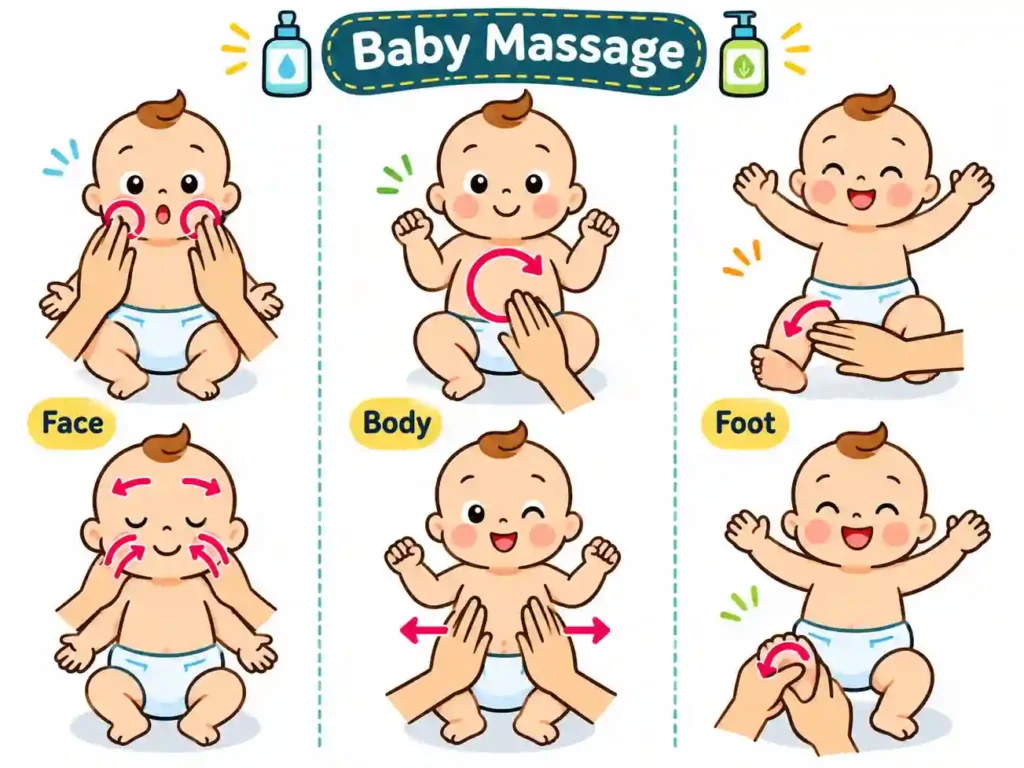
Infant massage is a gentle way to touch and comfort your baby using your hands. It involves softly stroking different parts of your baby’s body. You can also use light pressure and gentle kneading. Slowly moving your baby’s arms and legs is another part of the practice. Unlike adult deep-tissue massage, baby massage always uses soft and comfortable movements.
More Than Just a Gentle Touch
Infant massage is about much more than physical touch. It is a special time you share with your baby, not something you simply do to them. You can look into your baby’s eyes and talk in a soft voice. Pay attention to their little movements and facial expressions. These simple moments make the experience more loving and comforting.
Your baby may not understand your words yet. However, they can recognize your voice and feel your gentle touch. They also respond to your closeness and attention. Watching these small reactions helps you understand what makes your baby comfortable.
A Tradition Supported by Modern Research
Families across many cultures have practiced baby massage for centuries. Today, modern pediatric research also explores its possible benefits. Parents often enjoy this practice as a way to connect with their little ones. It can encourage bonding, relaxation, and loving interaction during the early months.
From the Comfort of the Womb to the Outside World
Think of infant massage as a gentle bridge between the womb and the outside world. Before birth, your baby was surrounded by warm amniotic fluid. The uterine walls also provided gentle and constant pressure. This created a cosy and familiar environment.
After birth, everything feels different. Your baby experiences more open space, new sounds, and changing temperatures. Their digestive system is also adjusting to life outside the womb. These changes can sometimes make babies feel unsettled. They may also trigger the natural startle reflex or moments of stress.
How Gentle Touch Can Comfort Your Baby
Slow and predictable touch can remind your baby of the comfort they experienced before birth. Gentle strokes can create a familiar feeling of closeness and security. They also give you a chance to respond to your baby’s needs.
Always follow your baby’s signals during massage. Use slow, soothing movements and keep the experience comfortable. This loving routine can help your little one feel safe, protected, and deeply loved.
Infant Massage: A Tradition Across the World
For generations, parents in many countries have used gentle massage as part of baby care.
1. Ancient India (Ayurveda): Baby oil massage, known as Abhyanga, has been practiced for thousands of years. Families use it for daily care and relaxation.
2. Traditional China: Tuina is an old massage practice that uses gentle hand movements. It has been used in traditional child care, including for tummy comfort.
3. Africa and Eastern Europe: Many families have passed down gentle baby massage and stretching routines. These practices encourage closeness between parents and babies.
4. Modern Hospitals: Some hospitals teach parents gentle massage techniques, especially when caring for premature babies. These techniques are adapted to each baby’s medical needs.
Benefits of Infant Massage
Gentle massage isn’t just a sweet bonding ritual—it can meaningfully support both a baby’s growth and a parent’s well-being. Here is what research and clinical experience point to in everyday terms:
Growth, Digestion, and Comfort
- Supports weight and head growth: Regular massage can help babies gain weight and may ease discomfort or help clear jaundice. In premature babies, studies have linked massage to gains in overall weight and head size, though it does not appear to change how fast they grow in length.
- Easier digestion and feeding: Gentle touch can help babies handle feedings more comfortably and supports healthy brain and nervous system development.
- Calms fussiness and colic: Because of its relaxing effect, massage can help soothe fussy babies dealing with colic.
Better Sleep and Feeding Routines
- Helps baby—and mom—sleep better: Adding massage to a bedtime routine can help babies drift off faster, wake less often during the night, and stay asleep for longer stretches. When babies sleep better, mothers often get more nighttime rest and have fewer sleep struggles too.
- Supports longer breastfeeding: Families who build massage into their routines are also more likely to continue breastfeeding up to six months.
Brain Development and Parent Well-Being
- Encourages brain maturity: Brain-wave readings (EEG) from research studies suggest that infant massage helps support healthy brain maturation over time.
- Lowers stress and builds confidence for parents: The benefits go both ways. Parents who massage their babies in a neonatal intensive care unit (NICU) often report feeling less stressed and less depressed, and over time it can help mothers feel more confident caring for their baby.
- Helps parents of babies with Down syndrome: In one study, parents who practiced infant massage with babies who have Down syndrome experienced short-term gains in acceptance, commitment, and feeling more aware of their positive impact.
A quick tip before you start: Every baby is different—watch your baby’s cues for comfort, keep strokes gentle, and check with your pediatrician first if your baby was born early or has specific health needs.
How Infant Massage Strengthens Parent-Baby Bonding
At its heart, infant massage is all about human connection. Through simple, focused time together, it naturally encourages:
- Skin-to-skin closeness: Direct, warm touch helps your baby feel safe and settled.
- Steady eye contact: Looking at each other builds trust and helps you tune in to what your baby is feeling.
- Two-way communication: Over time, you learn to read your baby’s small body cues and respond with gentle care—creating a real back-and-forth bond before your baby can even speak.
When parents learn massage techniques early on—such as during a hospital stay—it gives them a practical, comforting habit they can bring home and use well past the newborn stage to support their child’s emotional and physical growth.
Touch: A Baby’s First Language
From the very beginning, touch is how babies understand the world. That is why many hospitals place newborns directly onto a mother’s chest right after birth for skin-to-skin contact. Loving, consistent touch helps tiny babies feel less anxious and grow stronger. Research also shows that babies who receive regular, gentle touch make noticeably more eye contact—about 50% more—and are three times more likely to show happy, positive facial expressions compared to babies who don’t.
Everyday Benefits of Gentle Touch
Beyond bonding, regular massage supports your baby—and you—in practical ways:
- Calms fussiness and aids digestion: Helps reduce crying and eases gas, colic, and constipation.
- Supports healthy growth and sleep: Encourages steady daily weight gain and helps babies settle into deeper, smoother nighttime sleep.
- Eases common discomforts: Can gently relieve stuffy noses and teething pain.
- Builds physical strength: Improves muscle tone, flexibility, coordination, and body awareness, while keeping skin soft and supporting immune health.
- Relaxes and empowers parents: Slows things down so both you and your baby feel calmer, helping you grow more confident as a caregiver.
How Infant Massage Brings Parents and Babies Closer
A mother’s attachment begins during pregnancy and deepens after birth into a warm, shared bond that both mother and baby enjoy—and massage helps nurture that closeness.
Fathers benefit just as much. When dads take part in learning and practicing infant massage, it gives them hands-on confidence and creates a stronger, closer connection with their baby. Studies suggest that massage lowers stress and builds attachment equally well for both moms and dads, making it an especially meaningful way for fathers to stay grounded and connected through the ups and downs of early parenthood.
How Infant Massage Helps a Baby’s Body Grow and Move
When babies feel gassy, colicky, or uncomfortable, they often tighten up their bodies and seem stiff. Holding onto that tension makes it tougher for them to stretch out, move around freely, and explore the world around them.
Gentle, regular infant massage helps ease that physical tightness and supports healthy movement in a few simple ways:
- Boosts blood flow and body awareness: Soft, rhythmic strokes improve circulation and help babies gradually notice and understand how their arms, legs, and trunk feel and move.
- Supports balanced muscle tone: Relaxing tight muscles helps a baby’s body feel looser, more flexible, and better prepared for everyday milestones like rolling or reaching.
- Encourages natural movement and curiosity: When a baby feels comfortable and relaxed in their own skin, they are much more eager to stretch, wiggle, and explore.
Calming the Body to Ease Tummy Troubles
Gentle touch also activates the parasympathetic nervous system—the body’s built-in “rest and digest” mode. When this calming response kicks in, the digestive tract moves more smoothly, making it easier for trapped gas to pass and helping your baby feel settled and comfortable again.
How Infant Massage Helps a Baby’s Brain Develop
A baby’s brain grows at an incredible pace during the first year of life, and warm, loving touch plays a big part in shaping that development.
Gentle massage helps soothe and steady a baby’s developing nervous system, guiding them into a calm yet awake state—the sweet spot where babies learn best. When a baby feels safe, cared for, and settled in their body, they are much more ready to look around, pay attention, and connect with the world around them.
Using Baby Massage to Calm Down and Sleep Better
Every parent wants to help their baby get deeper, more peaceful rest. Adding a gentle massage to your day can make bedtime smoother in three simple ways:
- Releases body tension: Soft, slow strokes help tight little muscles relax after a busy day of new sights and sounds.
- Eases everyday discomfort: Calming touch soothes minor aches or tummy troubles that might otherwise keep a baby restless.
- Helps babies drift off smoothly: Feeling warm, secure, and relaxed makes it much easier for a baby to settle down into sleep.
As babies grow older, a short massage before bed also works as a comforting nightly cue—letting them know the day is winding down and it is time to rest.
When Can You Start Massaging a Newborn?
Parents can begin with gentle, nurturing touch from birth, provided the baby is medically stable and the care team has no concerns.
However, full-body massage using oil should be approached carefully during the newborn period.
Newborn massage timeline
| Baby’s age | Suggested approach |
|---|---|
| Birth to first few days | Skin-to-skin contact and gentle holding |
| First 1–2 weeks | Light touch; protect the healing umbilical stump |
| After the cord has healed | Gradually introduce gentle massage if the baby is comfortable |
| 1–3 months | Short, gentle sessions adapted to the baby’s response |
| 3–6 months | Continue gentle massage as part of positive interaction |
| 6–12 months | Adapt techniques as the baby becomes more active |
There is no universal age at which every baby must begin a structured massage routine.
If your baby was premature, has a skin condition or has a medical concern, ask your pediatrician first.
Why should you protect the umbilical cord stump?
The umbilical stump needs to remain clean and dry while it heals.
Avoid applying oil, lotion or massage products directly to it.
Wait until the stump has separated and the area has healed before including the tummy in a full-body oil massage.
If you notice redness spreading around the navel, discharge, an unpleasant smell or fever, seek medical advice.
Best Time to Massage Your Baby
You can begin gentle, short baby bonding activities like light stroking over your baby’s legs and back from day one, provided your baby is full-term and healthy. However, most pediatricians and certified infant massage instructors recommend waiting until your baby is 10 to 14 days old (or once the umbilical cord stump has fallen off and healed completely) before doing full-body sessions with oil.
- Best Time of Day: Aim for the “quiet alert” state—when your baby is awake, calm, and looking around, not crying from hunger or exhausted from over-tiredness.
- Watch the Clock Around Feeds: Wait at least 30 to 45 minutes after a feeding before doing a baby belly massage. Massaging a full stomach too soon can trigger spit-up.
- Before or After a Bath? Many parents love doing baby massage after bathing because warm water relaxes muscles and opens pores. However, because oil makes skin slippery, never pick up an oiled baby to put them into a tub—always bathe first, dry thoroughly, and massage afterward.
Good Opportunities for Baby Massage
- After a nap.
- During a quiet period in the morning.
- Before bedtime, if your baby enjoys it.
- At another relaxed time between feeds.
When to Avoid Baby Massage
- Immediately after feeding.
- When your baby is hungry.
- When your baby is crying intensely.
- When your baby is unusually sleepy.
- During fever or illness.
- When your baby is showing signs of discomfort.
Gentle Reminder: Do not wake a sleeping baby simply to maintain a massage schedule.
How to Prepare for Infant Massage
Preparing the room and gathering everything you need before starting will help make your baby’s massage session comfortable, calm and safe.
1. Prepare the Room and Massage Area
- Choose a warm, quiet room where you and your baby feel comfortable. Keep the temperature pleasant so your baby does not become cold while undressed.
- Make sure the room temperature is suitable for both you and your baby. You may refer to Red Nose’s room temperature guidance.
- Dim the lights if your baby finds bright lighting uncomfortable.
- Consider playing soft, calming music.
- Gather everything you may need before beginning so you do not have to leave your baby unattended.
- Remove your jewellery and wash your hands thoroughly.
- Keep your fingernails short and smooth to avoid accidentally scratching your baby’s delicate skin.
2. Choose a Safe Surface
- Place a clean, soft towel or baby massage mat on a flat, stable surface.
- The floor is generally a safer choice because it reduces the risk of your baby falling.
- You can also use a sofa or bed only when you remain in close contact with your baby and prevent them from rolling or falling.
- Avoid slippery surfaces and never leave your baby unattended on a raised surface.
- A changing table or another raised table may be convenient, but it requires your full attention throughout the session.
Important Safety Reminder: Never leave your baby unattended on a changing table, bed, sofa or any raised surface. Babies can suddenly move or roll, even before they can roll independently.
3. Gather the Essential Supplies
Keep these items within easy reach before starting:
- A clean, soft towel or massage mat.
- Clean nappies.
- Comfortable baby clothing.
- A suitable infant massage oil or product, if needed.
- A waterproof sheet or protective pad underneath the towel, if necessary.
- A warm room and clean hands.
4. Prepare the Massage Oil
- Choose a suitable, gentle product intended for your baby’s delicate skin.
- Avoid fragranced products, essential oils and ingredients that may irritate your baby’s skin.
- Pour a small, coin-sized amount of the selected product into your palm.
- Rub your palms together gently to spread and warm the product.
- If you are introducing a new product, check with your healthcare professional about its suitability and watch for any signs of skin irritation.
You do not have to use oil for every massage. Gentle massage can also be done without it.
5. Ask Your Baby’s Permission
Although a newborn cannot understand spoken instructions, using a familiar starting cue can help make massage part of responsive caregiving.
- Rub your hands together to make them warm.
- Gently bring your hands near your baby.
- Make eye contact and softly say, “Would you like a little massage?“
- Pause for a moment and observe your baby’s response.
- Begin only when your baby appears relaxed and comfortable.
Watch your baby’s body language throughout the session. If your baby turns away, cries, stiffens, becomes unsettled or shows signs of discomfort, pause or stop the massage.
Parent Tip: Your baby’s comfort matters more than completing a massage routine. Keep the experience gentle, flexible and guided by your baby’s cues.
How to Pick the Best Massage Oil for Your Baby
You don’t actually need oil for every single baby massage. Many parents enjoy doing a gentle “dry” massage over soft clothes or directly on skin, while others prefer a little oil to help their hands glide smoothly without pulling.
Because a newborn’s skin is super thin and delicate, what you put on it matters a lot. Plus, every bottle claims to be “pure” and “gentle.” When selecting infant massage oils, remember one golden rule: babies put their hands and feet in their mouths constantly. Anything you put on their skin should be edible-grade, cold-pressed, and completely free of synthetic fragrances.
6 Questions to Ask Before Buying an Oil
Walking down the baby aisle can get confusing when every bottle promises to be “pure” and “gentle.” Keep these quick checks in mind:
- Is it made for newborn skin? Don’t grab just any kitchen cooking oil off the shelf; look for a clean, infant-safe product.
- Is it completely fragrance-free? Added perfumes and synthetic scents can easily irritate fresh baby skin.
- Is it free of essential oils? Concentrated plant oils are too strong for babies.
- Is the ingredient list short and simple? Fewer ingredients mean fewer chances of a skin reaction.
- Does your baby have eczema or allergies? Sensitive or eczema-prone skin needs extra care and a doctor’s go-ahead.
- Has your pediatrician approved it? When in doubt, your baby’s doctor is your best guide.
How to Do a Safe Patch Test First
Even the purest natural oil can occasionally trigger a reaction. Before giving a full-body massage with a new oil or lotion, follow these four steps:
- Check with your pediatrician to make sure the oil fits your baby’s skin type.
- Dab a tiny drop onto a small patch of your baby’s arm or leg.
- Wait and watch for 24 hours to see how their skin handles it.
- Stop right away if you notice any redness, tiny bumps, dryness, or irritation. (Keep in mind that while a patch test is a smart safety habit, an allergy can still occasionally show up later on.)
Popular Baby Massage Oils at a Glance
| Oil Type | Best For & What to Keep in Mind |
| Cold-Pressed Virgin Coconut Oil | Top Pick for all skin types. A superstar choice for infant massage coconut oil lovers. It absorbs nicely, smells subtly sweet naturally, and has mild antibacterial properties.Check with your doctor if your baby has eczema. |
| Cold-Pressed Sweet Almond Oil | Smooth and light. Lightweight, rich in Vitamin E, and glides effortlessly without feeling overly greasy (skip if there is a severe family history of tree nut allergies until cleared by your doctor) |
| Cold-Pressed Sunflower Seed Oil | Great everyday option. Rich in linoleic acid, which helps strengthen a newborn’s delicate skin barrier. |
| Jojoba or Grapeseed Oil | Sensitive skin. Gentle, unscented, and low-allergy choices that won’t feel heavy. |
| Infant Mineral Oil | Basic glide. Safe if it is pure, medical/infant-grade, and unscented—though it sits on the skin rather than nourishing it. |
| Olive Oil | Skip for newborns. High in oleic acid, which can weaken a baby’s developing skin barrier and worsen dryness. |
| Mustard Oil | Skip for newborns. Even though it is traditional in many homes, pediatric doctors advise against it because it can irritate and damage fragile baby skin. |
A Closer Look at Common Oils
- Sunflower Seed Oil: One of the most studied oils for baby skin care. Cold-pressed sunflower oil rich in linoleic acid supports and protects the outer layer of newborn skin rather than breaking it down.
- Cold-Pressed Virgin Coconut Oil: A longtime favorite in many households. It feels comforting, absorbs nicely, and smells faintly sweet on its own. Still, even natural oils can occasionally bother extra-sensitive skin, so watch how your baby responds.
- Cold-Pressed Sweet Almond Oil: Lightweight and silky without feeling overly sticky. Because it comes from tree nuts, always check with your pediatrician first if allergies run in your family.
- Pure Infant Mineral Oil: Plain, fragrance-free, paraben-free, and sulfate-free baby mineral oil is generally gentle and unlikely to cause allergies. Always check the label for a simple, clean formula without harsh preservatives, dyes, or heavy perfumes, which can easily irritate delicate newborn skin.
Oils to Keep Off Newborn Skin
- Mustard Oil*: While used for generations in many Indian households, pediatric skin experts recommend avoiding it for routine baby massage. It contains natural compounds (like erucic acid) that can trigger redness, rashes, and weaken the skin’s protective barrier.
- Olive Oil: Even though olive oil is healthy to eat, it is very high in oleic acid. Studies show this can actually disrupt a newborn’s fragile skin barrier and make dry patches or eczema worse.
- Essential Oils: Never mix essential oils—like lavender, eucalyptus, or tea tree—into your baby’s massage oil unless a qualified doctor specifically tells you to. A young baby’s skin and lungs are far too sensitive for concentrated oils.
*Mustard oil has been a trusted favorite for baby massages across northern India for generations. However, a few studies have raised questions about whether its natural erucic acid might irritate or weaken a newborn’s delicate skin barrier. While there isn’t enough proof to label it strictly unsafe, it is smart to check with your pediatrician before making it part of your regular routine.
Infant Massage Techniques: Step-by-Step Guide
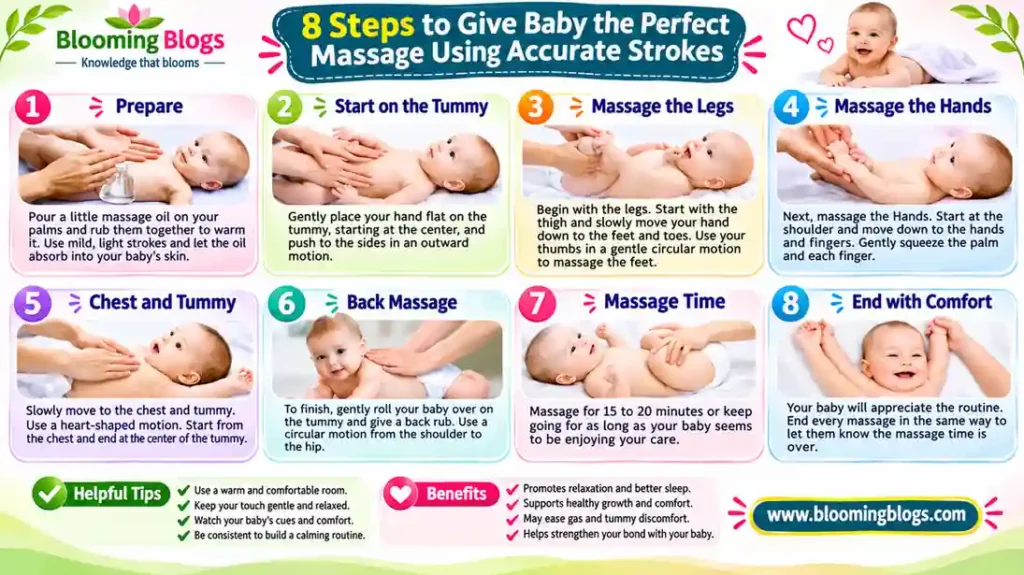
You don’t need fancy techniques to give your baby a wonderful massage—just warm hands, slow movements, and your full attention. Starting with the legs and feet works best for beginners because babies are already used to having their legs touched during diaper changes.
1.Set up a warm, cozy space:Takes 1 minute.
Choose a warm, draft-free room and lay your baby on a soft towel over a firm, safe surface like a bed or floor mat. Keep your baby in just a diaper (or light onesie if the room is cool), remove any rings or watches, and warm a few drops of baby-safe oil between your palms.
2.Ask permission and make eye contact:
Rub your warm hands together within your baby’s view so they hear the soft sound, look into their eyes, and softly say, “May I massage you?” Watching for calm body language—like relaxed hands and steady eye contact—builds trust before you even touch them.
3.Start with gentle leg strokes:Least sensitive area for beginners.
Cup one hand around the top of your baby’s thigh and glide smoothly down toward the ankle, then repeat with your other hand in a slow, gentle milking motion. Switch to the other leg after three or four slow strokes.
4.Massage the soles and tiny toes:
Use your thumbs to make soft, circular presses along the sole of each foot from the heel up to the toes. Finish by gently squeezing and rolling each tiny toe between your thumb and index finger.
5.Move to the tummy with clockwise circles:Skip right after a feeding.
Place your flat palm on your baby’s belly just below the ribs and trace slow, clockwise circles around the belly button (following the natural direction of digestion). Keep your touch feather-light, and avoid the belly button area if a newborn’s umbilical cord stump has not fallen off yet.
6.Glide softly over the chest and arms:
Rest both hands flat on the center of your baby’s chest and glide outward toward the shoulders, like smoothing the pages of an open book. Next, gently stroke down each arm from shoulder to wrist and lightly massage the palms.
7.Finish with back strokes and a cuddle:
If your baby still seems happy and relaxed, gently roll them onto their tummy and sweep your hands from the neck down to the bottom in long, soothing strokes. Wrap your baby up right away afterward to keep them warm and enjoy a quiet cuddle.
Watch your baby’s cues: If your baby arches their back, turns their head away, stiffens up, or starts crying, pause the massage right away. Even a 2-minute session is plenty when your baby is young.
Simple Infant Massage Strokes for Trapped Gas
When a baby is squirming, pulling their knees up, or fussy from trapped gas, gentle tummy strokes and leg movements help move gas bubbles along the digestive tract naturally. Always work clockwise on your baby’s belly—that is the natural direction food and gas travel through the large intestine—and wait at least 30 to 45 minutes after a feeding so your baby doesn’t spit up.
1. Paddling (Water Wheel)
Rest the outer edge of one hand just below your baby’s rib cage and gently glide it straight down toward the top of the diaper. As that hand lifts off, place your other hand at the ribs and glide down in the same way—repeating 5 or 6 times like a steady water wheel.
2. Hands of a Clock
Place both flat palms on your baby’s tummy and trace smooth, continuous clockwise circles around the belly button. One hand follows the other in a gentle rhythm to help nudge trapped air downward.
3. The “I Love You” (ILU) Stroke
This classic three-part stroke traces the path of your baby’s colon (keep in mind that “left” and “right” below are from your baby’s perspective):
- “I”: Use two or three fingertips to stroke straight down on your baby’s left side (your right) from just under the ribs to the hip.
- “L”: Stroke across the upper belly from your baby’s right side to left side, then straight down the left side to form an upside-down “L”.
- “U”: Start near your baby’s lower right hip, sweep up under the ribs, across the top of the belly, and down the left side in an upside-down “U”.
4. Moonwalking
Using the pads of two or three fingers, gently “walk” across your baby’s belly just above the belly button from their right side toward their left side in soft, rhythmic steps.
5. Bicycle Legs & Gentle Knee Press
Hold your baby’s ankles or calves and gently pedal their legs in a slow bicycle motion for 10–15 seconds. Then, bring both knees together and press them softly toward your baby’s tummy for 3 to 5 seconds—this light pressure often helps release stubborn gas right away.
Safety reminder: Keep your touch light and warm, skip belly strokes if your newborn’s umbilical cord stump has not healed yet, and check with your pediatrician if gas is accompanied by fever, vomiting, hard belly swelling, or trouble feeding.
I Love You Infant Massage Technique
The I Love You technique is a commonly taught tummy-massage pattern.
It uses strokes that trace the letters I, L and U across the baby’s abdomen.
Parents sometimes use this technique when trying to comfort a baby experiencing gas-related discomfort.
It is not a medically established treatment for constipation or colic.
Before starting
- Ensure the umbilical area has healed.
- Choose a calm time.
- Avoid massaging immediately after feeding.
- Keep your touch very gentle.
- Do not continue if your baby appears uncomfortable.
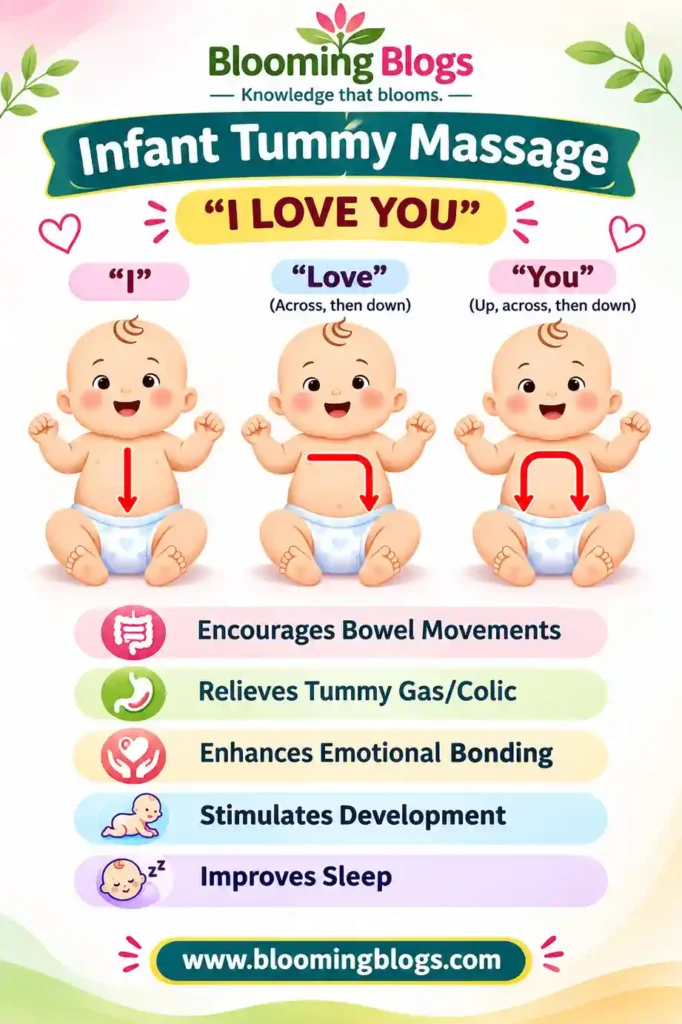
Step 1: The letter I
Using your fingertips, make a gentle downward stroke along the baby’s left side of the abdomen.
Step 2: The letter L
Start on the baby’s right side, move gently across the upper abdomen and then down the left side.
Step 3: The letter U
Begin low on the baby’s right side, move upward, across the upper abdomen and then downward along the left side.
Use only light strokes. Do not press deeply into the abdomen.
Remember: The technique is intended as a gentle comfort routine. It should not delay medical assessment for persistent constipation, vomiting, abdominal swelling or severe crying.
A short, calm massage before bed helps your baby unwind after the day and signals that it is time to sleep. Keep the lights low, move slowly, and follow your baby’s comfort cues—even three to four minutes is plenty if your baby gets sleepy early.
Simple 5-Minute Bedtime Baby Massage Routine
- Warm Up & Settle (about 45 seconds): Dim the room lights and lay your baby on a soft, warm surface in a clean diaper or light outfit. Rub a tiny drop of baby-safe oil (or keep your hands dry) between your palms until warm, then rest one hand gently on your baby’s chest or tummy for a few quiet seconds while breathing slowly.
- Soothe the Legs & Feet (about 1 minute): Hold one leg gently and glide your hands smoothly from the top of the thigh down to the ankle in slow, relaxing strokes. Switch legs, then press your thumbs softly along the soles of the feet from heel to toes to help release built-up restlessness.
- Calm the Tummy & Chest (about 1 minute): Trace slow, gentle clockwise circles around the belly button (skipping the belly button area if a newborn’s cord stump has not healed yet). Then rest both hands softly on the center of the chest and sweep outward toward the shoulders like opening a book.
- Relax the Arms & Hands (about 45 seconds): Gently stroke down each arm from shoulder to wrist using slow, unhurried movements. Finish by lightly stroking the back of each tiny hand and stretching the fingers open very gently.
- Finish with Back Strokes & Cuddle (about 1 minute): If your baby is still awake and content, roll them gently onto their tummy and sweep your hands from the neck down to the bottom in long, steady strokes. Put on cozy pajamas or a sleep sack, offer a quiet feed if needed, and place your baby in their sleep space while drowsy.
Bedtime tip: Keep talking soft and minimal during this routine so your baby learns that nighttime touch means slowing down for sleep. If your baby arches their back, turns away, or cries, stop and comfort them with a simple hug instead.
Baby Massage: Helpful Tips, Safety Precautions & Oils to Avoid
Baby massage can become a lovely part of your daily routine. You don’t need special skills or complicated techniques. A little patience, gentle touch and attention to your baby’s needs are enough to get started.
1. General Tips for Baby Massage
Keep these simple tips in mind when massaging your little one:
- Choose the Right Time: Massage your baby when both of you are relaxed and have enough time. Avoid massage immediately after feeding. Wait at least 45 minutes.
- Keep Your Touch Gentle: Use slow, gentle and comfortable strokes. Your touch should feel soothing, not ticklish or uncomfortable.
- Follow Your Baby’s Signals: Watch your baby’s facial expressions and movements. Stop if they cry, squirm, turn away or seem uncomfortable.
- Keep It Flexible: There is no fixed duration for baby massage. It may last 10–30 minutes, depending on your baby’s mood and comfort.
- Make It a Daily Routine: Choose a time that works for your family. Regular, gentle sessions can help your baby become familiar with the experience.
- Talk and Smile: Speak softly, sing or hum while massaging. Eye contact and a warm smile can make this a special bonding time.
- Practise Without Worry: You don’t need perfect techniques. Start with simple strokes and build your confidence over time.
2. Which Massage Oils Should You Avoid?
Your baby’s skin is delicate, especially during the first year. Choosing the right massage oil is therefore important.
Some oils may affect the skin’s natural protective barrier. These include:
- Olive Oil: It contains high levels of oleic acid, which may affect the developing skin barrier.
- Mustard Oil: It may irritate sensitive baby skin.
- Soybean Oil: It may not be suitable for every baby’s delicate skin.
Olive oil, in particular, is worth avoiding for newborn massage because of its high oleic acid content.
Choose a simple, fragrance-free product suitable for your baby’s age. If your baby has eczema or sensitive skin, ask your healthcare professional before using massage oil.
Also remember:
- Avoid products containing essential oils.
- Keep massage oil away from your baby’s eyes, nose and mouth.
- Check the ingredients before applying any new product.
3. Safety Precautions Before Baby Massage
A few simple precautions can make massage more comfortable and safer for your baby.
- Check Your Baby’s Health: Avoid massage if your baby has a fever, appears unwell or is unusually uncomfortable.
- Clean Your Hands: Wash your hands before starting. Keep your fingernails short and remove jewellery that could scratch your baby.
- Choose a Safe Surface: Place your baby on a comfortable mat or towel on the floor. Never leave them unattended on a raised surface.
- Be Careful During Hot Weather: If your baby has heat rash (miliaria rubra), avoid applying massage oil to the affected skin.
- Protect Sensitive Areas: Avoid pressure around the eyes, soft spots on the head, genital area and any irritated or injured skin.
- Keep Your Baby Comfortable: Use gentle pressure and watch their reactions. Stop whenever your baby seems unhappy or uncomfortable.
- Never Force a Massage: Some days your baby may enjoy massage. On other days, they may prefer cuddling. Always respect their comfort.
4. Can Baby Tummy Massage Help with Gas and Constipation?
According to the International Association of Infant Massage (IAIM), gentle tummy massage may help support digestive comfort. It may also help with common concerns such as gas and constipation.
Some parents find gentle tummy strokes helpful when their baby seems uncomfortable. However, massage is not a medical treatment for colic, constipation or other digestive problems.
If your baby has persistent discomfort, vomiting, a swollen tummy or feeding difficulties, consult your paediatrician before trying massage techniques.
Remember: The best baby massage is gentle, relaxed and guided by your little one’s comfort. There is no need to rush or follow a perfect routine. Enjoy these little moments of connection with your baby.
Infant Massage for Gas and Colic
Gas and crying can be stressful for parents, particularly during the first few months.
Babies may swallow air while feeding, cry when uncomfortable or have periods of unexplained fussiness.
Gentle massage may help some babies relax, but it cannot guarantee relief.
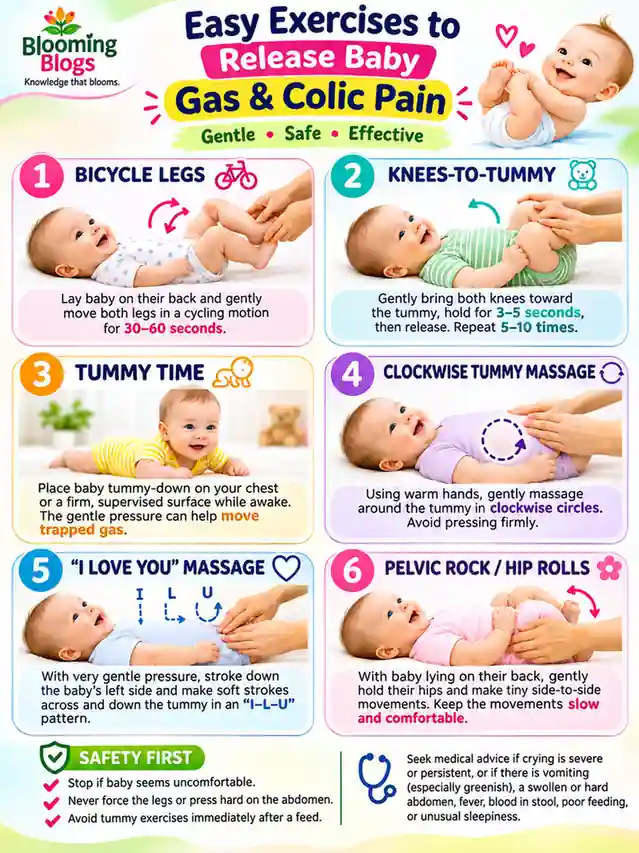
Gentle movements parents can try
- Light clockwise tummy strokes.
- Gentle leg movements.
- Holding the baby’s knees comfortably towards the tummy without force.
- Gentle cuddling and rocking.
- Allowing time for burping after feeds.
What about infant massage for constipation?
Gentle tummy massage is sometimes used as a comfort measure.
However, constipation in infants requires attention to feeding, stool consistency, age and possible medical causes.
Breastfed babies may have different stool patterns from formula-fed babies.
Seek pediatric advice if stools are hard, painful or associated with other symptoms.
When to seek medical advice
Contact your pediatrician if your baby has:
- Persistent or worsening crying.
- Repeated vomiting.
- A swollen or hard abdomen.
- Blood in the stool.
- Poor feeding.
- Fewer wet nappies than usual.
- Fever or unusual sleepiness.
Green vomit, severe abdominal swelling, breathing difficulty or a seriously unwell appearance requires urgent medical attention.
Infant Massage for Sleep and Relaxation
Some parents include massage in their baby’s evening routine.
The experience may help a baby settle, especially when combined with a calm environment and familiar interaction.
A simple bedtime routine
- Complete feeding with enough time for your baby to settle.
- Change the nappy.
- Keep the room comfortable.
- Use gentle touch if your baby is alert and receptive.
- Speak or sing softly.
- Stop when your baby shows signs of tiredness.
- Place your baby on their back in a safe sleep space.
Do not use massage as a substitute for safe sleep practices.
Avoid loose blankets, pillows and soft toys in an infant’s sleep area.
8 Baby Massage Tips and Tricks
- Choose a time when your baby is awake and calm.
- Avoid massage immediately after feeding.
- Keep the room comfortably warm.
- Wash your hands before beginning.
- Remove rings and bracelets.
- Start with gentle resting hands.
- Talk or sing softly.
- Follow your baby’s cues rather than completing a fixed routine.
Baby Tip: Even a minute of comfortable, positive touch can be a meaningful interaction. You do not need to complete a full-body massage every day.
Infant Massage Safety and Precautions
Safety should always come before technique.
When should massage be avoided?
Avoid massage when your baby:
- Has a fever.
- Is acutely unwell.
- Is experiencing unusual pain.
- Has an unexplained rash or skin injury.
- Has a swollen or painful abdomen.
- Has just received a feed.
- Is showing clear signs of distress.
Seek medical guidance before massaging a premature baby or a baby with a medical condition.
Special care after vaccination
Follow your healthcare professional’s instructions after vaccination.
Avoid applying pressure to a sore injection site. There is no reason to treat a blanket 72-hour waiting period as a universal rule for every baby.
Never use force
Avoid:
- Deep abdominal pressure.
- Vigorous rubbing.
- Forceful stretching.
- Twisting arms or legs.
- Pressing on the spine.
- Manipulating the neck.
- Pressing on the soft spot on the head.
Never leave your baby unattended
Keep one hand on your baby when changing position.
Never leave an infant unattended on a bed, table or changing surface.
Warning signs during massage
Stop immediately if your baby:
- Cries persistently.
- Turns away repeatedly.
- Becomes stiff.
- Develops skin redness.
- Shows unusual breathing.
- Appears distressed.
If the reaction is severe or accompanied by other concerning symptoms, seek medical help.
Common Infant Massage Mistakes to Avoid
| Mistake | Better approach |
|---|---|
| Massaging immediately after feeding | Allow time for settling |
| Using strong pressure | Use gentle strokes |
| Applying too much oil | Use little or none |
| Using mustard oil routinely | Follow pediatric skin-care guidance |
| Massaging the unhealed cord | Keep the area clean and dry |
| Continuing when baby cries | Pause or stop |
| Expecting massage to cure colic | Seek medical advice when needed |
| Leaving baby on a raised surface | Use a safe floor-level surface |
| Using essential oils | Avoid them for newborn massage |
| Following a fixed routine every day | Adapt to baby’s needs |
Helpful Hacks for Parents
1. The Warm Towel Wrap Hack: Toss your baby’s massage towel in the dryer for 3 minutes before starting so they land on a cozy, warm surface.
2. The Pump-Bottle Trick: Pour your cold-pressed coconut or sunflower oil into a clean, lockable pump dispenser so you can get more oil one-handed without tipping over a jar.
3. The Diaper-Change Mini Massage: Short on time? Do just 60 seconds of baby belly massage for gas and bicycle legs at every diaper change—little bursts add up fast!
4. Cover the Parts You Aren’t Massaging: Keep a light muslin swaddle draped over your baby’s chest while you massage their legs, then switch so they stay warm from head to toe.
5. The Two-Minute Connection: If you have little time, simply hold your baby’s feet gently and talk to them. Even these small moments can create a lovely bonding experience.
6. Use a Familiar Starting Cue: Repeat the same gentle greeting before each massage. This can help your baby become familiar with the routine.
7. Keep Supplies Ready: Prepare the towel, nappy and clothing before starting. This way, you never need to leave your baby unattended.
8. Make It a Shared Routine: Encourage all parents to learn their baby’s comfort signals and preferred touch. Sharing massage time can help everyone build a closer bond with the baby.
9. Do Not Chase Perfection: Your baby may enjoy a massage one day and prefer cuddling the next. Both are perfectly acceptable. Follow your baby’s mood and comfort rather than forcing a routine.
💡 Did You Know?
- Touch is one of the earliest ways babies interact with the world.
- Infant massage has been practised in many cultures for generations.
- Parents and fathers can both participate in infant massage.
- WHO includes gentle whole-body massage as an option for healthy, full-term newborns.
- Massage does not need to involve oil.
- Babies communicate comfort through movement, facial expressions and behaviour.
- A short, responsive session can be more appropriate than a long, fixed routine.
Practical Infant Massage Checklist
Before beginning:
- Baby is awake and comfortable.
- Baby is not immediately post-feed.
- Baby is not showing signs of illness.
- Hands are clean and warm.
- Jewellery has been removed.
- The room is comfortable.
- The surface is flat and safe.
- Massage product, if used, is suitable.
- Umbilical area is healed before tummy oil massage.
- Parent is ready to watch baby’s responses.
During massage:
- Begin with resting hands.
- Use slow, gentle movements.
- Maintain a comfortable position.
- Watch baby’s facial expressions.
- Avoid forceful pressure.
- Stop when baby shows discomfort.
After massage:
- Dress baby comfortably.
- Keep baby warm.
- Clean any excess oil.
- Store massage products safely.
- Follow the baby’s normal feeding and sleep routine.
Common Mistakes to Avoid
- Massaging Immediately After a Feed: Pressing on a full stomach is a guaranteed recipe for spit-up. Always wait at least 30 to 45 minutes.
- Using Counter-Clockwise Tummy Strokes: Your digestive tract moves clockwise. Rubbing counter-clockwise works against the natural flow of gas and stool.
- Applying Too Much Pressure: A newborn’s muscles and organs are delicate. Use the weight of your hand and gentle, steady pressure—never knead deeply.
- Continuing When Baby Cries or Turns Away: If your baby arches their back, turns their head away, stiffens, or cries, pause immediately. Massage should always be with your baby, never to your baby.
- Using Scented Adult Lotions: Synthetic perfumes, parabens, and alcohols can trigger contact dermatitis on thin newborn skin.
Expert Recommendations
Pediatricians and certified infant massage educators consistently emphasize safety and responsiveness above perfection:
- Follow American Academy of Pediatrics (AAP) Skin Guidelines: Stick to fragrance-free, hypoallergenic, cold-pressed plant oils or plain white petrolatum-based ointments if your baby has extremely dry skin.
- Respect Medical Red Flags: Skip massage and call your pediatrician if your baby has a fever, unexplained rash, swollen or rigid belly, inconsolable high-pitched crying, or received vaccinations within the last 24–48 hours (injection sites will be tender).
- Prioritize Safe Sleep Afterward: Once your relaxing newborn sleep routine wraps up, always place your baby flat on their back in a bare crib—never let them fall asleep on a soft massage pad or towel unattended.
Recommendations
If you are building your infant massage toolkit at home, keep it simple and clutter-free:
- 100% Organic Cold-Pressed Sunflower or Virgin Coconut Oil (stored in a small pump bottle).
- Two Oversized, Super-Soft Hooded Cotton Towels (one to lie on, one to cover up).
- A Waterproof Changing Pad Liner placed underneath the towel for easy cleanup.
- A Soft White Noise Machine or Gentle Instrumental Playlist to signal to your baby’s brain that relaxation time has begun.
Key Points
- Infant massage strengthens parent-child bonding, relieves gas and constipation, improves circulation, and supports deeper sleep.
- Start full-body oil massages around 2 weeks of age, once the umbilical cord stump has healed.
- Always stroke clockwise on the abdomen when performing a baby massage for gas or constipation.
- Choose single-ingredient, edible-grade, cold-pressed oils like coconut, sunflower, or sweet almond oil—and skip olive oil, mustard oil, and essential oils.
- Let your baby’s body language guide the length and pace of every session.
Gentle Reminders
Mama, you do not have to memorize every single stroke tonight. If you forget whether to do the “Water Wheel” before the “Sun and Moon,” your baby won’t grade you! What your little one feels most is your warm hands, your calm breathing, and your loving attention. Even two minutes of gentle foot rubs while smiling into their eyes is a huge win. Give yourself grace—you are doing an amazing job.
FAQs (50 Most Searched Infant Massage Questions)
1. What is infant massage?
Infant massage is the gentle, rhythmic stroking of a baby’s body using warm hands and baby-safe oil to promote relaxation, relieve gas, support healthy development, and strengthen bonding.
2. What are the main benefits of infant massage?
Key infant massage benefits include easier relief from gas, colic, and constipation, improved sleep quality, reduced stress hormones, healthier circulation, and deeper emotional attachment between parents and baby.
3. When can you start massaging a newborn?
You can do gentle, dry stroking over clothes from birth, and start full-body oil massages once your newborn is 10 to 14 days old and their umbilical cord stump has fallen off and healed.
4. Is infant massage safe for newborns?
Yes, infant massage is very safe for healthy, full-term newborns when done with gentle pressure, warm hands, and pediatrician-approved, fragrance-free oils.
5. How often should you massage a newborn baby?
You can safely massage your baby once a day as part of their daily care routine, or do brief 2-to-3-minute tummy and leg massages during diaper changes.
6. How long should a baby massage last?
A typical newborn session lasts 5 to 15 minutes, depending on your baby’s age, mood, and engagement cues.
7. Which oil is best for newborn baby massage?
Cold-pressed virgin coconut oil, sunflower seed oil, and sweet almond oil are among the safest, gentlest choices for newborn skin.
8. Which oil should be avoided for newborn massage?
Avoid olive oil, mustard oil, heavily fragranced mineral oils, and all essential oils, as they can irritate or weaken a newborn’s delicate skin barrier.
9. Is coconut oil good for infant massage?
Yes! Organic, cold-pressed infant massage coconut oil is moisturizing, naturally antimicrobial, edible-grade, and widely recommended by pediatricians.
10. Can I use olive oil for baby massage?
Pediatric dermatologists generally advise against olive oil on newborns because its high oleic acid content can break down skin barrier lipids and worsen dryness.
11. Can baby massage help with gas?
Yes, a clockwise infant tummy massage for gas gently stimulates intestinal movement, helping trapped gas bubbles pass comfortably.
12. How do you massage a baby’s tummy for gas?
Use warm hands to trace gentle clockwise circles around the belly button, perform the “I Love You” (ILU) stroke, and finish by pressing your baby’s knees gently toward their chest.
13. What is the “I Love You” infant massage?
The I Love You infant massage traces the letters “I”, an upside-down “L”, and an upside-down “U” clockwise across your baby’s abdomen to guide gas and stool down the large intestine.
14. Can baby massage help with constipation?
Yes, regular baby massage for constipation encourages gentle peristalsis (wave-like muscle contractions) in the colon, helping your baby pass stools more easily.
15. Does infant massage help with colic?
While colic has no single cure, daily infant massage for colic calms an overstimulated nervous system, eases tummy tension, and reduces evening crying spells.
16. Does baby massage improve sleep?
Yes, massaging your baby before bed lowers stress hormones and stimulates melatonin production, helping them fall asleep faster and stay asleep longer.
17. Should I massage my baby before or after a bath?
It is safest to do baby massage after bathing once your baby is completely dry, because oiled skin becomes very slippery in water.
18. Should I wash off massage oil after massaging my baby?
If you use a light layer of cold-pressed plant oil, it can safely absorb into the skin; simply pat away any excess with a soft cotton towel before dressing.
19. When should you not massage a baby?
Avoid massaging if your baby has a fever, active skin infection, unexplained rash, swollen belly, has just eaten within the last 30 minutes, or received vaccines in the past 24–48 hours.
20. How do I know if my baby enjoys massage?
Positive cues include relaxed open hands, soft cooing, steady eye contact, smiling, and calm breathing.
21. What are the signs my baby wants to stop the massage?
Stop right away if your baby turns their head away, arches their back, clenches their fists tightly, squirms anxiously, or begins to cry.
22. Can you massage a sleeping baby?
It is best to massage your baby while they are awake and in a quiet alert state so they can actively engage and give you cues.
23. How hard should I press during an infant massage?
Use gentle, soothing pressure—about the same pressure you would use to comfortably stroke your own closed eyelid.
24. What is the best room temperature for baby massage?
Keep the room comfortably warm at around 75°F (24°C) so your undressed baby stays cozy and relaxed.
25. Can fathers and grandparents do infant massage too?
Absolutely! Infant massage is a wonderful way for dads, partners, and grandparents to build deep confidence and one-on-one bonding with the baby.
26. How do I do an infant tear duct massage?
With clean, dry hands, place your index finger at the inner corner of the eye near the nose bridge and gently stroke downward 3–5 times, following your pediatrician’s guidance.
27. Can you massage a premature baby?
Yes, once medically stable, gentle touch therapy benefits preemies—always get clearance and specific instructions from your NICU team or pediatrician first.
28. Is baby massage good for babies with eczema?
Gentle moisturizing strokes can help lock in hydration, provided you avoid active flare-up patches and use an eczema-safe emollient or sunflower oil approved by your doctor.
29. Can I use lotion instead of oil for infant massage?
Unscented baby lotion works well, though pure cold-pressed oils offer smoother glide without needing constant reapplication.
30. Do I need to undress my baby completely for a massage?
Undressing down to their diaper allows wonderful skin-to-skin contact, though you can keep a light blanket over areas you aren’t currently massaging.
31. How do you massage a baby’s legs and feet?
Glide gently from the thighs down to the ankles using alternating hands, then use your thumbs to trace small circles across the soles of the feet.
32. Why do babies cry during massage sometimes?
A baby may cry if they are hungry, overtired, cold, overstimulated, or if the room is too bright—try again later during a calm window.
33. Can infant massage help with teething discomfort?
Gentle fingertip circles along the outer jawline, cheeks, and ears can help soothe facial tension caused by teething pain.
34. Is daily massage good for newborn babies?
Yes, daily baby massage at home creates predictability, supports sensory development, and reinforces healthy sleep and digestion routines.
35. What should I do if my baby pees or poops during a massage?
Laugh gently, clean up calmly, and carry on! Relaxation stimulates digestion and bladder release—it simply means your massage is working.
36. Can I massage my baby right after vaccinations?
Wait 24 to 48 hours after immunizations so you don’t accidentally press on sore, tender injection sites.
37. Does baby massage help babies gain weight?
By stimulating the vagus nerve and improving nutrient absorption and digestion, regular massage can support healthy weight gain in infants.
38. What time of day is best for baby massage?
Many parents prefer the early evening before bedtime, while others love mid-morning after a nap and feed.
39. Can I use almond oil if no one in our family has nut allergies?
Yes, cold-pressed sweet almond oil is widely used for infant massage; always do a 24-hour skin patch test first.
40. Is baby head massage safe around the soft spot?
Yes, as long as you use feather-light fingertip strokes on the scalp and never press firmly directly over the fontanelles.
41. How do I transition from baby massage to bedtime?
Wipe off excess oil, dress your baby in cozy pajamas, dim the lights, offer a bedtime feed, and place them safely on their back to sleep.
42. Are there certified infant massage classes near me?
Searching for “infant massage near me” or checking with your local hospital, lactation consultant, or Infant Massage USA directory can connect you with certified instructors.
43. Can baby massage help with reflux?
Gentle upright holding and slow back strokes can soothe reflux fussiness, though you should avoid deep tummy pressure and always wait 45+ minutes after feeds.
44. Should I talk or sing while massaging my baby?
Yes! Pairing touch with your calm voice, humming, or soft eye contact boosts language processing and emotional bonding.
45. At what age do you stop doing infant massage?
You never have to stop—simply adapt the strokes into fun toddler back rubs, bedtime foot massages, and playful “pizza massage” games as they grow!
46. Can I use shea butter for baby massage?
Pure, unrefined shea butter warmed between your palms works nicely for dry skin, though lighter liquid oils glide more smoothly for full-body strokes.
47. What if my baby has umbilical cord bleeding?
Hold off on tummy massages and contact your pediatrician right away if you notice active bleeding, foul odor, or redness around the cord area.
48. Does baby massage help with baby hiccups?
Gentle back strokes and upright cuddling can help relax the diaphragm and calm harmless newborn hiccups.
49. Can I massage my baby if they have cradle cap?
Yes, massaging a tiny drop of coconut or sunflower oil gently onto the scalp 15 minutes before bath time helps loosen dry cradle cap flakes softly.
50. What is the single most important rule of infant massage?
Always follow your baby’s lead—warm hands, gentle clockwise tummy strokes, safe single-ingredient oils, and responsive, loving connection come first.
Points to Remember
- Massage should be gentle and comfortable.
- Every baby responds differently.
- Oil is optional.
- Avoid mustard and olive oils for routine newborn massage.
- Protect the healing umbilical stump.
- Never massage immediately after feeding.
- Avoid forceful tummy pressure.
- Do not use massage to treat medical conditions.
- Parents and fathers can both participate.
- Safety and bonding matter more than technique.
- Warm your hands and oil first so cold touch doesn’t startle your newborn.
- Never put an oiled baby straight into water—always do baby massage after bathing, never right before, to prevent slipping accidents.
- Avoid direct pressure on the spine and soft spots (fontanelles) on the head.
- Consistency beats duration: Five loving minutes every evening works far better than one 30-minute session once a month.
- Keep Your Hands Clean: Wash your hands before starting. Keep your nails short and remove rings, bracelets or other jewellery that could scratch or hurt your baby.
- Be Careful with Heat Rash: If your baby has heat rash (miliaria rubra), avoid applying massage oil to the affected skin. During summer, you can massage your baby before bathing. In winter, you can massage after bathing, provided your baby is warm and comfortable.
External Authoritative References
The following trusted sources provide additional information about infant massage, newborn skin care, massage oils and baby-care safety. They also help readers explore the research behind the potential benefits of gentle touch.
1. Infant Massage and Baby-Care Guidance
- Cambridge University Hospitals NHS Foundation Trust. Infant massage on the neonatal unit.
This resource explains how infant massage is approached in a hospital setting, particularly for premature babies.
https://www.cuh.nhs.uk/patient-information/infant-massage-on-the-neonatal-unit/ - National Health Service (NHS). Washing and bathing your baby.
This guide provides practical advice on newborn bathing and everyday baby care.
https://www.nhs.uk/baby/caring-for-a-newborn/washing-and-bathing-your-baby/ - National Childbirth Trust (NCT). Baby massage: Tips and benefits.
Additionally, this resource offers practical information about baby massage and its potential benefits.
https://www.nct.org.uk/information/baby-toddler/caring-for-your-baby-or-toddler/baby-massage-tips-and-benefits
2. Newborn Skin Care and Massage Oils
- Indian Academy of Pediatrics (IAP). (2021). Indian Academy of Pediatrics Guidelines for Pediatric Skin Care. Indian Pediatrics, 58, 153–161.
This guideline discusses newborn skin care and considerations when choosing products for a baby’s skin.
https://www.indianpediatrics.net/feb2021/feb-153-161.htm - Effects of Topical Oils on Neonatal Skin: A Systematic Review. (2022).
This review examines research on the use of topical oils and their effects on neonatal skin.
https://pubmed.ncbi.nlm.nih.gov/36409192/ - Summers, A., et al. (2019). Impact of sunflower seed oil versus mustard seed oil on skin barrier function in newborns: A community-based, cluster-randomized trial. BMC Pediatrics, 19, 512.
For example, this study compares the effects of two commonly used oils on newborn skin barrier function.
https://doi.org/10.1186/s12887-019-1871-2
3. Scientific Research on Infant Massage
- Bennett, C., Underdown, A., & Barlow, J. (2022). Massage for promoting mental and physical health in typically developing infants under the age of six months. Cochrane Database of Systematic Reviews, Issue 3, CD005038.
This systematic review evaluates research on the potential physical and mental health effects of infant massage.
https://doi.org/10.1002/14651858.CD005038.pub3 - Mrljak, R., Danielsson, A. A., Hedov, G., & Garmy, P. (2022). Effects of Infant Massage: A Systematic Review. International Journal of Environmental Research and Public Health, 19(11), 6378.
Furthermore, this review examines published research on the possible effects of infant massage.
https://doi.org/10.3390/ijerph19116378
🔗 Related Articles
If you are preparing for a newborn, these helpful Blooming Blogs guides can help you plan, prepare, and care for your baby with greater confidence:
- 1. Best Infant Formula for Newborns: Types, Choices & Safety Guide
- 2. Newborn Baby Essentials Checklist for Soon-to-Be Parents
- 3. How to Prepare Formula Milk for a Newborn Baby
- 4. Newborn Baby Care: Complete Guide for New Parents
- 5. Formula Mixing & Bottle Ratio Calculator
- 6. Hospital Bag for Delivery: Complete Checklist for Mom and Baby
- 7. The Ultimate Pregnancy Hospital Bag & Registry Checklist: Your Stress-Free Delivery Guide
- 8. Hospital Bag Checklist Tool
- 9. Rompers for Newborn: Ultimate Guide to Safe Baby Clothes
- 10. Onesies and Rompers: How to Dress Your Newborn Right
- 11. Baby Onesies Buying Guide: Best Soft Outfits for Newborns
🛠️ Try Our Free Interactive Baby Care Tools
Planning your nursery or setting up daily routines? Check out these handy calculators designed to simplify baby care:
🌱 Continue Exploring…
Whether you’re nurturing a newborn, curating a sanctuary for your home and garden, or simply looking to level up your day-to-day life, there’s always a new perspective waiting to be discovered. From practical everyday parenting guidance, women’s wellness information, ideas to make your home more beautiful, tips for caring for pets and plants, or inspiration for your spiritual journey, Blooming Blogs brings useful knowledge together in one place.
Blooming Blogs — knowledge that blooms.
🌸 Blooming Blogs Promise
We’re here to bring you thoughtful, reliable, and helpful insights you can truly count on. Every article on Blooming Blogs is thoroughly researched, crafted with care, and written with genuine empathy to support you in your everyday journey. Your trust means everything to us, and we are dedicated to sharing content that informs, inspires, and makes your life a little easier.
📰 Editorial Notes
Our team strives for clarity, accuracy, and depth in every piece we publish. Content is periodically updated to ensure facts, recommendations, and guides stay relevant over time. While we consult trusted sources and expert research, our goal is always to present complex topics in a simple, practical, and conversational way that works for real life.
⚠️ Disclaimer
The content provided on Blooming Blogs is for informational and educational purposes only and should not be considered professional medical, legal, or financial advice. Always consult with a qualified expert or licensed professional before making decisions related to your health, family, or personal finances. Blooming Blogs is not liable for any actions taken based on the information provided on this website. (For full details, please visit our Disclaimer Policy Page).
💬 Share Your Experience — Leave a Comment
We’d love to hear from you! Did this article help you, or do you have a personal tip or story to share with our community? Drop your thoughts, questions, or feedback in the comment section below. Every voice enriches our community, and we read every single comment!