


1. Introduction
Choosing the right baby carrier is one of the most rewarding steps for new parents. Whether you call it a sling, wrap, or carrier, babywearing has been practised across cultures for centuries to keep little ones close while letting parents move hands-free.
This guide breaks down everything you need to know about styles, benefits, and safety rules to make your babywearing journey comfortable and secure.
Take a deep breath, mama…….
If you are staring at a mountain of laundry with one hand while bouncing a fussy newborn with the other, wondering how on earth you are supposed to make a cup of coffee, you are in exactly the right place.
Walking down the baby gear aisle—or scrolling online at 2:00 AM—can feel like trying to read a foreign language. Between stretchy wraps, woven ring slings, structured buckle carriers, hip seats, and mysterious acronyms like “TICKS” and “IHDI,” choosing a baby carrier quickly turns from an exciting milestone into major new-parent overwhelm.
Here is the good news: you do not need a closet full of expensive gear or a degree in engineering to wear your baby safely. When done correctly, babywearing can be a wonderful experience. It frees up your hands, may soothe fussiness, supports bonding, and lets you reclaim a little piece of your day while keeping your little one close to your heartbeat.
In this complete, no-fluff guide, we are breaking down everything you need to know about safe babywearing, from choosing the best newborn baby carrier for your body and budget to mastering the positioning rules that protect your baby’s airway and developing hips. Grab your lukewarm coffee, settle in, and let’s take the guesswork out of carrying your baby.
2. What Is Safe Babywearing and Why Does It Matter?
2.1 What Is Safe Babywearing?
Babywearing is simply the practice of holding your baby or toddler snug against your body using a specialised carrier, wrap, or sling. It keeps your little one comforted and close while giving you the freedom to move through your day hands-free.
Humans are often described as “carry mammals.” Unlike baby deer that walk minutes after birth, human newborns enter the world neurologically immature. During the first three months—often called the fourth trimester—your baby may crave the warmth, rhythmic movement, and steady heartbeat associated with life in the womb.
2.2 Understanding Baby Carriers, Slings, and Backpacks
While all babywearing gear serves the same core purpose—carrying your child safely on your front, hip, or back—each style works a little differently depending on your child’s age and stage of development.
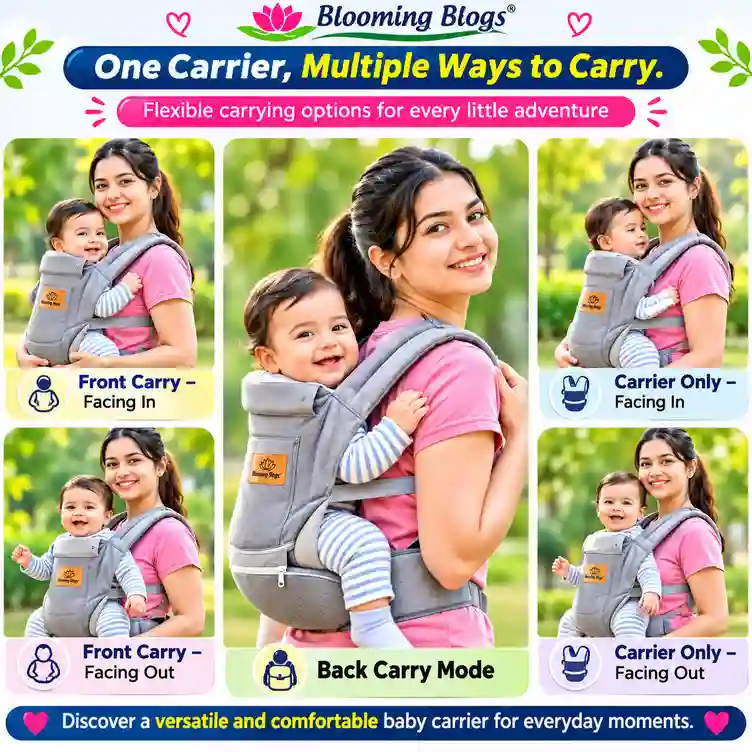
- Baby Carriers: Typically made with soft, padded straps and sturdy buckles, a baby carrier is most commonly worn on your front. Carrying your baby facing inward towards your chest is ideal for newborns and younger infants who cannot yet sit up or hold their heads steady. As your child grows stronger, many adjustable carriers can be shifted to allow outward-facing, hip, or back carries, according to the manufacturer’s instructions.
- Baby Slings: A sling consists of a continuous loop or long strip of fabric draped over one shoulder and worn across your torso. Ring slings use two rings to adjust the fabric. Inward-facing carries provide the support needed for young babies who do not yet have full head control.
- Baby Backpacks: Built with a sturdy, structured frame and worn on your back, these carriers are designed for older babies and toddlers who meet the manufacturer’s requirements for sitting ability, head control, age, and weight. Before transitioning to a framed backpack, it is wise to check with your paediatrician or family health nurse if you are unsure whether your child is physically ready.
2.3 What Are the Benefits of Using a Baby Carrier?
Wearing your baby in a carrier or sling goes far beyond just keeping your hands free—it offers genuine everyday advantages for both you and your little one.
- Fits Any Lifestyle: Whether you are tackling chores at home or heading out for errands, a carrier can adapt easily to your daily routine.
- Makes Getting Around Easier: Strollers can be bulky and frustrating in tight spaces. A baby carrier lets you navigate crowded public transport, narrow doorways, stairs, and uneven country trails more easily. Plus, many babies who fuss in a stroller may settle when held close.
- A Lifesaver for Multi-Child Families: If you are juggling twins or caring for an older toddler alongside a newborn, keeping one baby secure on your chest can leave your hands available to help the other. Carriers also allow partners, grandparents, and other caregivers to share the carrying experience while bonding with the baby.
- Strengthens Your Bond: Keeping your baby close helps you tune into their subtle needs more quickly and respond to their cues. Close contact also creates opportunities for interaction and bonding.
- Supports Caregiver Mental Health: Carrying your baby can be soothing for both parent and child. Some parents find that babywearing makes daily routines easier and helps reduce the stress of constantly picking up and putting down their little one.
- Encourages Breastfeeding Awareness: Wearing your baby may help you notice early hunger cues more quickly. Constant closeness can make it easier to recognise rooting, lip-smacking, and other feeding signals. Always remove your baby from the carrier before feeding.
2.4 Proven and Potential Benefits for Baby and Parent
- Crying Reduction: Classic paediatric research has suggested that babies who receive additional carrying may cry less, particularly during the evening hours.
- Regulated Vitals: Close chest-to-chest contact may support temperature regulation and provide comforting sensory experiences. However, it does not replace medical monitoring or appropriate care.
- Hands-Free Convenience: Whether you are navigating grocery aisles, caring for a toddler, or taking a suitable walk, an ergonomic infant carrier can make everyday tasks easier.
- Breastfeeding Support: Keeping your baby close may help you recognise early hunger cues. Always remove your baby from the carrier for feeding.
- Reduced Flat Head Pressure: Time spent upright in a carrier while awake provides an alternative to spending prolonged periods in swings, bouncers, and car seats. However, supervised tummy time and unrestricted floor play remain essential.
2.5 How to Keep Your Baby Safe in a Baby Carrier, Sling, or Wrap
Using a baby carrier is a wonderful way to keep your little one close, but following a few essential safety habits helps ensure every carry is secure.
- Follow Official Instructions: Always read the manufacturer’s manual to make sure your baby meets the exact age, weight, and height requirements for that specific carrier.
- Stick to Trusted Tutorials: If you buy a second-hand carrier without a manual, contact the brand or download the instructions and official video guides from its website. Be cautious with random social media tutorials, as influencers may demonstrate unsafe positioning.
- Inspect Second-Hand Gear: Before using a pre-loved sling or carrier, carefully check all seams, buckles, rings, and fabric for fraying or damage. If anything looks worn out, do not use it.
- Adjust for Every Wearer: Every adult and baby has a unique build. Always readjust the straps when switching carriers between caregivers—or consider having two different styles if one does not comfortably fit both parents.
- Dress Smart for the Weather: Young babies can become overheated because of your body heat and the additional carrier layer. Avoid overdressing them. In colder weather, secure your baby snugly inside the carrier first, then use suitable outer layers while keeping their face and head completely uncovered.
General Instructions –
- Use Common Sense: If you ever hold your baby in a position not explicitly outlined in the manual, support them with your hands just as you would when carrying them in your arms. Avoid tasks you would not safely perform while holding a baby.
- Keep the Air Smoke-Free: Avoid smoking while wearing your baby and keep your baby away from secondhand and thirdhand smoke exposure.
- Stay Alert and Awake: Only wear your baby when you are feeling well, focused, and fully awake. Never lie down or fall asleep with your baby inside a sling or carrier.
2.6 How Should Your Baby Be Held in a Baby Carrier?
Positioning your little one properly inside a baby carrier is the secret to keeping them safe, comfortable, and content while protecting your own back.
When adjusting your wrap or carrier, make sure every carry checks these essential boxes:
- Upright and Facing You: The safest way to carry your baby—especially during the early months—is generally in an upright position with their chest resting against yours.
- Snug and Visible: Your carrier should cradle your baby’s body firmly so they stay held high and close to you, allowing you to glance down and see their face at any moment.
- Balanced Weight Distribution: A properly fitted carrier spreads your baby’s weight across your shoulders, back, and hips rather than pulling on just one area.
- Comfortable and Secure: Carrying your baby should never feel lopsided or excessively loose. If the fit feels uncomfortable, take a moment to readjust the straps or ask a babywearing consultant for a fit check.
- Clear Breathing Space: Check your baby regularly while they are in the wrap or carrier to verify that their nose and mouth are completely unobstructed by fabric or your clothing.
- Chin Up and Away from the Chest: Always ensure your baby’s head is supported so their chin stays lifted away from their chest, helping to keep their airway open. This is especially critical for newborns and infants under four months old who are still building neck strength.
2.7 What Are the Benefits and Risks of Using a Baby Carrier, Sling, or Backpack?
Wearing your child in a baby carrier, sling, or backpack brings wonderful day-to-day advantages. It frees up your hands for suitable everyday tasks, gives curious little ones a comforting view of the world, and offers an easy way to soothe fussiness while building a close bond.
However, like any piece of baby gear, improper use can pose serious dangers—including falls, head injuries, or suffocation.
To enjoy the benefits of babywearing while keeping your child protected, make sure you:
- Pick an ergonomic design that feels comfortable and supports healthy hip positioning.
- Learn how to adjust and fasten the gear properly before heading out.
- Follow the T.I.C.K.S. safety checklist every single time to ensure your baby’s airways remain clear and unobstructed.
2.8 Understanding the Potential Risks of Baby Slings and Carriers
While serious accidents are uncommon, tragedies have occurred when slings and carriers were fitted or worn incorrectly. Understanding these risks helps you prevent them.
- Airway Obstruction and Suffocation: Because young infants lack strong neck muscles and cannot lift their heads reliably, slumping forward or having loose sling fabric or heavy clothing press against their face can block their breathing.
- Falls and Head Trauma: If straps, buckles, or wraps are left too loose or fastened improperly, a baby can slip out or suffer a traumatic head injury.
- Special Medical Considerations: If your baby was born prematurely, had a low birth weight, or has an underlying health condition, always consult your paediatrician or health nurse before using a baby carrier to get tailored safety advice.
- Caregiver Back Strain: Carrying a growing child in a poorly adjusted sling can leave you with sore shoulders or lower back pain. Working with a qualified babywearing educator for a one-on-one fit check can help you distribute the weight evenly and improve comfort.
2.9 What to Look for in a Baby Carrier, Sling, or Backpack
Shopping for a baby carrier can feel overwhelming with so many styles on the market, but focusing on four essentials makes narrowing down your choices much easier:
- Supports comfortable hip positioning.
- Meets applicable safety requirements.
- Keeps your baby cosy and unrestricted.
- Feels comfortable and balanced on your body.
2.9.1 Ergonomic Hip Support
Proper leg positioning is important for growing joints and may help support healthy hip development.
A good baby carrier, sling, or backpack should let your child’s legs naturally straddle your torso rather than forcing them to dangle straight down.
Look for a suitable seat that supports your baby’s thighs towards the backs of the knees, keeping their knees comfortably bent and generally slightly higher than their bottom in an ergonomic “M” shape.
2.9.2 Essential Safety Features
Not every region enforces identical mandatory safety standards for babywearing gear, so it pays to inspect a carrier carefully before buying.
- Clear Instructions: Make sure the product includes straightforward written guides, diagrams, or official video tutorials so you know how to fasten it properly.
- Sturdy Construction: Check that the fabric, stitching, buckles, and clips are durable and built to hold up under daily wear.
- Try Before You Buy: Bring your baby along when shopping so you can test the fit together, verify that they are within the recommended weight limits, and ask a store specialist for fitting tips.
- Freedom to Move and Breathe: Once your baby is seated inside, check that they can move their head, arms, and legs comfortably and that no fabric presses against their face.
- Easy Solo Adjustments: You should be able to put the carrier on, take it off, fasten every clip, and tighten the straps securely without compromising your baby’s position.
- Skip “Cocoon” Designs: Avoid bag-style slings marketed as “womb-like” or “cocoon-like.” These designs can curl a baby into a tight position or drape fabric over their face, increasing the risk of overheating and suffocation.
2.9.3 Long-Lasting Comfort for You and Your Child
The best way to judge comfort is to test a few styles with your child inside while keeping these practical details in mind:
- Supportive Straps: Wide, padded shoulder straps paired with a broad waist belt help spread your child’s weight evenly across your torso, easing shoulder strain and keeping the carrier from shifting side to side.
- Breathable Fabrics: Choose materials suited to your local climate so your baby stays cool and comfortable during warmer months.
- Room to Grow: If you want a carrier that lasts beyond the infant stage, look for adjustable designs that accommodate older babies according to their developmental readiness.
- Shared Fit: If partners, grandparents, or other caregivers will also wear the baby, pick a design that adjusts easily to fit different body types.
- Respect Weight Limits: Always check the maximum weight rating on the label, and retire the carrier as soon as your child exceeds its limits or it no longer feels safe and comfortable.
Note on Framed Backpacks: Structured hiking backpacks are not suitable for young infants. Babies must meet the manufacturer’s minimum age, weight, head-control, and independent-sitting requirements before using these products.
3. Common Types of Baby Carriers
Every family has different needs, and finding the right baby carrier comes down to your baby’s age, your comfort, and how you plan to use it day to day.
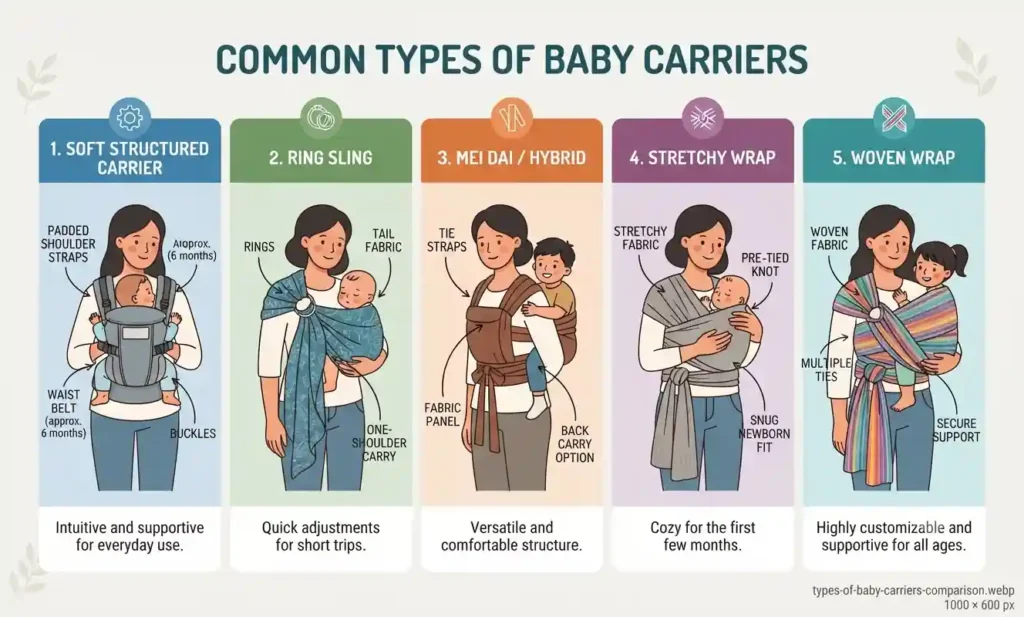
Below are the five most popular traditional carrier styles, along with newer hybrid designs that blend features from multiple styles.
3.1 Soft Structured Carriers
Designed with padded shoulder straps and a supportive waist belt that clips together with buckles, these carriers are fast to put on and easy to adjust. Because they adapt well as a child grows, they are a favourite for everyday errands and longer walks.
Some models work from birth, while others need a newborn insert or are designed for older babies. Always check the manufacturer’s guidelines for minimum age, weight limits and newborn suitability before use.
3.2 Ring Slings
Crafted from a long piece of woven fabric threaded through two sturdy rings, a ring sling creates an adjustable pouch worn diagonally across one shoulder. They take seconds to slip on and tighten once you learn the technique, making them ideal for quick errands or toddlers who constantly want to be picked up and put down.
Since the baby’s weight rests mainly on one shoulder, most parents prefer them for shorter carrying sessions. Make sure the fabric is properly tightened and your baby’s face remains visible, with their chin away from their chest.
3.3 Meh Dais
A traditional Asian-style design, a meh dai pairs a structured fabric body panel with four long straps that wrap and tie around your waist and shoulders. They offer the custom, body-hugging feel of a wrap without the same wrapping method.
Many models support carrying from infancy through toddlerhood when used correctly and according to the manufacturer’s instructions. Learn the recommended tying method before carrying your baby.
3.4 Stretchy Wraps
Made from a single, long length of soft, elastic fabric, stretchy wraps are tied around your torso before you tuck your baby inside. Parents love them during the newborn stage because they create a cosy, snug fit against your chest.
Once your baby gains weight, however, the stretch can begin to sag, making a firmer carrier more supportive. Follow the manufacturer’s instructions for the permitted carrying positions and weight limits.
3.5 Woven Wraps
Similar in shape to stretchy wraps, woven wraps are made from sturdy, non-stretch fabric that is wrapped and knotted around you and your child. They take a little practice to master, but their versatility is unmatched.
Depending on the wrapping method and your baby’s developmental stage, they can support front, hip and back carries from the newborn days well into the toddler years, when used correctly.
3.6 Hybrid Baby Carriers
Hybrid carriers combine features from different carrier styles, such as wrap-style fabric panels with buckles or structured waist support. They can offer a balance between the close fit of a wrap and the convenience of a structured carrier.
Their design and suitability vary by model, so check the manufacturer’s instructions for the baby’s age, weight, positioning and permitted carrying methods.
3.7 Hip Seats and Toddler Carriers
Hip seats provide a supportive platform for a baby or toddler to sit on while being held by an adult. Some models include shoulder straps or a carrier panel, while others are designed only as a support for carrying the child on your hip.
They may be convenient for short periods when a toddler frequently wants to be picked up and put down. However, a standalone hip seat does not necessarily secure a child hands-free. Follow the product instructions and keep a firm hold of your child.
3.8 Framed Hiking Baby Carriers
Framed hiking carriers are designed for older babies and toddlers who can meet the manufacturer’s developmental and weight requirements. They usually have a rigid frame, padded support and a structured seat.
These carriers are intended for outdoor walks and hiking rather than newborn use. Never use one for a baby who does not meet the manufacturer’s minimum requirements.
3.9 How to Choose Between Different Carrier Styles
There is no universal “best” baby carrier—what works wonders for one parent might feel awkward for another. The ideal pick really comes down to your baby’s stage, your daily routine, and what feels most natural on your body.
As you weigh your options, consider these key questions to narrow down the right fit:
1. How long do you plan to use it?
Some wraps and carriers are built specifically for the cosy newborn phase, while others feature adjustable seats and straps that expand into toddlerhood. If you want a single carrier to last for years, prioritise an adaptable, multi-stage design.
2. Who will be wearing the baby?
If you plan to pass the carrier back and forth between partners, grandparents, or babysitters, look for buckles or tie-straps that adjust quickly between different heights and body types.
3. Where will you use it most?
Think about your daily routine. A lightweight sling might be great for soothing a fussy baby around the house or popping into a store, whereas a structured, padded carrier makes more sense for longer outdoor walks or chasing after older siblings.
4. Do you want to breastfeed while wearing it?
If nursing convenience is high on your wish list, remember that the safest approach is to remove your baby from the carrier before feeding. Choose a carrier that is easy to adjust again afterwards.
5. How does it distribute weight on your body?
Every carrier shifts your baby’s weight differently across your shoulders, upper back, and hips. Especially if you plan to carry your child for extended periods, pay close attention to padding and waist support.
6. What is the weather like where you live?
Heavy layers of fabric can trap body heat quickly. If you live in a warm or humid climate, opt for lightweight, breathable materials like linen, cotton, or airflow mesh. Remember that breathable fabric does not eliminate the risk of overheating, so check your baby’s temperature regularly.
7. What is your budget?
You can find carriers across different price brackets. Some families prefer to invest in one versatile all-rounder from day one, while others choose budget-friendly styles tailored to each developmental stage.
Important: Whatever style you choose, make sure it is appropriate for your baby’s age, weight and development. Follow the manufacturer’s instructions and keep your baby’s face visible, nose and mouth clear, chin off the chest, and back supported.
3.2 Key Safety Checks When Shopping for a Baby Carrier
From your very first carry, a baby carrier should hold your little one securely in an ergonomic, comfortable posture. Whenever possible, test a few models in person before purchasing, or reach out to a fitting specialist for hands-on guidance.
As you try on different options, use this quick checklist to confirm a safe fit:
- Upright Positioning: The carrier holds your baby vertically against your chest rather than letting them slouch or recline.
- Clear Line of Sight: You can easily see your baby’s entire face simply by glancing down.
- Unrestricted Breathing: Their chin stays lifted away from their chest, and no excess fabric presses near their nose or mouth.
- Full Leg and Thigh Support: The seat supports your baby comfortably towards the backs of the knees so their hips rest in a healthy, natural spread.
- Custom Adjustability: Both the shoulder and waist straps tighten smoothly to hug your body and your baby’s build without unsafe gaps.
Keep in mind that every model has its own age and weight rules—while plenty of carriers work from birth, others require a padded newborn insert or are strictly built for older infants. Always double-check the brand’s specific safety guidelines before use.
3.3 Why You Should Skip Bag-Style and Cocoon Slings
Steer clear of carriers shaped like deep, loose pouches, duffel bags, or tight cocoons. Because these designs lack suitable structured support, they can easily curl a baby into a slumped, chin-to-chest posture or pull fabric over their face, dangerously restricting their airflow.
A safe baby carrier will keep your child appropriately supported and allow you to see their face and monitor their breathing.
3.4 Points to Remember Before You Buy a Baby Carrier
Not every carrier fits everybody—or every stage of parenthood. Before you click “add to cart,” let’s look at how the main styles compare in real life.
3.4.1 Stretchy Baby Carrier Wraps
A baby carrier wrap is a long piece of soft, stretchy jersey or bamboo-blend fabric that you tie around your torso before tucking your baby inside.
- Best For: Newborns from birth when they meet the manufacturer’s minimum weight requirements, often around 7–8 lbs, up to the model’s stated limit.
- Why Moms Love It: It feels like a cosy T-shirt hug, distributes weight evenly across both shoulders and your back, and moulds gently around tiny newborns.
- Watch Out For: Once babies gain weight, stretchy fabric may begin to sag, pulling on your shoulders. It also takes a few practice tries to master the tying method. Always follow the specific carrier’s weight limit.
3.4.2 Ring Slings and Baby Slings
A baby sling, most commonly a properly designed ring sling, is a single length of sturdy woven linen, cotton, or other suitable fabric threaded through two heavy-duty rings that rest on one shoulder.
- Best For: Quick ups and downs from the newborn stage right into toddlerhood, provided your baby meets the product’s weight and developmental requirements.
- Why Moms Love It: No buckles, lightweight for hot weather, and quick to use once you get the hang of threading and tightening the fabric.
- Watch Out For: Because the weight rests mainly on one shoulder, it may be better for shorter errands rather than long hikes. Avoid outdated “bag-style” or “duffel” pouch slings that curl a baby’s chin towards their chest.
3.4.3 Soft Structured Carriers (SSCs)
Often what people picture when they hear “structured newborn baby carrier,” SSCs feature a padded waistband, contoured shoulder straps, and a structured fabric body panel with quick-release buckles.
- Best For: Parents who want click-and-go convenience from infancy through toddlerhood, depending on the carrier’s weight limits and design.
- Why Moms Love It: Easy for partners and grandparents to adjust, supportive waistbands, and long-lasting value.
- Watch Out For: Many standard SSCs have seats that are too wide for a tiny one-month-old unless they feature an adjustable cinching base or an approved newborn insert.
3.4.4 Hybrid Carriers (Wrap-Buckle Combos)
Hybrid carriers combine a buckled waistband with wide, stretchy or soft woven shoulder straps that wrap and tie around you.
- Best For: Newborns and early infancy when the baby meets the carrier’s requirements.
- Why Moms Love It: They can provide a custom, snug newborn fit without requiring the same wrapping technique as a traditional wrap.
3.4.5 Baby Hip Carriers and Tush-Style Seats
A baby hip carrier, like the popular Tushbaby style, is a firm, padded shelf strapped around your waist without shoulder straps.
- Best For: Babies with strong head and trunk control who meet the product’s minimum age and weight requirements.
- Why Moms Love It: It can reduce the need to support a heavy baby’s weight entirely with your hip and arm.
- Watch Out For: Because there is no upper back panel, a standalone hip seat is not hands-free—you must always keep an arm securely around your child.
3.4.6 Hiking Backpack Carriers
Framed baby carrier backpacks feature an aluminium frame, kickstands, sunshades, and storage pockets for trail adventures.
- Best For: Older babies who can sit independently and meet the manufacturer’s age, weight, and developmental requirements.
- Why Moms Love It: Built-in storage, airflow for outdoor activities, and elevated views for curious toddlers.
4. The Golden Rules of Infant Carrier Safety: The TICKS Checklist
If you remember only one section of this entire guide, make it this one.
Leading babywearing safety educators teach the T.I.C.K.S. rule. Every single time you put your baby in a carrier, run through these five quick checks in the mirror.
- T — Tight: The carrier or wrap should be snug enough to hug your baby close to your body. Slack fabric lets your baby slump down, which can restrict breathing and strain your back.
- I — In View at All Times: You should always be able to see your baby’s face simply by glancing down. Never cover your newborn’s head with heavy fabric, blankets, or nursing covers that block airflow or obscure their face.
- C — Close Enough to Kiss: Your baby’s head should rest high on your chest—right below your collarbone—so you can easily tip your head forward and kiss their forehead or the top of their head.
- K — Keep Chin Off the Chest: A newborn’s neck muscles are weak, and their airway is particularly vulnerable to obstruction. If their chin slumps down onto their chest, their airway can become restricted. Always ensure their chin remains away from their chest.
- S — Supported Back: In an upright carry, your baby’s back should be supported in a natural, comfortable position so they cannot slump or fold forward.
Critical Safety Alert: Never use a baby carrier while cooking over a hot stove, drinking scalding hot beverages, riding a bicycle, driving a car, or sleeping or lying down. A carrier is not a car seat and is never safe for motorised travel.
Free Babywearing Safety Guide
Learn the essential T.I.C.K.S. safety checks before using a baby sling or carrier.
5. Ergonomic Newborn Positioning: Protecting Hips and Spine
Have you ever seen a baby dangling from a carrier by their crotch with their legs hanging straight down? That narrow-base design may leave the thighs unsupported and can place unnecessary stress on developing hip joints.
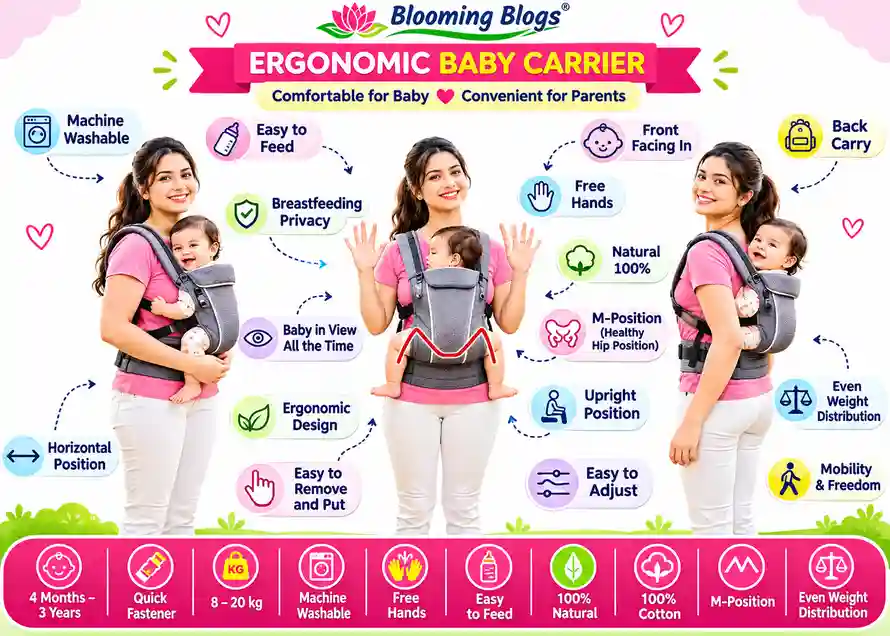
According to the International Hip Dysplasia Institute (IHDI), healthy babywearing places your baby in the M-position, also called the “jockey” or “spread-squat” position.
5.1 Four Important Positioning Checks
- Knee-to-Knee Support: The carrier fabric should support the baby’s thighs towards the backs of the knees.
- Knees Higher Than Bum: Your baby’s thighs should be supported so their knees sit slightly higher than their bottom, forming a capital “M” shape when viewed from the front.
- Pelvic Tuck: Where appropriate for the carrier and baby’s developmental stage, gently adjust the baby’s bottom and pelvis according to the manufacturer’s instructions. This can help create a comfortable seated position without forcing the spine.
- Newborn Head and Neck Support: Look for a newborn baby carrier with appropriate head and neck support. The top edge of the panel must not cover the baby’s face or obstruct airflow around the nose and mouth.
6. Step-by-Step: How to Carry a Newborn in a Carrier Safely
Whether you are using a stretchy wrap or a buckle carrier, follow this calm, step-by-step routine and the manufacturer’s instructions.
- Dress Lightly: Your body acts like a radiator. Dress your baby in one light layer, such as a breathable cotton onesie and socks, counting the carrier itself as an extra layer of clothing.
- Secure the Waistband: Position and fasten the waistband according to your carrier’s instructions. Check that it provides the required support and keeps your baby at the correct height.
- Adjust Seat Width for Newborn Size: Set the inner seat tabs to the appropriate newborn setting before lifting your baby.
- Scoop and Settle: Hold your baby securely against your chest with their legs positioned naturally. Bring the fabric panel smoothly up over their back, following the carrier’s instructions.
- Tighten Straps Evenly: Fasten the chest or back clip and snug the shoulder straps until there is no unsafe slack. Always keep one hand supporting your baby during adjustments.
- Check Positioning and TICKS: Check your baby’s head and body position, make sure their chin stays away from their chest, and confirm that their nose and mouth are completely clear.
7. Choosing a Baby Carrier by Age and Developmental Stage
7.1 0 to 2 Months: The Fourth Trimester
Newborns under eight weeks generally keep their legs tightly curled in a fetal position.
Focus on soft, supportive options such as a stretchy wrap, a properly fitted ring sling, or a dedicated newborn carrier like the Ergobaby Embrace.
Avoid forcing tiny newborn legs wide apart. Let their knees remain comfortably positioned within the carrier’s appropriate seat width.
7.2 3 to 5 Months: Head Control and Curiosity
As your baby gains stronger head control and starts looking around, structured carriers with adjustable seats may offer more options.
Keep your baby facing inward towards your chest unless they meet all the manufacturer’s requirements for another position.
7.3 6 to 12 Months: Sitting Up and Exploring
Once your baby sits independently without support and meets the carrier’s requirements, you can explore suitable back-carry options in a structured carrier or use a baby hip carrier for quick errands.
7.4 Note on Forward-Facing Carries
Only turn your baby outward-facing when they have full, consistent head and neck control, their chin clears the top of the carrier panel, and the carrier is specifically designed for forward-facing use.
Some manufacturers recommend limiting outward-facing sessions to short periods, such as 15–20 minutes. Follow the exact product instructions.
Never allow your baby to sleep facing outward. Turn them inward if they become tired or sleepy.
8. Special Considerations: C-Section Moms, Hot Climates, and Budget Picks
8.1 Babywearing After a C-Section
If you had a caesarean delivery, wait until your healthcare provider clears you to lift and carry your baby comfortably.
Choose carriers that do not place uncomfortable pressure directly on your incision. Some parents prefer a ring sling, a suitably adjusted wrap, or an apron-style carrier such as Happy Baby or Sakura Bloom, depending on their recovery and comfort.
8.2 Hot Weather and Breathable Fabrics (Including Tropical Climates Like India)
In warm, humid weather, heavily padded carriers can trap sweat quickly.
Look for:
- 100% linen ring slings.
- Bamboo-cotton wraps.
- Structured carriers made with 3D Air Mesh panels.
- Lightweight, breathable cotton fabrics.
Always check the back of your baby’s neck. If it feels hot and sweaty, remove a layer or take a cool break.
8.3 Budget-Friendly and Local Favorites
You do not have to spend $200 or more for a carrier that meets your needs.
Whether you are shopping globally or browsing popular regional retailers like FirstCry or Mothercare, look past flashy branding and check the seat width, fabric, construction, and safety instructions.
A budget-friendly cotton wrap or wide-seat ergonomic carrier under $40 / ₹2,000 may be suitable if it meets all the necessary safety and fitting requirements.
9. Comparison Charts and Tables
9.1 Carrier Style Comparison Matrix
| Carrier Type | Ideal Age / Weight | Learning Curve | Best Use Case | Comfort Level for Long Walks |
|---|---|---|---|---|
| Stretchy Wrap | Newborn to ~15 lbs (0–4 months) / Up to 6.8 kg | Moderate (takes 2–3 tries) | Cozy newborn carrying at home | High (distributes weight evenly) |
| Ring Sling | Newborn to 35 lbs (0–3 years) / Up to 15.9 kg | Moderate (threading takes practice) | Quick errands, hot weather | Low–Moderate (one-shoulder carry) |
| Newborn Hybrid Carrier | 7–25 lbs (0–12 months) / 3.2–11.3 kg | Easy (click + tie) | First-time parents wanting a wrap feel | High |
| Soft Structured Carrier (SSC) | 7–45 lbs (0–3+ years) / 3.2–20.4 kg | Easy (buckle & go) | Daily walks, travel, sharing with partner | Very High (padded waist + lumbar support) |
| Hip Seat Carrier | 6 months to 45 lbs / Up to 20.4 kg | Very Easy | Carry-assist for active toddlers | Moderate (requires one arm on child) |
| Framed Hiking Backpack | 6–9 months (sitting) to 40+ lbs / 18.1+ kg | Moderate | Trail hiking & outdoor adventures | Very High (built-in frame + storage) |
Important: Age and weight ranges vary between manufacturers. Always follow the specific product label rather than relying on general ranges.
2. Popular Ergonomic Baby Carriers Compared
| Brand & Model | Type | Min–Max Weight | Newborn Insert Needed? | Standout Feature |
|---|---|---|---|---|
| Ergobaby Embrace | Newborn Hybrid | 7–25 lbs / 3.2–11.3 kg | No (built-in fold) | Ultra-soft knit built specifically for newborns |
| Ergobaby Omni Breeze | Soft Structured | 7–45 lbs / 3.2–20.4 kg | No (slider seat) | Full-body breathable mesh + lumbar support |
| BabyBjörn Mini | Newborn Structured | 7–24 lbs / 3.2–10.9 kg | No | Super simple front buckles for tiny babies |
| Tula Free-to-Grow | Soft Structured | 7–45 lbs / 3.2–20.4 kg | No (snap width) | Lightweight cotton & intuitive panel adjustments |
| Momcozy / Mabe Monarch | Cross-Back Structured | 7–35/44 lbs / 3.2–15.9/20 kg | No | Chic styling with supportive cross-back straps |
| Happy Baby Original | Apron-Style SSC | 7–45 lbs / 3.2–20.4 kg | No (cinch base) | Lightweight linen, packable & C-section friendly |
| Tushbaby | Hip Seat Carrier | 8–45 lbs / 3.6–20.4 kg | Not for hands-free newborn carry | Built-in storage pockets; relieves hip strain |
| Boba / Solly Wrap | Stretchy Wrap | 7–25 lbs / 3.2–11.3 kg (best below 7.3 kg) | No | Second-skin softness for fourth-trimester bonding |
10. How to Safely Use a Baby Carrier, Sling, or Backpack
Carrying your child close is a wonderful bonding experience, as long as you follow the right setup and daily habits.
10.1 Securing Your Child Properly
- Check Sizing Tags: Always match your baby carrier, sling, or backpack to your child’s current height and weight ratings.
- Pre-Adjust Straps: Tighten the main straps before placing your child inside, then fine-tune the fit so they sit snugly against you.
- Test One-Handed Adjustments: Confirm that you can smoothly tighten and loosen the straps while supporting your baby with the other hand.
- Inspect Gear Before Every Use: Make it a quick habit to check buckles, stitching, and fabric for any wear or damage. If anything looks compromised, stop using the gear and contact the manufacturer.
- Practise First: Ask a partner or friend to assist until you feel confident putting your child in independently. Practising a few times with a teddy bear or doll can also build muscle memory.
10.2 Everyday Safety Habits While Babywearing
- Watch Your Step: Wear sturdy, comfortable footwear and stay alert when walking over uneven ground, curbs, or stairs.
- Avoid Overheating: Avoid prolonged carrying in extreme heat. Your body heat combined with carrier fabric can quickly raise your baby’s temperature.
- Be Extra Careful Putting It On and Taking It Off: Many babywearing falls happen while loading or unloading a child. Sit down on the floor or a low, stable surface, or have someone assist you during transitions.
- Bend at the Knees, Never the Waist: If you need to pick something up, hold onto a sturdy surface for balance, support your baby with one hand, and squat down using your knees so your child stays upright and secure.
- Keep Hazards Out of Reach: Remember that bending down brings your baby closer to low tables, hot coffee mugs, or sharp objects.
- Never Cook While Front-Carrying: Keep your child out of front carriers and slings while standing near a hot stove, oven, or boiling liquids to prevent accidental burns.
- Skip High-Risk Activities: Never carry hot drinks, run after older siblings, or do anything physically risky while wearing your child.
- Balance Carrier Time with Floor Play: Babies need plenty of unrestricted movement to build strength, so balance time in the carrier with daily tummy time and active floor play.
10.3 Warning Signs of an Unsafe Position
Remove your baby from the carrier or sling immediately if you notice any of these red flags:
- Their face is pressed against fabric, their chin is tucked tightly against their chest, or their head is slumped sharply to one side.
- Their body is curled tightly into a position that compromises their breathing.
- They are making grunting, wheezing, or whistling noises, or breathing unusually fast.
- Their skin takes on a pale, greyish, or bluish tint.
- They seem unusually restless, distressed, or uncomfortable.
If your baby has breathing difficulty, becomes blue or grey, or is unresponsive, seek emergency medical assistance immediately.
10.4 Safe Sleep and High-Risk Precautions
The safest place for an infant to sleep is always flat on their back on a firm, clear mattress.
If your little one drifts off inside a baby carrier or sling, keep their face visible and their airway clear while you arrange a transfer to a safe crib or bassinet as soon as possible.
Never lie down, recline, or fall asleep while wearing your baby.
Additionally, babies under four months old, those born prematurely or with a low birth weight, and infants with respiratory or other medical conditions may face a higher risk of airway obstruction while babywearing.
Always check with your paediatrician or child health nurse before using a carrier with a vulnerable infant so they can help you choose the safest setup for your child’s needs.
10.5 Can You Feed Your Baby Inside a Sling?
Walking around or doing chores while nursing or bottle-feeding a baby in a sling—often marketed as “hands-free” feeding—is not safe.
Loosening a carrier to feed while moving creates a tripping hazard from dangling fabric and puts your baby at serious risk of slumping into an airway-blocking position.
This is especially concerning for newborns under four months old, premature infants, and babies with underlying health conditions.
Whenever your baby is hungry, the safest approach is to remove them completely from the baby carrier or sling to feed.
Once they finish eating and are burped, you can either secure them back upright in the carrier or place them down in a safe space.
10.6 Can You Test a Baby Carrier Before Buying One?
Yes—and trying before you buy is one of the smartest ways to find the right fit.
Every parent’s body is different, and a carrier that feels effortless with a tiny newborn might feel completely different once your baby reaches six months.
Many local babywearing meetups, sling libraries, and speciality baby stores allow you to rent or test-drive different styles before making a purchase.
10.7 What If Your Baby Falls Asleep in the Carrier?
It is completely normal for babies—especially newborns—to drift off to sleep while snuggled close against your chest.
However, a carrier is not a designated safe sleep surface. Keep your baby upright, visible, and properly positioned while you arrange a transfer to a safe sleep space.
While your baby is being carried, check frequently to make sure:
- Their airway stays completely clear, with their chin lifted away from their chest and no fabric covering their nose or mouth.
- They have not slumped down into a curled posture, as young infants lack the neck strength to lift their heads reliably if their position shifts.
- They are not overheating from trapped body heat and heavy layers.
Never fall asleep while wearing your baby.
11. Everyday Life with a Baby Carrier
Parents all around the globe rely on a baby carrier as a simple, practical way to keep their little one comforted while tackling suitable daily activities.
Whether you are running errands, walking the dog, tidying up at home, or caring for an older sibling, wearing your baby can free up your hands without sacrificing closeness.
For many newborns and infants, feeling the steady rhythm of your heartbeat and gentle footsteps may help calm fussiness.
11.1 How Babywearing Supports Your Breastfeeding Journey
Babywearing and breastfeeding can complement each other naturally.
Having your baby tucked close to your chest makes it easier to notice subtle early hunger cues—like rooting or lip-smacking—so you can feed them before they become overtired or upset.
While some mothers simply enjoy keeping their baby close between feeds, others appreciate the convenience of having their baby nearby during daily routines.
11.2 Establish Your Nursing Rhythm First
During the first few weeks after birth, both you and your baby are still getting the hang of latching and positioning.
Most parents find it far easier to wait until breastfeeding feels smooth, comfortable, and well established before attempting other babywearing routines.
If it feels awkward early on, give yourself time. Once your baby gains stronger head and neck control, managing everyday carrying routines may become easier.
11.3 How to Breastfeed Safely in a Baby Carrier
The safest approach is to remove your baby from the carrier before breastfeeding.
Because carrier designs and adjustments differ, keep these key fundamentals in mind:
- Wear Nursing-Friendly Clothing: Choose tops and nursing bras that pull aside or clip down effortlessly, as pulling a tight shirt upward can be tricky when a baby is pressed against your torso.
- Remove Your Baby Before Feeding: Do not rely on a loosened carrier to support your baby during feeding.
- Support Your Baby with Your Hands: Cradle your baby’s head and body throughout the feed.
- Maintain a Comfortable Position: Ensure your baby can move their head freely and feed without fabric obstructing their face.
11.4 Repositioning Your Baby After a Feed
Once your baby finishes nursing, never leave them sitting low or slumped in a loosened carrier.
Instead:
- Finish feeding and burp your baby when appropriate.
- Place your baby securely back into the carrier according to the manufacturer’s instructions.
- Tighten all straps and buckles.
- Return your baby to the correct upright position.
- Run through the T.I.C.K.S. safety checklist to confirm their face is visible, their chin is away from their chest, and their airway is completely clear.
11.5 Quick Tips for Smoother Carrier Feeding Routines
- Pick a baby carrier with adjustments that are easy to manage.
- Practise adjusting your carrier straps in front of a mirror at home.
- Remove your baby from the carrier before feeding.
- Stay seated or stationary while feeding so you can focus fully on your baby’s latch and comfort.
12. Practical Babywearing Tips
- Practise With a Stuffed Animal First: Before putting a wiggly newborn into a wrap or sling, practise tightening the straps using a teddy bear or rolled-up towel in front of a mirror.
- Keep Your Baby Calm While Loading: Put the carrier on while your baby is fed, burped, and content—not crying hysterically—and gently bounce or sway as you buckle up.
- Skip Tight Footed Pajamas in Carriers: Tight footed sleepers can pull on your baby’s toes when their knees bend into the M-position. Opt for footless pants and comfortable socks if they fit better.
- Use a Small Hand Mirror on Walks: Keep a compact mirror in your pocket so you can check your baby’s face during back carries without twisting your neck.
13. Did You Know? 💡
- Did You Know? Babies who are carried in appropriately fitted ergonomic carriers experience gentle changes in body position and movement as their caregiver walks. However, babywearing does not replace tummy time or other opportunities to develop neck and core strength.
- Did You Know? International Babywearing Week is an educational initiative that promotes awareness of babywearing and safe carrying practices.
- Did You Know? Even a brand-new carrier can feel stiff out of the box. Washing natural cotton or linen wraps once or twice, following the label instructions, may soften the fibres.
14. Useful Babywearing Hacks
- The “H-Back” vs. “X-Back” Trick: If reaching behind your neck to buckle the chest clip feels impossible, check whether your carrier allows an alternative shoulder-strap configuration. Practise the correct method from the manufacturer’s instructions to find a comfortable fit.
- Drool Pad Lifesaver: Use soft, washable cotton burp cloths or manufacturer-approved snap-on drool pads around the top shoulder straps where teething babies love to chew. You can wash the small pads instead of the entire carrier.
- Car Trunk Hook: Keep a suitable storage hook or bag in your car or diaper bag so you can store your folded ring sling or carrier without dragging straps across dirty parking lot surfaces.
15. Common Mistakes to Avoid
15.1 Wearing the Waistband Too Low
Wearing the belt incorrectly can drop your baby too low, causing them to slump and straining your lower back. Follow the manufacturer’s instructions to position the waistband correctly.
15.2 Covering Baby’s Face with a Blanket or Hood
Using the carrier’s sun hood or a muslin blanket to completely cover your sleeping newborn blocks fresh airflow and hides visual breathing cues.
Leave the face fully visible at all times.
15.3 Letting Legs Dangle Straight Down
Narrow seats that leave thighs unsupported may not provide the hip positioning recommended for healthy infant hip development.
Choose a suitable carrier that supports your baby’s thighs.
15.4 Overdressing in Warm Weather
Putting a newborn in a fleece sleeper inside a thick carrier can lead to overheating.
Stick to breathable layers and monitor your baby’s temperature.
15.5 Falling Asleep While Wearing Baby
Never lie down on a couch, recliner, or bed with your baby strapped in a carrier. Shifting positions while asleep creates a serious suffocation hazard.
16. Expert Recommendations
- Start with One Versatile Option: You do not need four carriers before birth. Choose one newborn-friendly wrap or soft structured carrier with an adjustable seat, and wait until your baby arrives to see what your body prefers.
- Check Safety Standards: Look for carriers tested to ASTM F2236 for soft infant carriers or ASTM F2907 for sling carriers, where applicable. Also check recognised hip-health guidance from the International Hip Dysplasia Institute.
- Prioritise Safe Support: If your baby is under four months old, choose a carrier specifically designed for young infants that supports the baby’s body and allows you to monitor the airway. Avoid hip seats and rigid hiking frames for newborns.
17. Recommendations
- Best Overall for Newborn Snuggles: Ergobaby Embrace or Solly Baby Wrap for softness and close-fitting support, provided the baby meets the product requirements.
- Best All-in-One Longevity (Newborn to Toddler): Ergobaby Omni Breeze or Tula Free-to-Grow for adjustable seat widths and different carrying stages.
- Best Lightweight and C-Section Friendly: Happy Baby Original Carrier or a 100% linen ring sling, depending on your recovery, comfort, and fitting requirements.
- Best Carry-Assist for Toddlers: Tushbaby Hip Carrier for quick up-and-down errands once your baby meets the product’s age and developmental requirements.
18. Key Points
- Safe babywearing relies on the TICKS checklist: Tight, In view at all times, Close enough to kiss, Keep chin off the chest, and Supported back.
- Healthy hip positioning means supporting the thighs and allowing a comfortable M-shape with the knees generally higher than the bottom.
- A newborn’s face must remain completely uncovered, and their chin must stay away from their chest.
- Position the waistband according to the carrier’s instructions to support both your baby and your own body.
- Always check your baby’s airway, temperature, and position during carrying.
19. Points to Remember
- Carrier ≠ Car Seat: Never use a baby carrier inside a moving vehicle.
- Count the Carrier as a Layer: Dress your baby lightly underneath to prevent overheating.
- No Outward-Facing Sleep: Turn your baby inward if they become sleepy and transfer them to a safe sleep surface.
- Inspect Before Every Wear: Check buckles, stitching, rings, and webbing for wear and tear before loading your baby.
20. Gentle Reminders
You are learning a brand-new skill while running on broken sleep—be patient with yourself!
If your baby fusses the first time you put them in a wrap, it does not mean they hate babywearing. Often, they may simply need time to become familiar with the sensation.
Once everything is fitted correctly and safely, try gentle walking or swaying if your baby enjoys it.
You are learning together, one snuggly step at a time.
21. Frequently Asked Questions (FAQs)
21.1 What is the safest baby carrier for a newborn?
The safest baby carrier for a newborn is one that meets applicable product safety requirements, fits your baby’s current weight (some models start at 7–8 lbs), supports their body appropriately, allows comfortable hip positioning, and holds them upright high on your chest with their face completely visible.
21.2 What does TICKS stand for in babywearing?
TICKS is a five-point babywearing safety checklist: Tight, In view at all times, Close enough to kiss, Keep chin off the chest, and Supported back.
21.3 When can I start using a baby carrier for my newborn?
You can use a newborn-approved wrap, ring sling, or soft structured carrier when your baby meets the manufacturer’s minimum weight and other requirements. If your baby has medical conditions or was born prematurely, seek paediatric advice first.
21.4 How should a newborn’s legs be positioned in a baby carrier?
A newborn’s legs should be positioned comfortably, with the thighs supported and the hips allowed to bend and spread naturally. The M-position generally places the knees slightly higher than the bottom.
21.5 Is a baby sling safe for a 1-month-old baby?
Yes, a properly designed and correctly adjusted ring sling may be suitable for a one-month-old if the baby meets the product’s minimum requirements. Use an upright tummy-to-tummy position, keep the face visible, and ensure the airway remains clear. Avoid curved “bag-style” or pouch slings.
21.6 Can a newborn suffocate in a baby carrier?
Yes. Improper positioning poses a serious suffocation risk if a newborn’s chin slumps onto their chest or if loose fabric presses over their nose and mouth. Following the TICKS rules helps you maintain a clear and visible airway.
21.7 How long can a newborn stay in a baby carrier?
There is no single strict time limit that applies to every baby and carrier. Check your baby’s position, comfort, temperature, and feeding needs regularly. Take breaks for feeding, diaper changes, and floor movement. Follow your healthcare provider’s advice and the manufacturer’s instructions.
21.8 Should a newborn wear socks or footie pajamas in a baby carrier?
Both may be suitable if they fit comfortably and do not restrict movement or circulation. Check that the fabric does not pull tightly against your baby’s toes when their knees bend into the M-position.
21.9 Can my baby sleep in a baby carrier?
Babies may fall asleep while being carried, but a baby carrier is not a designated safe sleep surface. Keep your baby upright, monitor their face and breathing, remain awake, and transfer them to a safe crib or bassinet as soon as possible.
21.10 Can I lie down or nap while wearing my baby?
No. Never lie down, recline, or fall asleep while your baby is in a carrier, as shifting positions can obstruct your baby’s airway or cause a fall.
21.11 What is the difference between a baby wrap and a baby sling?
A baby wrap is a long piece of fabric wrapped over both shoulders and around your torso for two-shoulder weight distribution. A ring sling is a shorter piece of fabric worn asymmetrically over one shoulder using two rings.
21.12 When can my baby face forward in a baby carrier?
Only when your baby has strong, consistent head and neck control, meets the carrier manufacturer’s minimum age and weight requirements, and fits the carrier correctly. Follow the manufacturer’s instructions for session duration and turn your baby inward if they become tired or sleepy.
21.13 Why is outward-facing babywearing not recommended for newborns?
Newborns lack the neck muscles to hold their heads upright reliably. Facing outward can make it harder to maintain a safe head position and may increase the risk of airway obstruction.
21.14 Do I need a newborn insert for my baby carrier?
Only if your specific structured carrier requires one. Some carriers have seats that cannot be adjusted narrow enough to fit a newborn without an approved insert, while many modern carriers feature built-in adjustable seats. Always use the manufacturer’s approved accessories.
21.15 How do I know if my baby carrier is too tight?
Your carrier should feel snug like a firm hug without digging into your baby’s thighs, restricting comfortable movement, or pressing their face flat against your chest. Check that your baby can breathe freely and that their head and body are positioned correctly.
21.16 How high should a baby be in a carrier?
For many upright front carries, your baby should sit high on your chest—right below your collarbone—so you can easily kiss the top of their head without straining your neck. Follow the specific carrier’s instructions.
21.17 Can I breastfeed while wearing a baby carrier?
The safest approach is to remove your baby from the carrier before breastfeeding. Support your baby’s head and body throughout the feed, then secure them back into the carrier and check their positioning afterwards.
21.18 Are narrow-crotch baby carriers bad for hips?
Carriers where a baby’s legs hang straight down may leave the thighs unsupported and may not provide the hip positioning recommended by the International Hip Dysplasia Institute. Wide-base carriers that support the thighs towards the knees allow a more comfortable spread-squat position.
21.19 Which baby carrier is best for C-section moms?
C-section moms may prefer ring slings, stretchy wraps, or apron-style carriers such as Happy Baby because some designs can avoid direct pressure on the incision. However, recovery differs for everyone. Ask your healthcare provider before resuming babywearing.
21.20 Which baby carrier is best for petite moms?
Petite moms often prefer stretchy wraps, ring slings, Happy Baby carriers, or adjustable cross-back carriers such as the Ergobaby Embrace or Momcozy. Try different styles to find one that fits securely without bulky straps slipping off narrow shoulders.
21.21 Which baby carrier is best for plus-size parents?
Look for generous strap lengths and supportive waistbands, such as those available with some Tula Free-to-Grow models (with optional waistband extenders), Ergobaby Omni Breeze, Kinderpack, woven wraps, and longer ring slings. Check the actual measurements before purchasing.
21.22 Can dads use the same baby carrier as moms?
Absolutely! Soft structured carriers with adjustable waistbands and shoulder straps can be resized to fit different caregivers, making it convenient for both parents to share one carrier.
21.23 How do I dress my baby for babywearing in summer?
Put your baby in a single breathable cotton onesie or suitable lightweight clothing, choose a linen or mesh carrier, stay in the shade, and check their neck frequently for sweat and overheating.
21.24 How do I dress my baby for babywearing in winter?
Wear your baby inside a suitable oversized winter coat or babywearing jacket rather than putting them in a bulky snowsuit inside the carrier, which can cause overheating and interfere with a snug fit. Keep the baby’s face uncovered.
21.25 Is a baby hip carrier like Tushbaby safe for newborns?
A hip seat alone is not a hands-free newborn carrier because it has no back panel. You must support your newborn securely with your arms. It is generally intended for older babies who meet the product’s developmental and weight requirements.
21.26 When can I start back-carrying my baby?
In a soft structured carrier, wait until your baby meets the manufacturer’s requirements for head, neck, and torso control. Many carriers require independent sitting ability, often around six months, but the specific product instructions must guide your decision.
21.27 Why does my baby cry when I first put them in the carrier?
Babies often fuss during the loading process because the experience is unfamiliar. They may also be hungry, tired, uncomfortable, or too warm. Check the fit and their needs before trying again. Gentle walking or swaying may help some babies settle.
21.28 Can I use a second-hand baby carrier?
Yes, provided you inspect all buckles, stitching, Velcro, fabric, and rings carefully for cracks, fraying, or damage. Also verify that the model has not been recalled and obtain the original instructions.
21.29 How do I wash a baby carrier?
Follow the manufacturer’s washing instructions. Spot-clean minor spills when possible. For full washes, buckle all clips if instructed, place the carrier inside a mesh laundry bag or pillowcase when permitted, wash on the recommended gentle cycle with mild detergent, and air-dry completely if the label allows it.
21.30 What is the weight limit for most baby carriers?
Weight limits vary between models. Stretchy wraps may have lower maximum weights, while many soft structured carriers and ring slings support children up to 35 to 45 lbs. Always follow the specific product label.
21.31 Can premature babies be worn in a baby carrier?
Always ask your neonatologist or paediatrician first. Premature babies may have higher risks of airway compromise and temperature instability, so medical clearance and appropriate sizing are essential.
21.32 What is a pelvic tuck in babywearing?
A pelvic tuck is an adjustment technique used in some babywearing methods to help position the baby’s pelvis and support a comfortable seated posture. Learn the correct method for your carrier from its instructions or a qualified babywearing educator.
21.33 How tight should a stretchy wrap be before putting the baby in?
Follow the manufacturer’s wrapping instructions. The fabric should be snug and secure against your torso before putting your baby inside, while still allowing the correct fit and positioning.
21.34 Is a ring sling hard to learn?
It takes practice to learn how to spread the fabric across your shoulder and thread the rings smoothly without twisting the rails. A babywearing educator can demonstrate the correct method and help you adjust the sling.
21.35 Can I cook while wearing my baby?
Never wear your baby while cooking at a hot stove, frying food, or handling hot liquids due to severe burn and splatter hazards.
21.36 Can I bend over while wearing a baby carrier?
If you need to pick something up from the floor, bend at your knees in a squat while keeping one hand firmly on your baby. Avoid bending forward at the waist.
21.37 What is an apron-style baby carrier?
An apron-style carrier features a flat waistband where the main fabric panel hangs down like an apron before being positioned around your baby, creating a supportive seat with minimal bulk around your waist.
21.38 Are cradle holds safe in baby slings?
Cradle carries are generally discouraged by modern safety guidance because lying horizontally in a pouch makes it easier for a newborn’s chin to curl onto their chest, potentially blocking airflow. Upright tummy-to-tummy carries are generally safer for young infants.
21.39 How do I prevent back pain while babywearing?
Wear the waistband according to the manufacturer’s instructions, ensure there is no unsafe slack in the shoulder straps, and keep your baby’s weight centred close to your body. Seek professional advice if discomfort continues.
21.40 What are “H-straps” versus “X-straps” on a baby carrier?
H-straps run over your shoulders and connect across your shoulder blades with a chest clip, while X-straps cross over your back. Many parents find that different strap arrangements distribute shoulder weight differently, so comfort depends on your body and carrier design.
21.41 Can I wear my baby on an airplane?
Yes, baby carriers can be useful for navigating airports and soothing babies during flights. However, airline safety rules and crew instructions apply. You may be required to remove your baby from the carrier and hold them appropriately during takeoff and landing.
21.42 Why is my baby chewing on the carrier straps?
Babies love mouthing the shoulder straps near their face, especially while teething! Use washable, manufacturer-approved drool pads to keep the straps clean and dry. Make sure the covers do not create a breathing hazard.
21.43 Does babywearing spoil a newborn?
No—you cannot spoil a newborn by responding to their need for closeness. Meeting their needs for comfort, affection, and responsive care helps build a secure relationship.
21.44 What if my baby has hip dysplasia?
If your baby has been diagnosed with developmental dysplasia of the hip (DDH), consult their paediatric orthopaedic specialist. They can advise whether ergonomic M-position babywearing is appropriate alongside or between brace treatments.
21.45 How do I stop my ring sling rings from slipping down?
Start with the rings positioned according to the manufacturer’s fitting instructions, generally high on the shoulder. Feed excess slack smoothly towards the rings before pulling the tail to tighten.
21.46 Can I jog or exercise with my baby in a carrier?
Gentle walking may be suitable when both caregiver and baby are comfortable. Avoid running, jumping, or high-impact workouts, as bouncing puts stress on your baby’s developing body and may affect your recovering pelvic floor.
21.47 What fabric is best for a baby carrier?
Breathable natural fibres like 100% cotton, linen, bamboo blends, or suitable engineered athletic mesh are popular choices. Consider your climate, the baby’s comfort, and the carrier’s care instructions.
21.48 Why does my baby push away from my chest in the carrier?
Babies often push against your chest when they are hungry, need to burp, feel too warm, or want to change position. Check their needs and make sure the carrier fits correctly.
21.49 Should I buy a baby carrier before my baby is born?
Buying one versatile newborn-friendly carrier before birth can be helpful so you can practise using it. Save specialised carriers, such as toddler or hiking packs, until you know your baby’s growth and developmental needs.
21.50 When should I stop using a baby carrier?
You can continue babywearing for as long as both you and your child remain comfortable and your child stays within the manufacturer’s maximum weight, height, age, and developmental limits.
22. Quick Takeaways
- Safety First: Memorise TICKS (Tight, In view at all times, Close enough to kiss, Keep chin off the chest, Supported back).
- Hip Health Matters: Aim for comfortable thigh support in an M-position.
- Fit to Stage: Soft wraps and hybrids may suit the newborn stage; structured carriers and hip seats can offer options as your baby grows.
- Trust Your Instincts: If a carrier feels uncomfortable on your back or your baby looks slumped, remove your baby, check the fit, and try again.
23. Quick Summary
Choosing and using a baby carrier does not have to feel intimidating.
By picking an ergonomic style suited to your baby’s developmental stage—whether a cosy stretchy wrap for newborn snuggles, a breezy ring sling for quick errands, or an adjustable soft structured carrier for everyday adventures—and following the TICKS safety checklist and M-position hip guidelines, you can keep your baby close while enjoying the practical benefits of babywearing.
Always prioritise airway safety, appropriate positioning, and your baby’s comfort.
24. Final Review
From newborn wraps to toddler hiking packs, the best baby carrier isn’t necessarily the trendiest or priciest model on social media—it is the one that fits your body comfortably, respects your baby’s developing hips and airway, and actually gets used on busy Tuesday mornings.
Prioritise an adjustable knee-to-knee seat, breathable fabric, and easy buckles you can fasten safely, and you will have a useful parenting companion for years.
25. Final Thoughts
Parenting a newborn is equal parts breathtaking love and sheer exhaustion. Some days, just getting dressed feels like running a marathon.
Having a safe, cosy way to keep your little one close while you step outside into fresh air—or simply complete a suitable everyday task—can make your postpartum days easier.
You’ve got this, mama, one snuggly step at a time.
26. External Authoritative References and Citations
- American Academy of Pediatrics (AAP) — HealthyChildren.org: Baby Carriers: Backpacks, Front Packs, and Slings. Guidance on airway safety, minimum weight limits, and avoiding curved pouch slings.
- International Hip Dysplasia Institute (IHDI): Baby Carriers, Slings & Other Equipment. Guidance on the M-position / spread-squat posture and healthy infant hip development.
- Baby Carrier Industry Alliance (BCIA) & ASTM International: ASTM F2236 (Standard Consumer Safety Specification for Soft Infant and Toddler Carriers) and ASTM F2907 (Standard Consumer Safety Specification for Sling Carriers).
- U.S. Consumer Product Safety Commission (CPSC): Safety requirements for soft infant and toddler carriers and sling carriers.
- UK Consortium of Sling Retailers and Manufacturers: The T.I.C.K.S. Rule for Safe Babywearing. Guidance on tight fitting, visibility, kissing distance, chin positioning, and back support.
- British Association of Perinatal Medicine – T.I.C.K.S. Safe Babywearing Guidance.
🔗 Related Articles
If you are preparing for a newborn, these helpful Blooming Blogs guides can help you plan, prepare, and care for your baby with greater confidence:
- 1. Best Infant Formula for Newborns: Types, Choices & Safety Guide
- 2. Newborn Baby Essentials Checklist for Soon-to-Be Parents
- 3. How to Prepare Formula Milk for a Newborn Baby
- 4. Newborn Baby Care: Complete Guide for New Parents
- 5. Formula Mixing & Bottle Ratio Calculator
- 6. Hospital Bag for Delivery: Complete Checklist for Mom and Baby
- 7. The Ultimate Pregnancy Hospital Bag & Registry Checklist: Your Stress-Free Delivery Guide
- 8. Hospital Bag Checklist Tool
- 9. Rompers for Newborn: Ultimate Guide to Safe Baby Clothes
- 10. Onesies and Rompers: How to Dress Your Newborn Right
- 11. Baby Onesies Buying Guide: Best Soft Outfits for Newborns
🛠️ Try Our Free Interactive Baby Care Tools
Planning your nursery or setting up daily routines? Check out these handy calculators designed to simplify baby care:
🌱 Continue Exploring…
Whether you’re nurturing a newborn, curating a sanctuary for your home and garden, or simply looking to level up your day-to-day life, there’s always a new perspective waiting to be discovered. From practical everyday parenting guidance, women’s wellness information, ideas to make your home more beautiful, tips for caring for pets and plants, or inspiration for your spiritual journey, Blooming Blogs brings useful knowledge together in one place.
Blooming Blogs — knowledge that blooms.
🌸 Blooming Blogs Promise
We’re here to bring you thoughtful, reliable, and helpful insights you can truly count on. Every article on Blooming Blogs is thoroughly researched, crafted with care, and written with genuine empathy to support you in your everyday journey. Your trust means everything to us, and we are dedicated to sharing content that informs, inspires, and makes your life a little easier.
📰 Editorial Notes
Our team strives for clarity, accuracy, and depth in every piece we publish. Content is periodically updated to ensure facts, recommendations, and guides stay relevant over time. While we consult trusted sources and expert research, our goal is always to present complex topics in a simple, practical, and conversational way that works for real life.
⚠️ Disclaimer
The content provided on Blooming Blogs is for informational and educational purposes only and should not be considered professional medical, legal, or financial advice. Always consult with a qualified expert or licensed professional before making decisions related to your health, family, or personal finances. Blooming Blogs is not liable for any actions taken based on the information provided on this website. (For full details, please visit our Disclaimer Policy Page).
💬 Share Your Experience — Leave a Comment
We’d love to hear from you! Did this article help you, or do you have a personal tip or story to share with our community? Drop your thoughts, questions, or feedback in the comment section below. Every voice enriches our community, and we read every single comment!